fbpixel
Automate your sadaqah

for the last ten nights.

Hindutva and Anti-Muslim Violence: How to Navigate Hindu Supremacy

A paper to raise awareness of this growing threat and to equip Muslims with the knowledge needed to inspire meaningful, faith-driven action in response.

Published: March 10, 2026Ramadan 21, 1447

Updated: March 10, 2026Ramadan 21, 1447

Author: Safa Ahmed

بِسْمِ اللهِ الرَّحْمٰنِ الرَّحِيْمِ

In the name of God, the Most Gracious, the Most Merciful.

The Glorious Pages from Your Chronicles

October 1947 was a bleak time for South Asia. One month before, Partition had carved out the new states of India and Pakistan (along with what would later become Bangladesh), and in turn also cleaved through the subcontinent’s centuries-old Muslim population. Some chose to leave for the newly created state of Pakistan, where, unlike in India, Muslims would be a majority. Others were forced to uproot their lives and flee as intercommunal violence between Hindus, Muslims, and Sikhs exploded across the subcontinent, burning properties to ash and sending trains across the border filled with corpses. 
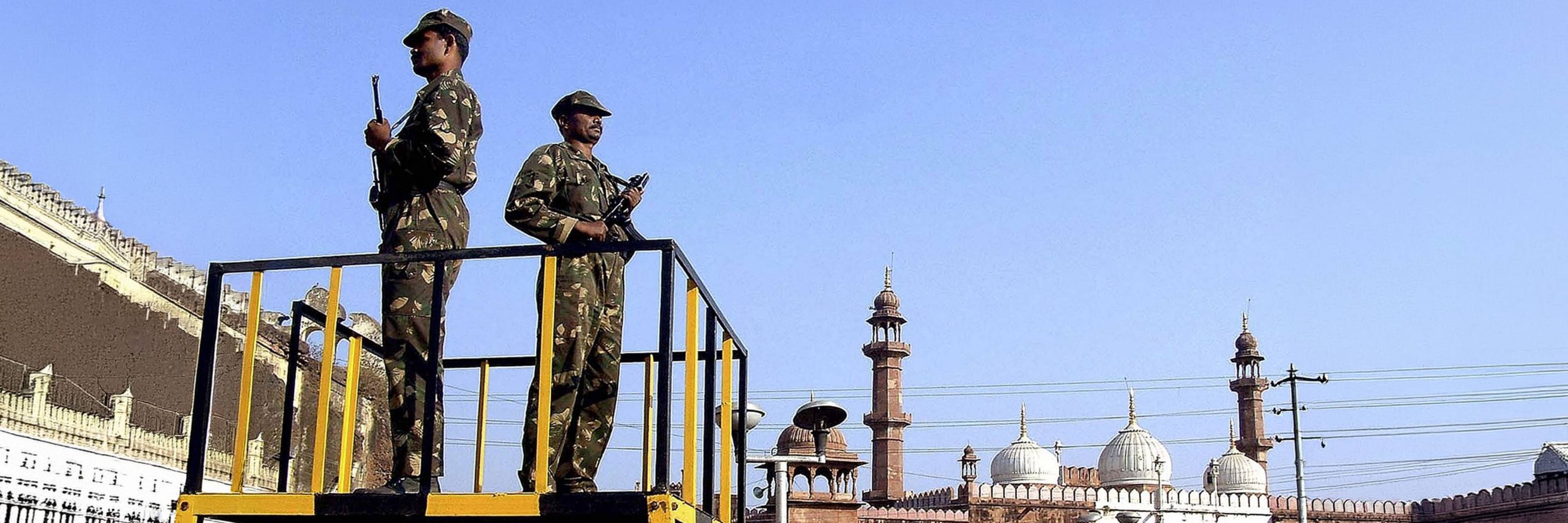
During this time of nationwide anxiety, the Indian freedom fighter and Islamic theologian Abul Kalam Azad stood on the steps of the three-hundred-year-old Jama Masjid in Delhi to address the congregation. Despite the climate of violence and the very real threat of systemic persecution, Azad—drawing on the core Islamic principles of tawakkul (trust in God) and istiqama (steadfastness)—saw no reason for his people to surrender to fear. Though his audience was just one congregation, his words would serve as assurance to the two hundred million Muslims who would remain in India as a vulnerable minority. 
“Raise your eyes! The minarets of Jama Masjid want to ask you a question,” Azad admonished. “Where have you lost the glorious pages from your chronicles? Was it only yesterday that on the banks of the Jamuna, your caravans performed wudu? Today, you are afraid of living here. Remember, Delhi has been nurtured with your blood. . . The words coward and frenzy cannot be spoken in the same breath as the word Muslim.”
Throughout his speech, Azad called for resilience over fear, calling on his people to look to the rich legacy of Islamic history for examples of courage, dignity, and perseverance in the face of oppression. He urged them to fortify their iman and take an active role in shaping their destiny—both as an ummah and as citizens of a free India. 
To some, the many facets of Azad’s identity and worldview might appear contradictory. He was drawn to pan-Islamism, yet strongly advocated unity and brotherhood between Hindus and Muslims. A respected alim and mufassir, he also played a central role in shaping India’s secular democratic framework. Yet in holding these views, he was far from alone.
Look through the writings and records of other Indian Muslim freedom fighters and political leaders of his time, and the same conviction emerges over and over again. It is present in the way the revolutionary fighter Ashaqullah Khan cheerfully accepted his execution by the British, writing to his nephews, “You will come to know to what extent I loved my motherland as a true Muslim.” It is in the fatwa of the mufti Fazle Haque, who rallied almost every major alim in Delhi to sign a call for Indian sepoys to rise up and fight a just war against British colonization, and it is in the intertwined spirituality and political activism of Abadi Bano Begum. In the minds of these freedom fighters, the Muslim neither seeks isolation nor begs for recognition, but instead—in true Prophetic fashion—is an architect of their nation’s destiny, no matter how small their numbers might be.
“I do not ask you to seek certificates from the new echelons of power. I do not want you to lead a life of sycophancy as you did during the foreign rule,” Azad said. “Your forefathers . . . not only plunged headlong into the seas, but trampled the mountains, laughed at the bolts of lightning, turned away the tornadoes, challenged the tempests and made them alter their course. It is a sure sign of a dying faith that those who had once grabbed the collars of emperors are today clutching their own throats.”
Seventy-seven years later, the faith and courage of Azad and his contemporaries serves as a blueprint for how Muslims can meet the challenge of Hindutva, or Hindu supremacy—not as passive victims, but as figureheads in the fight against this corrosive far-right ideology. 
In order to fight against it, however, one must first understand it. In the service of fostering this understanding, this paper provides a detailed guide to the Hindu supremacist movement, beginning by unpacking the extremist beliefs of Hindutva’s earliest ideologues, tracing the rise of the violent paramilitary groups whose political offshoot would become India’s ruling Bharatiya Janata Party (BJP), and examining the movement’s continuing global reach. In doing so, the aim is not only to raise awareness of this growing threat but also to equip Muslims with the knowledge needed to inspire meaningful, faith-driven action in response.

Hindutva 101: Its History, Core Beliefs, and Infrastructure

In January 1948, just months after Azad’s speech on the steps of Jama Masjid, a man named Nathuram Godse shot and killed Mahatma Gandhi. At the time of his death, Gandhi was weeks into a hunger strike protesting the Hindu-Muslim violence that wracked the subcontinent. His murderer was of the opposite conviction: that India had no place for Muslims, and should be turned into a Hindu ethnostate. A longtime adherent of Hindutva, Godse not only admitted to killing Gandhi, but called it a “moral” act done in service of Indian Hindus.
“I have no doubt,” he said during his trial, “[that] honest writers of history will weigh my act and find the true value thereof someday in future.”
In every way, Hindutva is the antithesis of everything Indian Muslim revolutionaries fought for. Based on the belief that Hindus are a race superior to non-Hindus, Hindutva asserts that India should be a Hindu state and theocracy rather than a secular democracy, and that the interests and values of Hindus should dominate all areas of society. According to Georgetown University’s Bridge Initiative, Hindutva “is a modern political ideology used . . . to carve out an exclusive identity and justify discrimination and violence against minority communities,” particularly against Muslims. Today—as Godse had hoped—Hindutva is the driving ideology of India’s current government, headed by Prime Minister Narendra Modi and the far-right Bharatiya Janata Party (BJP). 
The conceptualization of India as an ancient and superior Hindu civilization had been presented by different movements and individuals throughout the late 1800s. The term Hindutva, however, was formally codified by a man named V. D. Savarkar, a former freedom fighter who, after being imprisoned for aiding revolutionaries, later begged the British for clemency and pledged to be “the staunchest advocate” of loyalty to their empire. In his 1923 pamphlet ​​Essentials of Hindutva, which would become the basis of Hindu supremacist thought, Savarkar argued that Muslims and Christians were, by virtue of following religions that had originated outside of the subcontinent, incapable of showing loyalty to India. His writings paint India as having a glorious monolithic “Hindu” past, where Hindus are imagined as one race, and whose time “living in the land of dreams” was brutally ended by Muslim and Christian invaders in the medieval period. Using this logic, he urges Hindus across castes to unite with “hatred” against this “common foe” and reclaim their motherland from the “alien adulteration” of foreign faiths. Here, Savarkar’s framing of the barbaric Mohammedan invader reflects an Orientalist European view of Muslims that originated as early as the Crusades: one that, as Sahar Aziz writes, paints Islam as “propagat[ing] ignorance, violence, and sensuality as a threat to Christianity’s perceived light, knowledge, and reason.” 
Though the Hindu supremacists of today are keen to conflate Hindutva with the religion of Hinduism, Savarkar himself believed no such thing. An agnostic, he wrote disparagingly throughout his life about Hindu beliefs and practices, and emphasized that Hindutva was not rooted in faith, but in a politicized imagining of the Hindu culture and race as separate from that of other Indians. 
“Hindutva is not identical with what is vaguely indicated by the term Hinduism. By an ‘ism’ it is generally meant a theory or a code more or less based on spiritual or religious dogma or creed,” Savarkar wrote. “Hindutva embraces all the departments of thought and activity of the whole Being of our Hindu race.”
In referring to Hindus as a race of their own—separate from and superior to adherents of “foreign” faiths like Islam and Christianity—Savarkar revealed just how deeply he had been inspired by Nazi imaginings of racial hierarchy and “purity.” At a speech he delivered in 1938, Savarkar went as far as to openly praise Hitler and Mussolini, holding up Nazism and fascism as models for national revival.
“Who are we to dictate to Germany, Japan or Russia or Italy to choose a particular form of policy of government?” Savarkar asked his audience. “Hitler knows better . . . what suits Germany best. The very fact that Germany or Italy has so wonderfully recovered and grown so powerful at the touch of [a] Nazi or fascist magical wand is enough to prove that those isms were the most congenial tonic their health demanded.” 
Savarkar’s writings radicalized K. B. Hedgewar, a physician and disillusioned former member of Nehru’s Indian National Congress Party. In 1925, just two years after Essentials of Hindutva was published, Hedgewar founded the Rashtriya Swayamsevak Sangh (RSS), a fascist organization that would become not only the largest militant group in India, but the largest volunteer-based organization in the world. Serving as the driving force behind the Hindutva movement, the RSS went on to spawn a vast network of Hindu militant groups, as well as affiliated schools, charities, and programs. (It was in the RSS that Nathuram Godse, the murderer of Gandhi, formed his political beliefs and opted for their violent execution.) In modern times, the RSS can be compared to the head of a hydra that encompasses a network of groups not only in India, but in the United States, Canada, the United Kingdom, and beyond.
Like Savarkar, Hedgewar had no love for minorities and once referred to Muslims as “foreign snakes.” But it was the second chief of the RSS, M. S. Golwalkar, who articulated in the plainest terms what would become of minorities in a Hindu supremacist India. 
“The foreign races must either adopt Hindu culture and language, must learn to respect and hold in reverence Hindu religion, must entertain no ideas but those of glorification of the Hindu race and culture,” he said. “[Minorities must be] wholly subordinated to the Hindu nation, claiming nothing, deserving no privileges . . . not even citizens’ rights.” 
In the late 1930s and 1940s, Golwalkar reportedly worked to cast the RSS in the mold of a Nazi militia, “with the goal of eventually installing himself as führer,” as Dhirendhra K. Jha writes. By 2014, Prime Minister Narendra Modi and his far-right Bharatiya Janata Party (BJP) would become responsible for turning Golwalkar’s fantasy into a normalized reality.
Modi’s devotion to the Hindu supremacist movement goes all the way back to his childhood, when in 1958 at only eight years old, he joined the RSS. Over the years, he rose through the ranks of the organization and was eventually transferred by RSS leadership to its affiliated political party, the BJP.
In 2002, while serving as the Chief Minister of Gujarat state, he cemented himself as an open ally to the far right by facilitating the 2002 Gujarat pogrom, during which he reportedly ordered police not to intervene while nearly two thousand Muslim women, children, and men were slaughtered by Hindu militants—including affiliates of the RSS. Modi would ride the resulting wave of far-right support to the office of Prime Minister in 2014, officially instating the Hindu supremacist BJP as the head of India’s government. 
What followed would be ten years of relentless attacks—ideological, political, and physical—on India’s Muslim community, as Modi and the BJP began their project to turn India from a democracy into a Hindu supremacist ethnostate. As BJP leader Navneet Rana once declared before a cheering crowd, “If you want to live in India, then you have to say ‘Jai Sri Ram’ [Glory to Lord Ram].” 
Looking at the words of Savarkar and Hedgewar, Golwalkar and Godse, Modi and the leaders of the BJP, it becomes clear that Hindutva is far from unique. Rather, it is rooted in the same myths of imagined victimhood and racial supremacy as Nazism and white Christian nationalism. From the lens of Islamic history, it also shares the core motivations of the earliest enemies of Islam. 

Muslims Under Attack

On April 23, while campaigning for India’s 2024 general elections, a state wing of the BJP made a post on X aimed at targeting the opposition Congress Party. Titled “Congress Manifesto or Muslim League Manifesto?,” the post claimed that voting for the opposition would result in “Hijab Enforcement in Educational Institutions,” “Freedom to Practice Personal Laws,” and a “Mandate for Public & Private Entities to Hire Muslims.” None of this had been promised by the Congress Party—but it did reveal that, in the eyes of the BJP and its base, to promise basic civil liberties to Muslims is inherently anti-Hindu.
This post stripped back all purported defenses of Hindutva—the claims of wanting to protect Hindu faith and culture—and laid bare the true engine of the ideology. At its core, Hindutva is not about Hindus at all. It does not argue for the rights of Hindu oppressed castes, women, or tribals. Instead, it posits the Hindu identity solely as a reaction to other religious identities, one where Hindu pride and strength is drawn from the violent subjugation of Indian Muslims and Christians. In other words, it aims to exact revenge for Mughal rule and Christian proselytization upon the followers of “foreign” Abrahamic faiths in India today, framing this subjugation as a clash of civilizations rather than the lashing out of an insecure and radicalized Hindu population.
In Essentials of Hindutva, Savarkar laid the groundwork for this core motivation: “Nothing makes Self conscious of itself so much as a conflict with non-self. Nothing can weld peoples into a nation and nations into a state as the pressure of a common foe . . . such were the forces, overwhelmingly furious, that took India by surprise the day Mohammad [of Ganzi] crossed the Indus and invaded her.”
Savarkar here relies on an ahistorical narrative that is central to Hindu supremacist ideology: the idea that India was invaded and violated by the Muslim foreigner, that the Muslim population grew only via forced conversion of Hindu masses, and that Hindu unity and greatness began its decline at the moment of Islam’s arrival. The way to reclaim that mythological greatness, in his view, was to link Indianness to Hinduness and write off all others as simply incompatible with, if not a threat to, the very idea of India.
“Must ye, o Hindus,” he urged, after proclaiming that the “conflict of life and death” began with Islam’s arrival in India, “consolidate and strengthen Hindu nationality; not to give wanton offence to any of our non-Hindu compatriots, in fact to anyone in the world, but in just and urgent defence of our race and land.”
Look at Indian news headlines, and this phenomenon of “wanton offense” against the “common foe” becomes abundantly clear. Today, it is common practice to “celebrate” Hindu festivals by holding violent rallies in Muslim neighborhoods, dancing to genocidal pop music in front of mosques during prayer time, and seeking out Muslims to attack in mobs. Mosques that broadcast the call to prayer—a practice that had been normal and unproblematic for decades—are purposefully drowned out with Hindu hymns blasted from speakers. 
Egregiously, Modi and the BJP have also criminalized the most personal and fundamental elements of Islamic practice. In several Indian states, calling the adhan from loudspeakers is banned, while praying outside of a mosque—whether by the roadside during a bus trip or near a national monument like the Taj Mahal—can result in a police investigation and harassment by Hindu supremacists. Beginning in 2022, the state of Karnataka forced thousands of Muslim women to choose between their religious garments and their education by banning the hijab in schools—a practice that was quickly picked up by institutions nationwide. Women and girls who continue to wear the hijab to school are berated and harassed for displaying their religious affiliation; Hindu classmates retaliate by wearing saffron scarves to flaunt their support for the BJP and call it their own expression of faith. 
Bolstered by popular outcry over “love jihad,” a popular conspiracy theory that claims Muslim men have an agenda to convert Hindu women to Islam through seduction, twelve Indian states have passed laws that criminalize conversion to Islam and Christianity, emboldening Hindu extremists to threaten the lives of Muslim converts, arrest imams and preachers, and attack Muslim men over even minimal interactions with Hindu women.
Rather than celebrating their existing places of worship, Hindu supremacists have launched attacks on centuries-old mosques across the country, as BJP leaders promote the ahistorical claim that Mughal-era masjids were built on the ruins of demolished Hindu temples—just as militants tore down the nearly five-hundred-year-old Babri Masjid in 1992, which the Modi government later replaced with a temple in 2024. This precedent has emboldened Hindu supremacist groups to launch legal campaigns targeting other historic mosques, demanding that they be handed over to Hindus for demolition or conversion into temples, and in some cases setting up idols of Hindu deities on masjid premises. Several mosques now face the same threat: the three-hundred-year-old Gyanvapi Masjid has already been forced to section off its basement for Hindu prayers, while the 355-year-old Shahi Eidgah is the subject of eighteen court petitions by Hindu supremacists seeking to seize it.
Hindu supremacists’ dietary restrictions, particularly the prohibition of beef, translate to a surge of violent and often fatal attacks on Muslims who transport, slaughter, or eat beef. In many ways, the Hindutva “practice” of Hinduism has become fundamentally about antagonizing Muslims.

Criminalizing Muslim Existence

This obsession is made evident through the way anti-Muslim hatred not only dominates popular imagination in India but also forms the backbone of federal policy. 
In 2019, Muslims of all backgrounds—men, women, and children alike—flooded the streets of India to protest against the Citizenship Amendment Act (CAA), a discriminatory law that offers fast-tracked citizenship to all religious groups except Muslims. Combined with India’s National Registry of Citizens (NRC)—which lists individuals who “qualify” as citizens of India, without accounting for the fact that legal documentation is highly inaccessible to many of India’s poorest and most vulnerable citizens—the CAA allows Hindus without documentation to “regain” their citizenship quickly, while millions of Muslims are essentially rendered stateless. 
While the CAA and NRC are the most well-known anti-Muslim policies in India, they are far from the only ones. The 2025 Waqf (Amendment) Act erodes Muslims’ control over community-endowed lands—often used for masjids, Islamic schools, and graveyards—by mandating the appointment of Hindus to these properties’ overseeing committees. The Uniform Civil Code (UCC) in Uttarakhand state, which the BJP is pushing to implement nationally, does away with a historic recognition of sharia laws in personal matters, forcing Muslims to register marriages, divorces, and adoptions through a common law formulated by the Hindu supremacist state. In a number of cities, BJP lawmakers and police have attempted to enforce economic apartheid by ordering business owners to display their names on their shops, effectively making it easy to boycott Muslims in the name of protecting “Hindu piety.” 
Combined, these laws seek to criminalize all aspects of Muslim life, from the public to the private, turning existence while Muslim into a crime. 

Bulldozer Injustice

Mirroring the Israeli tactic of targeted and wanton deployment of bulldozers against Palestinian-owned homes, the Indian government has popularized what its supporters refer to as “bulldozer justice” against Muslim-owned homes, businesses, schools, and places of worship. Over the past few years, civic authorities nationwide have demolished hundreds of thousands of properties, mostly belonging to Muslims living in poverty, sometimes rendering entire settlements’ worth of families homeless and without their livelihoods. 
In some cases, the demolitions are carried out after accusations of “crime,” including baseless accusations of eating beef, participating in “love jihad,” or resisting Hindu mob attacks by pelting stones. In many other cases, however, Muslim-owned properties are strategically targeted in “anti-encroachment” drives, during which structures—including masjidsare demolished with no due process after being labeled “illegally” built. As Muslim activist Fawaz Shaheen put it, bulldozer justice is “a form of collective punishment that seeks to demoralise and deter anyone who questions the government or their majoritarian politics.” 

Institutional Complicity 

The government’s forthright bigotry has also corrupted law enforcement, turning the police into a complicit arm of the state. Officers are frequently caught on video ignoring or outright enabling Hindu supremacist violence, while at the same time beating Muslims at polling booths during elections, torturing Muslims in custody, and firing bullets at Muslims who protest their oppression. 
This contempt has likewise eroded the independence of the judiciary, which has become willing to bend the law to the whims of Hindu supremacists. One prominent example is the disregard for the Places of Worship (Special Provisions) Act, 1991, which preserves the religious character of all places of worship as they were in 1947. In violation of this law, courts have entertained Hindu supremacist groups that launch legal campaigns targeting historic mosques, demanding that they be handed over to Hindus for demolition or to be turned into temples. 
Further, it has become the norm for courts—whether at the district, state, or national level—to convict Muslim human rights defenders and journalists under draconian anti-terror laws for exercising their right to dissent, while simultaneously granting impunity to Hindu supremacists charged with antiminority violence. 
The contrast here is stark: In 2022, the judiciary denied bail to a number of prominent Muslim activists who were detained for their role in protests against the Citizenship Amendment Act, including student leaders Umar Khalid, Sharjeel Imam, and Gulfisha Fatima—none of whom were responsible for any sort of violence. In the same year, however, the Supreme Court facilitated the release of eleven Hindu supremacist convicts who gang-raped a Muslim woman, Bilkis Bano, and murdered fourteen members of her family during the Gujarat pogrom. Months later, a Gujarat court acquitted another sixty-seven Hindu militants who were involved in the 2002 Naroda Gam massacre, during which a mob of five thousand Hindu extremists burned Muslims alive and raped and mutilated nearly four hundred Muslim women and girls. One of those militants was the notorious Babu Bajrangi, who boasted that he had “slit open” a pregnant Muslim woman during the Gujarat pogrom.
“Kill, chop and burn them . . . I enjoy it [killing Muslims],” he was caught boasting in a recording. “I say it even today, they should not be allowed to prosper.”

A Climate of Bloodshed

Though the release of the convicts in the Bilkis Bano case was reversed a few months later, Babu Bajrangi remains a free man. By no means is his ilk rare. The website Hindutva Profiles has cataloged hundreds of extremists who either celebrate anti-Muslim violence or have played a direct role in it, encouraging everything from murder and mutilation to outright genocide. This widespread and normalized bloodlust reflects what the Ten Stages of Genocide describes as the moment when society “overcomes the normal human revulsion against murder . . . Indoctrination prepares the way for incitement.” It is both horrifying and unsurprising, then, that Indian Muslims are subjected to relentless interpersonal violence, with hate crimes reported nearly every day.
Hindutva leaders’ calls for Hindus to “protect” themselves, to “kill and die” to create a Hindu nation, has translated to a surge of interpersonal violence that spares no one. Muslim children have reported being slapped by Hindu teachers and beaten by police officers over claims of disrespect; Muslim women are subjected to rape threats both on- and offline as a way to seek revenge against the imagined perpetrators of “love jihad”; elderly Muslims are attacked in public.
Violence carried out by mobs is also pervasive, during which Hindu extremists gather in groups—sometimes numbering in the dozens—to abduct, assault, humiliate, and sometimes murder individuals accused of even minor offenses. The threat of mob lynchings looms constantly: Muslim men have been beaten or even tortured to death over accusations of theft, alleged relationships with Hindu women, traffic accidents, and petty conflicts with Hindus (in one particularly disturbing case in June 2024, a Muslim man was lynched after a local Muslim cricket team in Gujarat beat their Hindu opponents). Most commonly, accusations—fabricated or otherwise—of eating or slaughtering cows for beef can lead to brutal lynchings carried out by cow vigilantes, who operate in militia-like groups with near impunity. 
In many cases, victims of mob attacks are filmed in their distress and humiliation. One such video from 2021 shows a Muslim man being beaten as he walks along a road with his young daughter, who cries and pleads for the mob to stop hitting him. Another video, this one from 2024, shows a 72-year-old Muslim man being assaulted while on a train ride to visit his daughter: During the trip, a group of young Hindu supremacists repeatedly hit him on the chest and face. 
The past few years have also seen a rise of mob attacks on Muslim-majority areas, often around Hindu festivals. These incidents often involve hundreds of Hindu extremists holding processions through Muslim neighborhoods in a deliberately provocative manner. In many of them, participants are armed, brandishing swords and tridents. Often, they will chant slogans associated with mob lynchings (including “Jai Shri Ram,” or “Glory to Lord Ram”) and blasting Hindu supremacist pop music (“You are not humans, you are butchers, enough of this Hindu-Muslim brotherhood,” one popular song declares). Indian social media is saturated with images of Hindu processions circling mosques, throwing shoes into masjid courtyards, attempting to break down their gates, vandalizing nearby cemeteries, and planting saffron flags—the color associated with Hinduism—on their domes.
Such processions often devolve into violence and arson. In January 2024, following the consecration of the Ram Temple over the site of the destroyed Babri Masjid, Hindu supremacists across India “celebrated” by storming Muslim neighborhoods, vandalizing mosques, torching shops and homes, beating Muslim men and harassing women, destroying vehicles, and, in one incident, setting fire to a Muslim graveyard. In 2022 and 2023, mob violence raged nationwide during Hindu supremacist celebrations of the holiday Ram Navami, which targeted Muslim-majority localities and triggered intercommunal violence. In one horrifying case in the state of Bihar in 2023, a Hindu procession set a mosque and Islamic school on fire, which escalated into stone-throwing, assaults, and petrol bombs. One sixteen-year-old boy was killed. In the aftermath of these attacks, however, it is Muslims who are arrested en masse and whose homes are bulldozed as collective punishment. 
Beyond the violence itself, an equally troubling dimension lies in how the perpetrators are received by the public. Fellow Hindu supremacists, both in the form of online comments and public remarks, often shower these violent individuals with praise for their crimes. Videos of Muslim men begging for mercy as they are beaten rack up thousands of likes and laughing emojis on Facebook. Hindu militant groups hold rallies to protest the arrest of individuals accused of lynching Muslims. Cow vigilante leader Monu Manesar, who is the prime suspect in the brutal double-homicide and burning of two Muslim men in 2022, has been rewarded with a Gold Play Button for running a popular YouTube channel that glorifies anti-Muslim violence. Most chillingly, the men who raped Bilkis were garlanded with flowers and fed sweets after they were released from prison. One BJP lawmaker praised them as having “good values”—a statement that, if nothing else, reveals the collective deterioration of the Hindu supremacist conscience.

Violence Against Kashmiris

Jammu and Kashmir, a Muslim-majority region, has suffered under Indian military occupation for decades, leading to years of research comparing Indian tactics of oppression in Kashmir to those of Israel in Palestine. As Kashmiri anthropologist Ather Zia writes, “Since 1947, India’s colonial project has focused on conquering, controlling, assimilating, and ultimately erasing Kashmiri indigeneity . . . The Indian government operates unimpeded under the guise of integrating the territory, development, and fighting Kashmiri resistance that is cast as terrorism or proxy war. In violation of international law, India has changed Kashmir’s landscape through dense militarization, resource extraction, and economic exploitation that entrenches colonial benefits at the cost of local communities.”
In another piece, Zia elaborates, “The dispossession of the natives, dense militarization, ecocide, brutality of troops, constant checkpoints, crackdowns, raids, encounters, and direct and indirect violence share uncanny similarities [with Palestine].” Lawyer and writer Suchitra Vijayan similarly writes that these shared tactics between India and Israel encompass “demographic engineering, the criminalization of dissent . . . [and] shared infrastructures of violence: surveillance, digital repression, population control, and policing regimes that are increasingly modelled on each other’s practices.” 
In 2019, the Modi government revoked Article 370 of the Indian Constitution, stripping Kashmir of its special semiautonomous status and bringing the region under a full military crackdown. Soon after, Sandeep Chakravorty, India’s consul general to New York City, proclaimed that India would build settlements modeled off the settler colonial project of Israel, saying, “If the Israeli people can do it, we can also do it.”
In the years since, Kashmiris have suffered extrajudicial killings, torture by Indian military and police forces, wanton arrests, internet shutdowns, land seizures, the forced closure of mosques and house arrest of imams during Muslim holidays, and other human rights abuses. Kashmiri journalists and human rights defenders are especially vulnerable; a number of them have been detained under draconian anti-terror laws and held indefinitely with slim chances of bail. In 2024, the Modi government introduced the Local Bodies Laws (Amendment) Bill, which would disenfranchise Kashmiri Muslims by offering government reservations to pro-BJP and upper-caste ethnic groups. 
As one Kashmiri businessman told Human Rights Watch in 2024, “It might seem calm with all the tourists, late night shopping, and other overt signs of normalcy, but we are festering inside.”

Hate Speech

In February 2026, the official account of the state of Assam’s BJP posted a video featuring Chief Minister Himanta Biswa Sarma, a well-known hatemonger who has been steadily pushing for economic apartheid and ethnic cleansing of Muslims from the state. In the video, Sarma was shown posing with a rifle, then shooting several AI-generated images of Muslim men with beards and skullcaps. “No Mercy,” read the text over the macabre scene. Though the video was deleted quickly thereafter, the BJP has refused to apologize, with one local leader simply saying, “There is no comment. It has been deleted. There is nothing to say.”
Violence against Muslims is normalized by the hate speech that has permeated online spaces in India and beyond. A study conducted by the Islamic Council of Victoria found that between 2019 and 2021, over 50 percent of all anti-Muslim posts on X (formerly Twitter) originated in India, surpassing both the US and the UK. Scroll through Indian X and Facebook, and the number of hateful posts is overwhelming: troll accounts calling Muslims “jihadis,” “invaders,” and “terrorists”; Hindu supremacist leaders posting explicit calls for violence; and videos of Muslim women, children, and men being attacked by Hindu supremacists circulating to a chorus of likes and celebratory comments. Posts offering firearms for sale in Hindu militant Facebook groups have gone untouched for an extensive period of time, while Facebook responded to activist concerns by claiming such posts didn’t violate any community policies.
Similarly, Instagram and YouTube have become go-to platforms to promote anti-Muslim violence. This includes explicit promotion of cow vigilantism, or organized militia violence against primarily Muslim men in the name of preventing the slaughter of cattle, which are seen as sacred in Hinduism. These videos often involve cameras being shoved in the faces of men who are being beaten, humiliated, or otherwise in distress, sometimes even showing victims in the moments before they die of their injuries. Instead of this content being censored, it is often rewarded; one well-known Hindu militant, Monu Manesar, who is accused of orchestrating the horrific mob lynching of two Muslim men in 2023, received a Gold Play Button from YouTube for running a massively popular channel that films and glorifies cow vigilante attacks against Muslims. 
Any demands made to strike such content go largely ignored by media corporations, several of which have been exposed for their entanglement with the Indian state. Frances Haugen, a former Facebook employee and whistleblower, exposed the company in 2021 for promoting violent and hateful content through its algorithm in a way that benefited far-right governments and movements globally—including India. Leaked documents reported, “[Hindu nationalist] Users, Groups, and Pages promote fear mongering, anti-Muslim narratives targeted pro-Hindu populations with violent and incendiary intent . . . There were a number of dehumanizing posts comparing Muslims to ‘pigs’ and ‘dogs’ and misinformation.” Just a year prior to the leak, India’s Facebook policy head, Ankhi Das, was accused of being politically partisan by the Wall Street Journal, which found that Facebook only deleted anti-Muslim posts made by a BJP leader after the paper asked about them. This decision to ignore Facebook’s hate speech policy to benefit the BJP was reportedly made by Das, who told employees that “punishing violations by politicians from Mr. Modi’s party would damage the company’s business prospects in the country.”
X has similarly folded to state pressure, suspending thousands of accounts and deleting thousands more tweets made by activists, journalists, NGOs, and civilians both in and outside of the country over the years. In one incident that made global headlines, X struck down links to watch the 2023 BBC documentary India: The Modi Question, which chronicled Modi’s rise to power following his role in the 2002 Gujarat pogrom. Notably, X owner Elon Musk called himself a “fan” of Modi in 2023, though in 2025 the degree of censorship appeared to overwhelm even him; in 2025, X filed a lawsuit against the Indian government declaring its escalating policing of online speech to be “illegal and unconstitutional.”
Over the years, a growing number of journalists have been arrested under India’s draconian anti-terror laws for reporting on human rights abuses or fact-checking propaganda on social media. News outlets have been forced to take down articles, had their offices raided, and in some cases been banned altogether. Everyday social media users have also been named in police reports for making “anti-India” posts; a prominent example is the recent wave of arrests of individuals criticizing Operation Sindoor, a series of air strikes against Pakistan in May 2025 that killed thirty-one people and led to a surge of anti-Muslim violence within India. So rampant is this censorship that India routinely ranks among the top five countries for social media censorship requests. As a result, critics are silenced while hatemongers are allowed to grow their followings unimpeded by any regard for community guidelines. 

Electoral Hate

Hate speech isn’t confined to the realm of social media posts. Hate speech events, during which Hindu supremacist leaders give charged antiminority speeches to extremist audiences, are held with alarming regularity across India. According to the Center for the Study of Organized Hate, anti-Muslim hate speeches skyrocketed by 74 percent in 2024 due to India’s election season, during which the BJP blazed their way to a third term in office after structuring almost their entire campaign around hatred for Muslims and other minorities. 
This election revealed how central the subjugation of Muslims is to Hindu supremacist ideas of power and rule. For months, BJP leaders mimed shooting arrows at mosques; they referred to Muslims as “infiltrators” and “diseases”; they thumped their chests about how quickly Hindus would be able to kill Muslims if they so desired (fifteen seconds, as BJP leader T. Raja Singh boasted at one rally). One BJP leader, Kapil Mishra, asked a crowd of his supporters, “How many Afzals [Muslims] will you kill? You will find [a Muslim] in each household. Wherever [a Muslim] comes out, we will enter that house and kill him  . . . In [Modi’s] third term, all these diseases would be treated.”
Another senior BJP leader and close ally of Modi, Uttar Pradesh Chief Minister Yogi Adityanath, threatened to “deal with” Muslims “so harshly that their descendants will remember.” On another occasion, Adityanath boasted that his government had effectively criminalized Muslim acts of worship: “No one dares to even pray namaz [salah] on our roads. The mosques have removed their mics. In the next five years people will forget about screams [adhan] from mosques.”
The press should have treated the BJP’s almost casual threats of violence and celebration of discrimination as a major news story. Instead, most mainstream media outlets have been turned into bullhorns for the ruling party’s propaganda, often legitimizing and amplifying these harmful narratives to hundreds of millions of Indians. Just as the Nazis had the propaganda machine of Goebbels, and those orchestrating the Rwandan genocide had Radio Rwanda, the Hindu supremacist government of India uses the mainstream media to radicalize voter bases and manufacture consent for violence and discrimination against Muslims. 
These comparisons are not hyperbolic. In June 2022, the Editors’ Guild of India directly compared the country’s mainstream media to Radio Rwanda, observing that several channels “deliberately [create] circumstances that target vulnerable communities by spewing hatred towards them and their beliefs.” 

Hate as Curriculum

As Dr. Jason Stanley writes for the Nation, “There is a continuum from supremacist nationalism to fascism  . . . Fascism survives off myths that create an out-group, who are relegated to, at best, second-class citizens. Schools and universities allow for critical inquiry into these myths, and so attacks on them are always the canaries in the coal mine of authoritarianism.”
Thus, India’s education system has also become an insidious frontier for Muslim erasure. In 2023, the National Committee of Educational Research and Training (NCERT) removed the only chapter of the standardized curriculum for high school students on Mughal history, skipping over centuries of empire and achievements directly to British colonization. Stripped away, also, were a passage explaining what a masjid is, references to Maulana Azad, the banning of the RSS after Gandhi’s assassination, the 2002 Gujarat pogrom under Modi’s reign as Chief Minister, and indicators that a unified Hindu society did not exist during millennia of caste discrimination, violence against women, and wealth inequality. 
This Hindutva retelling of both past and present is often referred to as “saffronization,” and impacts all tiers of the education system as the Modi government cracks down on academic freedom. Students who hold protests or put on educational events about Hindu supremacist atrocities are subject to arrests, suspensions, and violent attacks by other radicalized students, while faculties have been steadily replaced with pro-BJP, pro-RSS educators and administrators. As Nandini Sundar writes, Modi’s reelection in 2019 paved the way for “blanket denials of space or permission to all extracurricular events with a current-affairs focus. In their place came religious events or speeches by RSS representatives. To earn promotions, faculty members were required to attend RSS-staffed “refresher courses.” The only student group given free run of campuses was the BJP-affiliated Akhil Bharatiya Vidyarthi Parishad (ABVP), whose members became known for violent physical attacks on members of other student organizations.” In other words, India’s state-run universities—like the mainstream media, law enforcement, and judiciary—have been subject to ideological capture. 
Even academics based outside of India are not safe. In 2021, a group of scholars and activists organized a virtual event titled the “Dismantling Global Hindutva” conference. The three-day event, which was cosponsored by over fifty-three universities in the US and internationally, was aimed at discussing Hindutva and its ties to Islamophobia, fascist ideologies, and caste discrimination. After the conference and its speakers were announced, Hindu supremacists protested by sending nearly one million emails to cosponsoring universities, while thousands more messages were sent, filled with anti-Muslim slurs and expletives, to the organizers by US-based Hindutva groups.
A report released by academics from Columbia University found that over 63,000 tweets were made about the conference, the majority of them negative. Some of the most widely circulated tweets were made by high-profile Hindu nationalists in India, including Suresh Chavhanke, the owner of a right-wing news channel, and BJP politician Kapil Mishra. One of Mishra’s tweets calls Hindutva “terror for terrorists” and declares that “war will be a blistering blow on the cheeks of those who dream of dismantling Hindutva.” The post has, to date, garnered over 62,000 likes and 27,000 retweets, threatening anyone outside of India who pushes back against the mythologies of saffronization.
Mirroring Dr. Stanley’s analysis on the essential dependence of fascism on myth, Professor Apoorvanand writes, “School textbooks have made Indian Muslims an inalienable part of the national memory with their history long predating an invasion and their immense contributions an inescapable reality, so this legacy must be deleted. Mughals and Muslim rulers must be referenced only as cruel invaders  . . . The marginalisation of Mughals and Muslims in textbooks mirrors what Muslims in Modi’s India are facing in real life. The recent textbook edits are part of a cultural genocide.”
Welcome back!
Bookmark content
Download resources easily
Manage your donations
Track your spiritual growth

The Global Impact of Hindutva

In 2024, RSS leader Ram Madhav was invited to speak at the National Conservatism Conference (NatCon) in Washington, DC. This moment was emblematic of the interconnectedness of the global multiracial far right. Here was a Hindu supremacist from India, featured as a speaker at an event that brings together far-right leaders from the US, the UK, France, Israel, and other Global North countries, boasting to the crowd of the “success” of Hindu supremacy in India: “[We] came here to tell you about the success story of conservatism in India—the defeat of the left-liberal-Marxist-radical Islamist cabal in India.” 
Madhav’s speech serves as a stark confirmation that modern-day fascists do not operate in isolation; Islamophobia is a global phenomenon, and the racist, supremacist, and nationalist movements that fuel it are deeply interconnected. 
Much like Zionist groups, branches of violent Hindu militant groups like the RSS operate globally, from the United States to Canada and the United Kingdom to Kenya, forming a vast network of organizations known as the Sangh Parivar. These groups—which include cultural organizations, children’s programs, and political action committees (PACs)—work to advance Hindu supremacist ideology among diaspora communities. The lobbying group Overseas Friends of the BJP, which was founded by an RSS affiliate in order to rehabilitate the Hindu right’s image after the demolition of the Babri Masjid, has chapters in the US, the UK, Canada, and Australia, where it solicits donations for the BJP from wealthy diaspora members. 
The Vishwa Hindu Parishad of America (VHPA)—the American offshoot of the bloodstained militant group Vishwa Hindu Parishad—was established in the 1970s, and in the years since 9/11 has collaborated with anti-Muslim figures like Robert Spencer, Laura Loomer, and Pamela Geller, as well as with entities like the Middle East Forum. Another group, the Hindu Swayamsevak Sangh (HSS)—the overseas wing of the RSS—poses as a benign cultural organization while disseminating anti-Muslim rhetoric in the US and Canada. Collectively, the behemoth of the Sangh Parivar shuttles millions of dollars in donations back to RSS-affiliated groups in India, as well as to Hindu supremacist policy initiatives and electoral candidates in democratic nations. 
As such, Hindutva does not only harm Muslims in India; it has found resonance in diasporic communities, involves itself in transnational repression, and openly pledges its allegiance to other far-right movements. Its supporters amplify Zionist propaganda that enables Israel’s genocide in Palestine, provide eager audiences for prominent Islamophobes, and even collaborate politically with dangerous white supremacists. To counter this growing threat, Muslims and allies must recognize the global harms of Hindu supremacy and build equally coordinated efforts to resist it.

Hindutva, Zionism, and Palestine

After October 7, 2023, people of conscience worldwide were stunned by the amount of hatred and anti-Palestinian disinformation that flooded social media from the global far right. What surprised many, however, was just how much of this hatred came from accounts run by Hindus in India—a country that, up until Modi’s rise to power, had long professed solidarity with Palestine. And yet, in a plethora of cases, it was Indian accounts that fed millions of followers posts about the Hamas rape hoax, lies about beheaded babies, and the disturbing “Pallywood” conspiracy after videos of suffering Palestinians began to go viral. 
Journalist Azad Essa, author of Hostile Homelands: The New Alliance Between India and Israel, answers a question many had following October 7: Why do Hindu supremacists feel such kinship with Jewish supremacists, despite the latter’s religious beliefs aligning far more closely with the Muslims they hate? In an interview with +972 Magazine, Essa explained, “At the heart of this new alliance is Islamophobia . . . Both [Zionism and Hindutva] see themselves as ancient, age-old civilizations, which is important to building and amplifying their claim of cultural superiority, and both have a particular orientalist disdain for Muslims.” 
This thought process has been explicitly laid out by BJP leaders and far-right Indian pundits alike. As BJP leader Kangana Ranaut declared during a 2023 meeting with Israel’s ambassador to India, Naor Gilon, “That they can’t give us [each of Hindus and Jews] one land is inhumane and stingy of the Islamic world . . . Today, the whole world, especially Israel and India, are fighting their war against terrorism.” Put simply, Hindu supremacists see Zionists both as aspirational and as allies who share a common enemy: the Muslim. 
The playbooks used by both movements are also similar, with the Hindu right often implementing Zionist tactics to legitimize their movement in the diaspora. Both groups weaponize their minority status to provide cover for their bigotry, conflating their religious identity with their supremacist politics. Where Zionists cry “antisemitism” any time Israel is criticized, Hindu supremacists hurl bad-faith claims of “Hinduphobia” against those who criticize Hindutva, Hinduism, and the Modi government. Like Zionists, Hindu supremacists also weaponize the language of social justice and exaggerate claims of victimhood, referring to their ethno supremacist and expansionist ideals as “decolonial” or acts of “protection” for the entire community. 
So promising is this partnership in the eyes of the far right that David Brog, former Executive Director of Christians United for Israel (CUFI), wrote an essay in Jewish Journal that declared, “Jews and Hindus can be the core of such a new alliance” to push back against “radicals” and “race baiters.” Mihir Meghani, cofounder of Hindu American Foundation, added an explicitly anti-Muslim angle to Brog’s vision when they appeared as guests on a podcast, saying, “Clearly the Arab and Muslim immigration has overtaken the Hindu and Indian community . . . and [is] perhaps approaching the Jewish community population, so we’re gonna need to forge these alliances.” 
As a result, Indian flags are raised at rallies for Israel in the United States, and Israeli flags are raised on the streets of India during Hindu supremacist processions. In one recent incident, the Israeli flag flapped right behind a replica of the Ram Temple during an Indian Independence Day parade in New York. Representatives of diaspora Hindu supremacist groups, including the Hindu American Foundation and others, have included accusations of “antisemitism” in their attempts to smear their Muslim and pro-Palestine critics. Hindu supremacists and Zionists have joined forces in California to oppose ethnic studies curricula. Online, Hindu supremacists react to images of destruction in Gaza with glee, trending hashtags like #IndiaWithIsrael and #IslamIsTheProblem, relying on the tired conflation of Islam with terrorism to justify violent retaliation against Muslims in both India and Palestine. 
In this way, Hindu supremacists can be considered as complicit as white Christian nationalists in the bloodshed and destruction wrought on Gaza, with an added degree of shamelessness: Hindu supremacists have no skin in this colonial game. They do it simply because they enjoy seeing Muslims suffer. 

Hindutva and White Supremacy

As dangerous as it is, the Hindutva-Zionist alliance in the West is a small part of a larger picture, in which white supremacy, and the nationalisms born of it, remain an overarching power. Zionism has for decades furthered its legitimacy by allying with white supremacists and Christian nationalists—two groups often characterized by their historic hatred for and persecution of Jewish people. Zionists have, however, made it clear that they are willing to brush this bigotry aside so long as it benefits their political project and helps them retain global influence, an idea traced back to the ideology’s founder, Theodore Herzl. In his book The Jewish State, he wrote, “The Governments of all countries scourged by Anti-Semitism will be keenly interested in assisting us to obtain [the] sovereignty we want.” In his Diaries, he added, “The anti-Semites will become our most dependable friends, the anti-Semitic countries our allies.” 
Similarly, Hindu supremacists’ alliances with Western, often white supremacist far-right movements (such as the Make America Great Again movement) can be understood as seeking proximity to whiteness—a theory defined by Dr. Nimisha Barton as minoritized groups seeking “access to certain forms of power, resources, as well as social, economic, and cultural capital that have been historically constructed to advantage white people . . . at the expense of people of color.” The Savera coalition expands on this theory with regards to Western, and particularly American, Hindu supremacists: “Even though Hindus do face the brunt of white supremacy, Hindu Far Right groups have moved to seek accommodation within that structure, aspiring to whiteness rather than joining in solidarity with its oppressed.” 
In other words, these groups seek to be integrated, like Italians, the Irish, and Jewish people, under the label “good” or “model” minorities—a label that Dr. Nimisha Barton explains “furnishe[s] [minorities] with a fragile adjacency to whiteness.” Often, implicitly or explicitly, Hindu supremacists reference Black, brown, and Muslim minorities as being the opposite of “model,” relying on wedge politics to superficially distance themselves from other vulnerable communities. The far-right group Hindu Policy Research and Advocacy Collective (HinduPACT) referred to this mindset in blatantly racist terms in an infographic, declaring, “Indians skipped the ‘ghetto stage’ common to most immigrant stories.” This same mindset has pushed American Hindu supremacists to take on causes commonly associated with white supremacists, including support for stopping Muslim immigration and backlash against the construction of a mosque near 9/11’s Ground Zero. 
The political rise of the far right in the US and UK also provides ample examples of this phenomenon. In the United States, a number of Hindu Americans were appointed to prominent positions in the Trump cabinet following the 2024 presidential election. Some of these figures have been explicit in their support for Modi and maintain relationships with the American Sangh. Director of National Intelligence Tulsi Gabbard has posed for pictures with RSS members, while FBI Director Kash Patel has repeated far-right claims about the Babri Masjid being built on the grounds of a demolished Hindu temple. Vivek Ramaswamy, formerly appointed to Trump’s so-called Department of Government Efficiency, has not only claimed that Americans need to “learn” from Modi’s “unapologetic” nationalism, but has also publicly affiliated with HinduPACT, an advocacy initiative of the Vishwa Hindu Parishad of America (VHPA)—the US wing of a violent Indian militant group that calls Muslims “barbaric” invaders of India on its website. 
Affiliates of the Sangh have also lent their enthusiastic support to the American far right and its anti-Muslim affiliates. VHPA member Krishna Gudipati went viral in 2021 for raising an Indian flag amid a sea of red, white, and blue during the January 6 insurrection on the US Capitol and would be later invited to an inaugural ball hosted by a coalition of Hindu and Latino groups for Donald Trump in 2024. Another VHPA affiliate, Vibhuti Jha, has repeatedly hosted prominent American Islamophobe Robert Spencer on his YouTube show, the Jaipur Dialogues.
Similarly, in the United Kingdom, far-right British nationalists have found a dedicated fanbase among Hindus in both India and the UK. Conservative Parliamentarian and vocal Islamophobe Bob Blackman has received “considerable funds,” according to a report released by Georgetown University’s Bridge Initiative, from Hindutva groups with ties to the BJP and RSS. Hatemonger Tommy Robinson, whose racist rhetoric played a direct role in fueling anti-Muslim riots in the UK in 2024, regurgitated Hindu supremacist talking points when he was interviewed by former BJP spokesperson Nupur Sharma in 2022. So prevalent is this form of hatred that a police report commissioned by the Secretary of State for Foreign and Commonwealth Affairs in 2025 named Hindu nationalism as a “breeding ground for extremism” in the UK. 

Other Expressions of Hindutva

While Hindu supremacists often perform their anti-Muslim bigotry for white supremacist and Zionist audiences, expressions of Hindutva outside of India are not necessarily aimed at seeking the broader far right’s approval. Over the years, diaspora Hindu supremacists have grown increasingly emboldened in their displays of bigotry, which are often aimed at intimidating Muslims, Sikhs, Dalits, and other victims of Hindutva globally. 
Chilling parallels to Indian mob violence have been seen in other parts of the world. In 2022, the English city of Leicester was rent with riots instigated by Indian Hindu supremacists, who marched through a predominantly Pakistani Muslim neighborhood while chanting “Death to Pakistan.” Tensions between Hindus and Muslims escalated, culminating in a mob of Hindus dressed in hoodies and balaclavas marching through a Muslim-majority area while chanting “Glory to Lord Ram”—a phrase inextricably associated with mob lynchings of Muslim men. In 2024, Canadian Sikhs in Brampton held a demonstration against the Modi government’s targeting of Sikh activists abroad. Pro-Modi protesters reportedly instigated a violent clash, with one Sikh man recalling that a counterprotester told him, “We’re going to kill you,” before punching him. The demonstration devolved into a scene of people throwing bricks, kicking cars, and violently assaulting one another; one video of the incident showed a Hindu man with a bullhorn calling on the Indian army to storm Sikh temples in Canada. 
Emboldened groups have also taken to displaying anti-Muslim symbols as acts of intimidation. A bulldozer decorated with pictures of Prime Minister Narendra Modi and Chief Minister Yogi Adityanath was paraded down the streets of Edison, New Jersey, during an Indian Independence Day event in 2022. When Indian American Muslims raised alarms over this event, Hindu supremacists responded by arranging for digital trucks with anti-Muslim messaging to circle a number of mosques in the area. Two years later, in 2024, the VHPA collaborated with the Indian consulate to include another hate symbol—a float depicting the Ram Temple—in the even larger India Day Parade in New York City. 
Sangh-affiliated groups have also shuttled a number of prominent Indian hate speakers to the US for speaking tours, often bringing these virulent Islamophobes to communities with significant Muslim American populations. In 2025, for example, the VHPA helped arrange events nationwide for hate speaker Kajal Hindustani, who called on her audience to boycott Muslim businesses in Dallas and referred to Muslims as “braindead zombies” and “living monsters” in New Jersey. In 2019, the Hindu American Foundation sponsored a speaking tour for Aarti Tikoo Singh, a journalist who has derided “Islamophobia” as nonexistent, blamed Kashmiri Muslims’ suffering on “Islamic jihad” rather than Indian militarism after the abrogation of Article 370, and smeared Muslim American politicians as proponents of “Islamic fascism.” Most notably, a 2019 event in Houston titled “Howdy Modi” featured the Indian Prime Minister himself—as well as Donald Trump as a special guest—and attracted a crowd of 50,000 cheering supporters from all over the United States. 
In the United States specifically, Hindu supremacists have launched attacks on Muslims in civic spaces, smearing prominent organizations like Council on American-Islamic Relations and Islamic Circle of North America as “Islamist” or terror-affiliated. They’ve launched campaigns of intimidation to crush elected officials’ condemnation of human rights abuses in India. In one egregious case in Illinois, Hindu supremacists influenced the passage of a law instating an Indian American Advisory Council to the Governor, which blatantly excluded Muslims by defining an “Indian” as “a person descended from any of the countries of the subcontinent that are not primarily Muslim in character.”
Educational spaces, workplaces, online platforms, and even places of worship are not safe. In California, groups like the Hindu American Foundation have attempted to shoehorn Hindu supremacist retellings of Indian history into public school textbooks. In 2021, American Hindu supremacists and Indian bots flooded the Naperville, Illinois, city website with comments opposing the construction of a new mosque. Lawsuits designed to intimidate have been levied by Sangh-affiliated groups against Muslim civil rights groups, journalists, activists, universities, and even American state agencies for criticizing Hindutva and its harms. 
At the heart of this matter is a very human pain: Indian Muslims globally have felt a growing sense of fear since Modi was first elected to power in 2024. A community survey conducted by the Indian American Muslim Council (IAMC) found that a staggering 81 percent of respondents experienced some form of harassment, discrimination, or prejudice from Hindu friends or social contacts in the past decade. Another 70 percent reported experiencing similar treatment from Hindu colleagues at work. Indian American cultural spaces have turned hostile, while in the broader Muslim community, there remains little mainstream awareness of the urgency of the problem. 
This reality demands urgent recognition from the broader Muslim community: Hindutva is not just an Indian problem, but a global one. To meet this challenge, Muslims must deepen their awareness, build solidarity across communities, and organize proactively to safeguard our dignity, our spaces, and our future.

Resistance Is Our Inheritance: Actionable Steps

In the moments immediately after the Treaty of Hudaybiyya was agreed upon, the companions of the Prophet Muhammad ﷺ were in shock. In their eyes, they had been trapped into an unfair and inhumane political reality, in which Muslims in Mecca could no longer flee to Medina for refuge, and Muslims in Medina would be forced to abide by terms that favored the Qurayshi oppressor. It was a bleak moment that appeared to suck the hope out of the fragile community. 
Yet as the Muslims returned to Medina, an ayah was revealed to the Prophet ﷺ that was more beloved to him than the entire world: “No doubt, We have given you a clear victory” (Qur’an 48:1). That moment of despair would prove to be the greatest opportunity gifted to the young Muslim ummah, and it would ultimately change the tides of history in their favor.
In modern times, it is easy for Muslims to feel trapped by the systems of injustice that dominate our world, the same way the companions did as they watched the Treaty of Hudaybiyya unfold. But through this ayah, and through their steadfastness and patience, the companions were shown that victory in Islam is not measured by dominance, but by trust in Allah’s plan and steadfastness upon the truth.
Through this story, we learn that a moment of perceived weakness can pave the way to widespread societal change. A moment of despair can actually be the doorway to a divine opportunity. What seems like loss can, in fact, be preparation for a revolution. A clear victory lies in our ability to trust that Allah will not let our efforts go to waste—if only we are brave enough to take a stand. 
Thus, even in the face of international Hindutva, there is a clear victory within our community’s reach. What follows is a simple seven-step guide to staying hopeful, getting informed, and joining the fight against Hindu supremacy. 

Step 1: Understand that Hindu supremacists are fundamentally weak

For all Hindu supremacists do to endear themselves to Zionists and white supremacists, they are, ironically, looked down upon by the very people they see as their closest allies. At the same time, their acceptance in interfaith and civil rights spaces has grown precarious, as more and more Sangh-affiliated groups reveal both their selective compassion as well as their affinity for exclusionary and authoritarian politics. Laundering their image is also a lost cause: They have virtually no purchase in mainstream media or advocacy spaces the way Zionists do, meaning that simply googling Hindutva pulls up a wealth of resources, news stories, and documentaries exposing its violent nature.
Most importantly, civil and human rights organizations have grown increasingly vigilant about the impact of Hindu supremacy in the West. The Southern Poverty Law Center (SPLC), Georgetown University’s Bridge Initiative, and Rutgers Law School’s Center for Security, Race, and Rights have all produced resources on Hindutva in the US and UK. Combined with resources created by the Indian American Muslim Council; Hindus for Human Rights; Equality Labs and hate watchdogs like Hindutva Watch and India Hate Lab; and community organizers, like the South Asia Scholar Activist Collective, Hindutva Harassment Manual, and Savera: United Against Supremacy—which cover everything from the dirty laundry of American Sangh groups to resources for victims of bad-faith bias claims —there is no shortage of ways for one to gain a comprehensive tool kit for combating Hindu supremacy. 
Lastly—and perhaps most hearteningly—Hindu supremacists have been repeatedly humiliated in the public sphere by relatively small advocacy groups. 
When the Hindu American Foundation sued a number of activists in a SLAPP lawsuit (A Strategic Lawsuit Against Public Participation) for providing Hindutva-critical quotes to an Al Jazeera journalist, a district judge not only threw out their case, but also scathingly remarked that HAF’s discovery request against the plaintiffs “amount[ed] to a fishing expedition.” 
When an event advertised that former New York City mayor Eric Adams would share a stage with Hindu supremacist figure Kajal Hindustani, a coalition of civil rights groups raised the alarm so effectively that Adams pulled out of the event. 
When the VHPA partnered with the Indian consulate in New York to include a float glorifying the Ram Temple in an Indian Independence Day parade, civil rights groups stood together on the steps of NYC’s city hall to condemn it, resulting in media coverage in the US, Canada, Australia, and India. 
When Illinois passed the Indian American Advisory Council Act, concerned activists were quick to meet with their representatives, effectively pushing lawmakers to amend the act and introduce instead the more inclusive South Asian American Advisory Council.
In other words: Hindutva is no match for a well-organized community. We have proven that time and again. 

Step 2: Become informed

Knowledge is the most powerful tool against hate. To effectively counter any supremacist ideology, one must not only understand its history and philosophy, but also be able to recognize its talking points and tactics of intimidation. Misinformation and ignorance allow such movements to thrive unchecked; informed communities, on the other hand, are equipped to recognize and resist them.
Below is an extensive list of resources—including articles, documentaries, and research papers—that will enable you to not only speak with authority on the subject of Hindutva, but also recognize its talking points, its tactics, and its key players. 

Step 3: Join or support organizations aimed at combating Hindutva 

Across the world, numerous civil society organizations are actively working to research and counter the spread of Hindu supremacy. These groups bring together scholars, activists, faith leaders, and community members committed to advancing pluralism, democracy, and human rights.
Some of the national organizations at the forefront of this fight include: 
  • Indian American Muslim Council (IAMC)
  • Hindus for Human Rights (HfHR)
  • Sikh Coalition
  • Sikh American Legal Defense and Education Fund (SALDEF)
  • Equality Labs 
  • India Civil Watch International
  • Dalit Solidarity Forum USA
  • Savera: United Against Supremacy
There are many ways individuals can engage with or support the work of these organizations, depending on their interests, expertise, and capacity. Opportunities may include participating in educational initiatives, supporting research and advocacy efforts, attending public events, contributing professional skills, volunteering, or supporting their work through donations.
Those interested in learning more are encouraged to visit the respective websites of these organizations to explore their work, priorities, and available opportunities for involvement.

Step 4: Initiate your own campaigns 

Once you are equipped with a solid understanding of Hindutva’s ideology and methods, you will be better prepared to recognize its manifestations in your own community—whether in the form of disinformation campaigns, inflammatory rhetoric, or local chapters of organizations affiliated with Hindu supremacy.
When such issues arise, remember that you are not alone, but rather a part of an international movement—one with the resources and influence to support you. Whether you’re seeking to combat a threat or interested in doing proactive education work, this movement is well-prepared to lend you its strength. 
You can reach out to any of the aforementioned organizations for:
  • Assistance starting a campaign on a local issue (for example: a campaign to raise awareness on the visit of a Hindu supremacist speaker to your area)
  • Tips on how to organize meetings with elected officials—whether at the city or state level—to brief them on Hindu supremacy
  • Educational resources, pamphlets, presentations, and talking points on a wide range of issues
  • Assistance organizing educational events, teach-ins, film screenings, and seminars at your local masjid, university, or community center (many of these organizations are happy to cosponsor and amplify local events)

Step 5: Build coalition and community

While it may sound daunting to build a coalition or a community, it is often as simple as reaching out to one or two like-minded individuals or organizations and exploring opportunities to collaborate.
Once you’ve explored which national organizations have a presence in your community, you can branch out to find local interfaith groups, civil rights groups, student organizations, roundtables, researchers, activists, and places of worship that are interested in the fight against Hindutva. 
Next, you can engage these potential partners by suggesting a collaboration on any of the following local initiatives:
  • A teach-in, film screening, or university event 
  • An advocacy day aimed at bringing together a coalition of individuals to meet with local elected officials 
  • An educational event at a place of worship or third space for interfaith activities
It’s important here to branch out beyond the Muslim community and reach out to groups that also serve other marginalized communities. This form of thoughtful coalition building ultimately disrupts one of Hindutva’s most enduring tactics: division. The ideology thrives by pitting communities against one another—Hindus against Muslims, Indian Americans against other people of color. 
By nurturing these relationships with other communities, showing up for each other, and coming together with a shared purpose, you will be able to cultivate a group of allies who are able to more effectively mobilize when Hindu supremacy rears its head. 

Step 6: Do not forget about Muslims in India 

Indian Muslims are not, and have never been, silent in the face of oppression. We began this paper with stories of historic resistance, and that revolutionary spirit blazes on in the millions of courageous, proud, and steadfast Indian Muslims who refuse to be pushed to the margins.
Hopelessness cannot exist in a world where Indian Muslim women—careerwomen and students, homemakers and grandmothers—became the defining voices of the anti-CAA protests of 2019, packing the streets of Delhi’s Shaheen Bagh for months on end to demand their right to belong. Muslim men raise the call of “Jail Bharo” (“Fill the Jails”) as they risk their freedom by marching in protest against the laws attacking their beloved places of worship. Muslim communities put up signs saying “I Love Muhammad” on their homes, daring Hindu supremacists to attack them for declaring their faith. Muslim student activists jailed since 2020 write letters and poetry from their jail cells, keeping the movement alive even from within prison walls. 
It is the responsibility of the ummah, therefore, not to give in to cynicism. We must instead uplift Indian Muslim voices, and mirror their courage in fighting back against the forces that threaten them.
Follow these Indian Muslim and Kashmiri activists and journalists to stay up-to-date with voices on the ground:
  • Rana Ayyub, Journalist
  • Safoora Zargar, Activist
  • Afreen Fatima, Activist
  • Sharjeel Usmani, Activist
  • Zeba Warsi, PBS NewsHour
  • Mohammed Zubair, AltNews
  • Raqib Naik, Center for the Study of Organized Hate
You can also follow these independent news outlets and research organizations to get coverage of the stories that impact Indian Muslims and other vulnerable communities:
  • The Wire
  • Scroll.in 
  • The Caravan magazine
  • The Quint
  • Newslaundry
  • The Center for the Study of Organized Hate
  • Hindutva Watch

Step 7: Let faith be your guide 

Look back to the Muslim freedom fighter Abul Kalam Azad, back to the speech he gave to a frightened community. In that speech, he reminded Muslims that they had no reason to feel small. Early Islamic history itself is the best reminder that the believers fear none but Allah, even as minorities on earth. 
“Today, you fear the earth’s tremors; once you were virtually the earthquake itself. Today, you fear the darkness; once your existence was the epicenter of radiance,” Azad said. “Those were none but your forefathers who not only plunged headlong into the seas, but trampled the mountains, laughed at the bolts of lightning, turned away the tornadoes, challenged the tempests and made them alter their course.”
In the twilight of Partition, when the Indian Muslim community stood far removed from those glory days, Azad then laid out a prescription that would combine pride, acumen, and faith into a doctrine of resistance. Like the Prophet ﷺ after the Treaty of Hudaybiyya, Azad and the Muslims who helped win India’s independence were not fazed by the fact that they were a minority standing up to political and economic power. In that fitna (trial), there was an opportunity to build something new.
“I do not ask you to seek certificates from the new echelons of power. I do not want you to lead a life of sycophancy as you did during the foreign rule,” said Azad as he stood on the steps of Jama Masjid. “Keep a grip on your senses. Learn to create your own surroundings, your own world. This is not a commodity that I can buy for you from the marketplace. This can be bought only from the marketplace of the heart, provided you can pay for it with the currency of good deeds.”
It is necessary for Muslims to turn knowledge into action. Nearly all mainstream Muslim civil rights organizations are aware that Hindu supremacy threatens our communities. Additionally, there are vibrant coalitions of Indian American organizations who have come together across religious lines—groups like the Indian American Muslim Council (IAMC), Hindus for Human Rights (HfHR), Sikh Coalition, Dalit Solidarity Forum, and Savera: United Against Supremacy. Our community can further the fight against Hindutva by supporting these organizations, joining their bases as volunteers, attending their trainings and webinars, and contacting them for tailored resources and awareness events. 
Lastly, Muslims must know our collective history, and we must also learn to apply it to the present. This advice is mirrored in the admonishment of the pious to the Pharaoh’s right-hand man, Qarun, who himself came from an oppressed community: “Seek the life to come by means of what God has granted you, but do not neglect your rightful share in this world. Do good to others as God has done good to you. Do not seek to spread corruption in the land, for God does not love those who do this” (Qur’an 28:77).
As we take pride in our past, we must also remember the courage and vision of Muslim freedom fighters who stood for justice, dignity, and pluralism. In times when they feared oppression and erasure, they did not let go of their faith, but neither did they give up their right to dignity in a difficult world.
“I want you to remind you that these bright etchings which you see all around you, are relics of processions of your forefathers,” Azad continued. He spoke of the centuries of Muslim impact he saw all around him: the minarets of Jama Masjid, the marriage between Arabic and Hindi to create the Urdu tongue, the deep shared memory of a pluralistic society. “Do not forget them. Do not forsake them. Live like their worthy inheritors, and, rest assured, that if you do not wish to flee from this scene, nobody can make you flee. Come, today let us pledge that this country is ours, we belong to it and any fundamental decisions about its destiny will remain incomplete without our consent.”
“Brothers,” he concluded, “I do not have a new prescription for you. I have the same old prescription that was revealed to the greatest benefactor of mankind, the prescription of the Holy Quran: ‘Do not fear and do not grieve. If you possess true faith, you will gain the upper hand.’”
Resistance is not new to our story. It is part of our inheritance.

Notes

1 Abul Kalam Azad, “Maulana Abul Kalam Azad’s Iconic Speech at Jama Masjid, 23 October 1947,” Janata Weekly, February 21, 2021, https://janataweekly.org/maulana-abul-kalam-azads-iconic-speech-at-jama-masjid-23-october-1947/
2 Azad, “Speech at Jama Masjid.”
3 Arshad Afzal Khan, “Brave Dies Once: Last Thoughts of Kakori Martyr,” The Times of India, December 19, 2020, https://timesofindia.indiatimes.com/city/lucknow/brave-dies-once-last-thoughts-of-kakori-martyr/articleshow/79806249.cms
4 Iqbal Husain, “Fazle Haq of Khairabad—A Scholarly Rebel of 1857,” Proceedings of the Indian History Congress 48 (1987): 355–65, http://www.jstor.org/stable/44141709
5 FOEJ Desk, “‘Burqa-Clad’ Revolutionary: Abadi Bano Begum’s Untold Story of Indian Freedom Struggle,” Foundation for Ethical Journalism, July 12, 2023, https://foej.in/burqa-clad-revolutionary-abadi-bano-begums-untold-story-of-indian-freedom-struggle/.
6 Azad, “Speech at Jama Masjid.”
7 While this paper focuses on explaining the specific ideology of Hindu supremacy and its dominant role in expanding and intensifying the scope and vitriol of anti-Muslim hatred in India, it is important to point out that anti-Muslim sentiment is far from an exclusively right-wing phenomenon. Indeed, the Indian constitution itself fails to provide safeguards against Muslim erasure in a Hindu-majority nation. Through its wording, Muslims have been denied proportionate representation in legislatures and excluded from protected categories, such as the Scheduled Caste category, about which activist Sharjeel Imam writes: “In India, what privileges do Muslims enjoy constitutionally which we would lose in an emerging Hindu [nation]? Our share in administration and politics is already at the lowest possible level.” Nor have Muslims ever been fully safe under opposition rule: The Nellie Massacre in 1983, the Hashimpura Massacre in 1987, and the Mumbai Riots in wake of the Babri Masjid demolition in 1992 all occurred under the rule of the Congress Party, long before Modi became either Gujarat’s Chief Minister or India’s Prime Minister. 
Numerous Muslim activists have criticized self-described liberals for failing to name anti-Muslim hatred as a driving force behind rising authoritarianism in India—a phenomenon M. Ali refers to as “tabooing the word ‘Muslim.’” It is common to see those branding themselves as “secular” then withholding solidarity from the “wrong” type of Muslim: criticizing the hijab in the same breath as criticizing hijab bans in schools, for example, or shutting down chants of “La ilaha illa Allah” as “communal” at protests against explicitly anti-Muslim policies. As Mudasir Amin and Samreen Mushtaq write for the Caravan magazine in wake of the 2019 Citizenship Amendment Act (CAA) protests, “Solidarity from liberals is conditional because of their understanding of Muslims as quintessentially illiberal. The liberals boast about the country’s pluralistic credentials, but see any assertion on part of Muslims who foreground their identity in religious terms as inimical to India’s secular fabric.” This reluctance by liberal intelligentsia to name anti-Muslim hatred as the core of the CAA was noted by Sharjeel Imam, who has been imprisoned since 2020 under India’s draconian anti-terror law for his influence during the anti-CAA protests: “The time has come when we should tell non-Muslims that if they sympathise with us, then they must stand with us on our terms. If they can’t agree to our terms, they can’t sympathise with us.” 
Apoorvanand summarizes the failure of liberal and secular powers to protect Muslims throughout the decades in a piece for the Wire, published during the Muslim-led protests against the discriminatory Citizenship Amendment Act (CAA) in 2019: “If the secular political class is reluctant to give voice to this anxiety of Muslims, what are they supposed to do? They did not come out when individual Muslims were being killed. They did not come out when the top leadership of the country was demonising them . . . It did not disturb the political class when the Muslimness of India was being erased bit by bit. The process started long back.” 
M. Ali drives home this contradiction in an open letter to Indian liberals for Maktoob Media: “I found the [Muslim] taboo in your struggle to restore secularism, democracy, and diversity in India. The inherent Islamophobia in your politics underlies the op-ed sermons on secularism where your call for the absence of religion in public spaces is only applied to Hijabi women, bearded Muslim men, and Islam . . . Your criticism begins with Hindutva quite effortlessly, but you flee the battleground before the frontline even sees the light of Hindutva’s anti-Muslimness.”
8 Agence France-Presse, “Gandhi’s Killer Godse ‘Real Patriot’ for Some Hindu Nationalists,” Al Jazeera, January 27, 2023, https://www.aljazeera.com/news/2023/1/27/gandhis-killer-godse-real-patriot-for-some-hindu-nationalists-in-india.
9 Himanshupratap8226, “Why I Killed Gandhi: Nathuram Godse’s Final Address to the Court,” December 21, 2014, https://www.scribd.com/document/250659637/WHY-I-KILLED-GANDHI-Nathuram-Godse-s-Final-Address-to-the-Court.
10 Christophe Jaffrelot, “Hindutva’s ‘Purification’ Drive,” Carnegie Endowment, October 13, 2016, https://carnegieendowment.org/posts/2016/10/hindutvas-purification-drive?lang=en.
11 Shamsul Islam, “Fanatic Madness: Democracy at Crossroads,” Social Development Issues 46, no. (2023): https://doi.org/10.3998/sdi.5298.
12 V. D. Savarkar, Essentials of Hindutva (Hindi Sahitya Sadan, 1923), 19–33, https://savarkar.org/en/encyc/2017/5/23/2_12_12_04_essentials_of_hindutva.v001.pdf_1.pdf.
13 Sahar F. Aziz, “Orientalism, Empire, and the Racial Muslim,” in Overcoming Orientalism, ed. Tamara Sonn (Oxford University Press, 2021), https://ssrn.com/abstract=3525743.
14 Savarkar, Essentials of Hindutva, 4. Here it is necessary to highlight the relationship between Hindutva and caste. The Indian caste system is one of the oldest systems of social discrimination in the world, and has its origins in an ancient Hindu religious text called the Manusmriti, which “acknowledges and justifies the caste system as the basis of order and regularity of society.” As defined by the Dalit rights group Equality Labs, “The caste system consists of graded levels of alleged purity and places people within a certain hierarchy—leaving those in the lowest tier, called ‘Dalit’ or ‘untouchable,’ subject to abuse, attacks, and systemic social exclusion.” At the top of this hierarchy are Brahmins, often self-styled as a “pure” and superior (both physically and intellectually) race over “lower” castes. 
As defined by the Ambedkar King Study Circle, “Brahminism is an ideology of brahmin supremacy (narrow view) and ‘twice-born’ caste supremacy . . . It ensures the maintenance of caste boundaries and prevents caste mixing (which is anathema to orthodox Hindus).” This idea of caste supremacy also deeply informs the Hindutva worldview. Take, for example, the insistence of BJP supporters upon banning the sale of meat during Hindu holidays, despite the fact that vegetarianism is a concept irrevocably tied with Brahminism—the “purity” of the food is linked to both the absence of prohibited animal products as well as whether or not it was prepared by upper caste hands. As Akanksha Mishra writes, “The essence of Hindutva is Brahminical . . . The argument about the [Bharatiya Janata Party’s] attempted unity across Hindus might hold true in terms of electoral mobilization . . . [however,] they’re not indicative of a shift in Hindutva’s caste inclusivity, but a facade of nationalistic unity propped up by the BJP in the name of uniting against an ‘other,’ in this case, a communal other i.e. Muslims. This farcical unity though has not brought about any changes within Hinduism’s own hierarchical structures.”
It cannot be ignored, however, that the BJP offers the illusion of a united Hindu community—one that some from oppressed caste communities have indeed bought into. Saurabh Raj explains in an article for the European Center for Populism Studies that the BJP achieved this through a combination of factors. Modi, their figurehead, presented himself as a common man for the common people; they vied for the support of castes who felt left out of populism politics headlined by the Yadav castes in the 1980s, and they offered these groups unity under the umbrella of Hindutva—which, by definition, meant painting Muslims as the true enemy of oppressed castes, not the Brahmin overlord. Raj also recounts an incident that illustrates this phenomenon at the individual level: In it, a young man from the disadvantaged Yadav caste is at a rally for Modi, shouting the Hindu supremacist slogan “Jai Shri Ram” (“Glory to Ram”). When asked why he is not at a rally for Lalu Yadav, a politician from his own caste, the young man replies: “I am done with caste politics and now it’s time to focus on my religion.”
15 Marzia Casolari, “Hindutva’s Foreign Tie-Up in the 1930s: Archival Evidence,” Economic and Political Weekly 35, no. 4 (2000): 218–28, http://www.jstor.org/stable/4408848http://www.sacw.net/DC/CommunalismCollection/ArticlesArchive/casolari.pdf.
16 Hartosh Singh Bal, “The Instigator: How MS Golwalkar’s Virulent Ideology Underpins Modi’s India,” Indian Express Archive, The Caravan, June 30, 2017, https://caravanmagazine.in/reportage/golwalkar-ideology-underpins-modi-india.
17 “Hindutva Network,” Stop Hindutva in America, accessed November 7, 2025, https://www.stophindutvainamerica.com/hindutva-network/.
18 Meghand Bose, “Pranab Da, Here’s ‘Great Son of India’ Hedgewar Contradicting You,” The Quint, June 8, 2018, https://www.thequint.com/news/politics/pranab-mukherjee-great-son-of-india-rss-hedgewar-contradicting-you.
19 Bal, “The Instigator.”
20 Dhirendra K. Jha, “Guruji’s Lie: The RSS and MS Golwalkar’s Undeniable Links to Nazism,” The Caravan Magazine, Hindutva Watch, August 1, 2021, https://www.hindutvawatch.org/gurujis-lie-the-rss-and-ms-golwalkars-undeniable-links-to-nazism/.
21 “The 2002 Gujarat Genocidal Massacres,” Genocide Watch, August 2, 2023 (updated August 1, 2024), https://www.genocidewatch.com/single-post/the-2002-gujarat-genocidal-massacres.
22 “Lok Sabha Elections: ‘Jai Shri Ram nahi kehna toh Pakistan jaa sakte hain’: BJP’s Navneet Rana Stirs Controversy,” Mint (LiveMint), May 6, 2024, https://www.livemint.com/politics/news/jai-shri-ram-pakistan-bjp-gujarat-navneet-rana-kutch-bharuch-lok-sabha-elections-11714989131672.html.
23 Maktoob Staff, “‘Blatant Lies, Islamophobia’: BJP Karnataka Joins PM Modi’s Hate Campaign Against Muslims, Posts Lies to Spread Anti-Muslim Hate,” Maktoob Media, April 23, 2024, https://www.maktoobmedia.com/india/blatant-lies-islamophobia-bjp-karnataka-joins-pm-modis-hate-campaign-against-muslims-posts-lies-to-spread-anti-muslim-hate/.
24 Notably, Hindu supremacists tend not to attribute their violent hatred of Christians to British colonialism in the same way that they attribute their anti-Muslim hatred to Mughal rule. As writer Rajeev Balasubramanyam puts it, Hindutva is a form of “colonial envy”—ideologues like Savarkar and Golwalkar sought to emulate European colonial powers rather than taking a principled anticolonial stance. Hindu supremacists’ anti-Christian hatred, therefore, is not framed as a response to British domination, but rather to the prevalence of oppressed caste individuals converting to Christianity to escape the horrors of the caste system, hence the common anti-Christian slur “rice bag convert,” accusing Christians of disloyalty to their Hindu ancestry by converting to escape poverty and Brahminism. See more here: https://indianexpress.com/article/opinion/columns/br-ambedkar-ideology-dalit-violence-dalit-christian-6158816/.
25 Savarkar, Essentials of Hindutva, 19–20.
26 Savarkar, Essentials of Hindutva, 54.
27 Saurabh Shukla, “Azaan vs Hanuman Chalisa Reaches UP’s Aligarh, Administration Cautious,” NDTV, April 15, 2022, https://www.ndtv.com/india-news/azaan-vs-hanuman-chalisa-reaches-ups-aligarh-right-wing-groups-petition-district-administration-2891291.
28 Divya Arya, “Karnataka Hijab Controversy Is Polarising Its Classrooms,” BBC News, February 15, 2022, https://www.bbc.com/news/world-asia-india-60384681.
29 Citizens for Justice & Peace (CJP) Team, “The Anti-Conversion Law of Rajasthan: A Threat to Individual Liberty and Religious Freedom,” CJP, February 4, 2025, https://www.cjp.org.in/the-anti-conversion-law-of-rajasthan-a-threat-to-individual-liberty-and-religious-freedom/.
30 Geeta Pandey and Yogita Limaye, “Ayodhya Ram Mandir: India PM Modi Inaugurates Hindu Temple on Razed Babri Mosque Site,” BBC, January 22, 2024, https://www.bbc.com/news/world-asia-india-68003095.
31 Pankaj Srivastava and Santosh Kumar Sharma, “Court Rejects Hindu Side’s Plea to Declare Mathura Shahi Idgah Disputed Structure,” India Today, updated July 4, 2025, https://www.indiatoday.in/india/law-news/story/allahabad-high-court-rejects-hindu-sides-plea-to-declare-shahi-idgah-a-disputed-structure-2750740-2025-07-04.
32 Citizens for Justice & Peace (CJP) Team, “November 2024 Surge in Cow Vigilantism: Rising Violence and Legal Apathy in North India,” CJP, November 27, 2024, https://cjp.org.in/november-2024-surge-in-cow-vigilantism-rising-violence-and-legal-apathy-in-north-india/.
33 “India: Citizenship Amendment Act Is a Blow to Indian Constitutional Values and International Standards,” Amnesty International, March 14,  2024, https://www.amnesty.org/en/latest/news/2024/03/india-citizenship-amendment-act-is-a-blow-to-indian-constitutional-values-and-international-standards/.
34 Ananya Sharma, “Of Rubble, Ruins, and Bulldozers: Punitive Populism, Popular Culture, and the Indian Case,” Global Studies Quarterly 5, no. 2 (2025), https://doi.org/10.1093/isagsq/ksaf048.
35 “India: Citizenship Amendment Act Is a Blow.”
36 Zafar Aafaq, “India Activist Afreen Fatima Says Her House Bulldozed ‘Illegally,’” Al Jazeera, June 13, 2022, https://www.aljazeera.com/news/2022/6/13/act-of-vendetta-afreen-fatima-on-her-house-bulldozed-in-india.
37 Mukul Kesavan, “Hindu Nationalism and the New Jim Crow,” Journal of Democracy 35, no. 2 (2024), https://www.journalofdemocracy.org/articles/hindu-nationalism-and-the-new-jim-crow/.
38 Human Rights Watch, “India’s Police Found Complicit in Anti-Muslim Mob Violence,” Human Rights Watch, July 17, 2020, https://www.hrw.org/news/2020/07/17/indias-police-found-complicit-anti-muslim-mob-violence.
39 Indian American Muslim Council, IAMC Annual Report 2025: India’s Human Rights Crisis Deepens in 2024 (IAMC: 2025), https://iamc.com/iamc-annual-report-indias-human-rights-crisis-deepens-in-2024/.
40 “Arrests after Muslims Killed in Mosque Survey Violence in India’s Sambhal,” Al Jazeera, November 25, 2024, https://www.aljazeera.com/news/2024/11/25/arrests-after-muslims-killed-in-mosque-survey-violence-in-indias-sambhal.
41 Pranay Kumar, “The Erosion of Judicial Independence: Is India’s Judiciary an Extension of Hindutva?” Eurasia Review, March 11, 2025, https://www.eurasiareview.com/11032025-the-erosion-of-judicial-independence-is-indias-judiciary-an-extension-of-hindutva-oped/.
42 Hannah Ellis-Petersen, “Thousands of Mosques Targeted as Hindu Nationalists Try to Rewrite India’s History,” The Guardian, October 30, 2022, https://www.theguardian.com/world/2022/oct/30/thousands-of-mosques-targeted-as-hindu-nationalists-try-to-rewrite-indias-history.
43 Human Rights Watch, “India: Arrests, Raids Target Critics of Government,” Human Rights Watch, October 13, 2023, https://www.hrw.org/news/2023/10/13/india-arrests-raids-target-critics-government.
44 Nupur Dogra, “No Bail to Umar Khalid, Sharjeel Imam, 7 Others in 2020 Delhi Riots Case,” NDTV, September  2, 2025, https://www.ndtv.com/india-news/no-bail-to-umar-khalid-sharjeel-imam-7-others-in-2020-delhi-riots-case-9203740.
45 “India’s Modi Government Approved Release of Bilkis Bano’s Rapists,” Al Jazeera English, October 18, 2022, https://www.aljazeera.com/news/2022/10/18/indias-modi-government-approved-release-of-bilkis-banos-rapists.
46 “Naroda Gam Massacre: India Court Acquits All Accused in 2002 Gujarat Riots Case,” BBC News, April 21, 2023, https://www.bbc.com/news/world-asia-india-65334381.
47 “2002 Gujarat Genocidal Massacres.”
48 Ashish Khetan, “Had Good Police Support Because of Modi: Babu Bajrangi in Ashish Khetan’s Undercover,” The Caravan, January 17, 2021, https://www.caravanmagazine.in/conflict/had-good-police-support-because-of-modi-babu-bajrangi-in-ashish-khetan-undercover.
49 “Home,” Hindutva Profiles, accessed November 7, 2025, https://hindutvaprofiles.org/; Rhea Mogul and Swati Gupta, “India’s Hindu Extremists Are Calling for Genocide Against Muslims. Why Is Little Being Done to Stop Them?” CNN, January 14, 2022, https://www.cnn.com/2022/01/14/asia/india-hindu-extremist-groups-intl-hnk-dst.
50 Gregory H. Stanton, “The Ten Stages of Genocide,” Genocide Watch, 1996, https://www.genocidewatch.com/tenstages.
51 “Persecution Against Muslims,” Hindutva Watch, accessed November 7, 2025, https://www.hindutvawatch.org/persecution-against-muslims/.
52 Samar Halarnkar, “Lynchistan: Hindus Silent as a Wave of Violence against Muslims Sweeps India,” Quartz India, updated July 20, 2022, https://qz.com/india/1014162/lynchistan-muslims-die-hindus-watch-in-silence-as-india-descends-into-primeval-bloodletting/.
53 Kunal Purohit, “In a Maharashtra Village, a Muslim Youth Who Led Ganpati Festivities Was Lynched by a Hindu Mob, Among Them His Friends,” Article 14, August 21, 2025, https://article-14.com/post/-in-a-maharashtra-village-a-muslim-youth-who-led-ganpati-festivities-was-lynched-by-a-hindu-mob-among-them-his-friends-68a6b06fb4f07
54 “Gujarat: Angry with Muslims Playing Well, Pro‑Hindutva Locals Lynched Muslim Man at Cricket Match,” The Wire, July 1, 2024, https://m.thewire.in/article/communalism/gujarat-cricket-match-muslim-lynching-death-hindutva/amp
55 Vittoria Elliot, “‘Cow Vigilantes’ in India Are Attacking Muslims and Posting It on Instagram,” WIRED, November 19, 2024, https://www.wired.com/story/cow-vigilantes-india-instagram/
56 Geeta Pandey, “Beaten and Humiliated by Hindu Mobs for Being a Muslim in India,” BBC News, February 23, 2022, https://www.bbc.com/news/world-asia-india-58406194.
57 Sukanya Shantha, “‘They Said They Would Throw Me Out of the Moving Train’: 72-Year-Old Muslim Man Assaulted Over Beef Suspicion,” The Wire, September 2, 2024, https://www.thewire.in/article/communalism/gujarat-cricket-match-muslim-lynching-death-hindutva/amp
58 Hanan Zafar and Danish Pandit, “Hindutva Pop Is the New Soundtrack to the Anti‑Muslim Movement in India,” Time, December 20, 2022, https://time.com/6242156/hindutva-pop-music-anti-muslim-violence-india/
59 IAMC Annual Report 2025.
60 “Ram Navami Violence in Bihar: 130 Held in Biharsharif, 15 FIRs Registered, Curbs Stay,” The Indian Express, April 4, 2023, https://www.indianexpress.com/article/cities/patna/ram-navami-violence-in-bihar-130-held-in-biharsharif-15-firs-registered-curbs-stay-8536342/.
61 “Raipur Lynching of Three Muslim Men; BJP Yuva Morcha Leader Among 4 Arrested,” Maktoob Media, June 26, 2024, https://maktoobmedia.com/india/raipur-lynching-of-three-muslim-men-bjp-yuva-morcha-leader-among-4-arrested/
62 “Bilkis Bano’s Rapists Are ‘Brahmins, Have Good Sanskar’: BJP MLA,” NDTV, August 18, 2022, https://www.ndtv.com/india-news/bilkis-banos-rapists-are-brahmins-have-good-sanskar-bjp-mla-3266193
63 Ather Zia, “The Iterative Temporal Dynamic of Settler Colonialism in Kashmir,” Society for Cultural Anthropology, July 10, 2025, https://www.culanth.org/fieldsights/the-iterative-temporal-dynamic-of-settler-colonialism-in-kashmir
64 Ather Zia, “Intifada: From Palestine to Kashmir,” Social Text, February 27, 2025, https://socialtextjournal.org/periscope_article/intifada-from-palestine-to-kashmir/
65 Hafsa Kanjwal, “How India Is Implementing the ‘Israel Model’ in Kashmir,” Middle East Eye, June 13, 2024, https://www.middleeasteye.net/opinion/india-implementing-israel-model-kashmir-how
66 Azad Essa, “India Consul General in United States Calls for ‘Israeli Model’ in Kashmir,” Middle East Eye, November 26, 2019, https://www.middleeasteye.net/news/india-consul-general-united-states-calls-israeli-solution-kashmir
67 IAMC Annual Report 2025.
68 “India: Authorities Must End Repression of Dissent in Jammu and Kashmir,” Amnesty International, September 18, 2024, https://www.amnesty.org/en/latest/news/2024/09/india-authorities-must-end-repression-of-dissent-in-jammu-and-kashmir/.
69 “Centre Moves Bill to Provide Reservation to OBCs in Local Bodies in J&K,” The Hindu, updated February 5, 2024, https://www.thehindu.com/news/national/centre-moves-bill-to-provide-reservation-to-obcs-in-local-bodies-in-jk/article67814697.ece.
70 “India: Repression Persists in Jammu and Kashmir,” Human Rights Watch, July 31, 2024, https://www.hrw.org/news/2024/07/31/india-repression-persists-jammu-and-kashmir.
71 “AI video of Assam CM Sarma shooting Muslims causes outrage in India,” Al Jazeera, February 9, 2026, https://www.aljazeera.com/news/2026/2/9/ai-video-of-assam-cm-sarma-shooting-muslims-causes-outrage-in-india 
72 Umar Butler, “Islamophobia in the Digital Age: A Study of Anti-Muslim Tweets,” SSRN, August 10, 2022, http://dx.doi.org/10.2139/ssrn.4227488
73 Suresh Chavhanke (@SureshChavhanke), “Should those who attack police and doctors be shot? 8pm #BindasBol #Indore #IslamicCoronaJehad #कोरोना_जिहाद #निजामुद्दीन दरगाह #Ramnavmi,” X, April 2, 2020, https://twitter.com/SureshChavhanke/status/1245653800368500738?t=dAoP641gMkDSqhFuh6q_LA&s=19.
74 Newley Purnell, “Guns Offered for Sale in Facebook Groups Devoted to Religious Extremists in India,” Wall Street Journal, February 8, 2023, https://www.wsj.com/articles/guns-offered-for-sale-in-facebook-groups-devoted-to-religious-extremists-in-india-11675861299#selection-221.51-221.77.
75 Elliot, “‘Cow Vigilantes’ in India.”
76 Anupreeta Das and Hari Kumar, “‘Cow Vigilantes’ Have India’s Muslims on Edge,” New York Times, September 7, 2024, https://www.nytimes.com/2024/09/07/world/asia/india-religious-violence-muslims-modi.html.
77 “YouTube Gave Gold Play Button to Monu Manesar, Self‑Confessed Cow Protector Now Accused of Murdering  2  Men,” India Today Tech, updated February 17,  2023, https://www.indiatoday.in/technology/news/story/youtube-gave-gold-play-button-to-monu-manesar-self-confessed-cow-protector-now-accused-of-murdering-2-men-2336109-2023-02-17
78 Cat Zakrzewski, Gerrit De Vynck, Niha Masih, and Shibani Mahtani, “How Facebook Neglected the Rest of the World, Fueling Hate Speech and Violence in India,” Washington Post, October 24, 2021, https://www.washingtonpost.com/technology/2021/10/24/india-facebook-misinformation-hate-speech/
79 “Ankhi Das: Facebook India’s Policy Head Quits amid Hate Speech Row,” BBC, October 28, 2020, https://www.bbc.com/news/world-asia-india-54715995
80 Agence France-Presse, “X Blasts India ‘Censorship’ Order on Thousands of Accounts,” Courthouse News, July 8, 2025, https://www.courthousenews.com/x-blasts-india-censorship-order-on-thousands-of-accounts/
81 Charmaine Jacob, “‘I Am a Fan of Modi’: Elon Musk on His Friendship with India’s Prime Minister,” NBC News, June 21, 2023, https://www.nbcnews.com/news/world/-fan-modi-elon-musk-friendship-indian-prime-minister-modi-rcna90319
82 Munsif Vengattil, Arpan Chaturvedi, and Aditya Kalra, “Musk vs. Modi: Inside the Battle over India’s Internet Censorship,” Reuters, August 6, 2025, https://www.reuters.com/business/media-telecom/musk-vs-modi-inside-battle-over-indias-internet-censorship-2025-08-06/
83 “India: Arrests Surge over ‘Anti-India’ Social Media Posts,” International Federation of Journalists, July 1, 2025, https://www.ifj.org/media-centre/news/detail/article/india-arrests-surge-over-anti-india-social-media-posts; “Operation Sindoor: What’s the Significance of India’s Pakistan Targets?,” Al Jazeera, May 7, 2025, https://www.aljazeera.com/news/2025/5/7/operation-sindoor-whats-the-significance-of-indias-pakistan-targets; Kunal Purohit, “‘Traitors’: Hate-Filled Songs Target Indian Muslims After Kashmir Attack,” Al Jazeera, April 29, 2025, https://www.aljazeera.com/news/2025/4/29/traitors-hate-filled-songs-target-indian-muslims-after-kashmir-attack.
84 Agence France-Presse, “X Blasts India ‘Censorship’ Order.”
85 India Hate Lab and Center for the Study of Organized Hate, Report  2024:  Hate  Speech  Events  in  India (Center for the Study of Organized Hate, February  2025), https://www.csohate.org/single-post/hate-speech-report-india-2024/.
86 “BJP Leader Threatens to ‘Finish Off’ Muslims in 15 Seconds,” Indian American Muslim Council, May 15, 2024, https://iamc.com/bjp-leader-threatens-to-finish-off-muslims-in-15-seconds/
87 Indian American Muslim Council (@IAMCouncil), “In the capital city of Delhi, BJP leader Kapil Mishra instigated violence against Muslims during a hate speech he delivered at an election meeting: ‘They asked how many Afzals (Muslims) you will kill? You will find Afzal in each household. Wherever Afzal comes out, we will enter that house and kill him. For how long will they come out? They have stopped now.’ He referred to Muslims as ‘termites’ and ‘diseases’ and threatened that Narendra Modi was only laying the foundation and removing termites. ‘In this third term, all these diseases would be treated,’ he said,” X, May 24, 2024, https://x.com/IAMCouncil/status/1794171056543924239
89 “Uttar  Pradesh Chief Minister Yogi  Adityanath Delivers Communal Speech in Palghar,” Hindutva Watch, May 18, 2024, https://www.hindutvawatch.org/uttar-pradesh-chief-minister-yogi-adityanath-delivers-communal-speech-in-palghar/.
90 “India,” Reporters Without Borders, accessed November 8, 2025, https://rsf.org/en/country/india.
91 Team Clarion, “Some Channels Seemingly Inspired by Radio Rwanda, Says Editors Guild on Hateful Debates,” Clarion India, June  8, 2022, https://clarionindia.net/some-channels-seemingly-inspired-by-radio‑rwanda‑says‑editors‑guild‑on‑hateful‑debates/
92 “The Editors Guild of India is disturbed by the irresponsible conduct of some national news channels for deliberately creating circumstances that target vulnerable communities by spewing hatred towards them and their beliefs,” Editors Guild of India, June  8, 2022, https://editorsguild.in/statements-issued/.
93 Jason Stanley, “The 5 Themes of Fascist Education,” The Nation, September 13, 2024, https://www.thenation.com/article/society/fascist-education/.
94 Srishti Jaswal, “Mughals, RSS, Evolution: Outrage as India Edits School Textbooks,” Al Jazeera, April 14, 2023, https://www.aljazeera.com/news/2023/4/14/mughals-rss-evolution-outrage-as-india-edits-school-textbooks.
95 Sayan Dey, “The Saffronization of Public Knowledge in India,” Public Humanities 1 (2025): e10, https://doi.org/10.1017/pub.2024.19.
96 Nandini Sundar, “Inside Modi’s Assault on Academic Freedom,” Journal of Democracy 37, no. 1 (2026): 70–79, https://dx.doi.org/10.1353/jod.2026.a977945.
98 Manan Ahmed Asif, Sriharsha Devulapalli, and Juan Francisco Saldarriaga, “Targeted Harassment of Academics by Hindutva: A Twitter Analysis of the India-US Connection,” GitHub, May 3, 2022, https://dgh-tweet-study.github.io/; Dismantlinghindutva (@dghconference), “The following tweets do not have their nefarious language censored, in an attempt to show Hindutva's true form. Please proceed with caution.” X, August 19, 2021, https://twitter.com/dghconference/status/1428480377019117570
99 Asif, Devulapalli, and Saldarriaga, “Targeted Harassment of Academics by Hindutva.”
100 Kapil Mishra (@KapilMishra_IND), “Hindutva: Yes, It’s Terror for terrorists
If you come as Kalam, you’ll become Buddha
If you come as Kasab, you’ll face war
A resounding slap on the cheek of those dreaming of dismantling #Hindutva
watch Kapil Mishra full video here:
101 Apoorvanand, “Why Is Modi So Scared of History Textbooks?,” Al Jazeera, April 13, 2023, https://www.aljazeera.com/opinions/2023/4/13/why-is-modi-so-scared-of-history-textbooks
102 Savera, “Hindu Supremacy and the Multiracial U.S. Far Right,” Political Research Associates, October 30, 2024, https://politicalresearch.org/2024/10/30/hindu-supremacy-and-multiracial-us-far-right/.
103 “Overseas Friends of the BJP,” Stop Hindutva in America, accessed November 8, 2025, https://www.stophindutvainamerica.com/hindutva-network/overseas-friends-of-the-bjp/
104 Savera, The Global VHP’s Trail of Violence (Savera: United Against Supremacy, 2024), https://www.wearesavera.org/wp-content/uploads/2024/02/The-Global-VHPs-Trail-of-Violence-v2.pdf.
105 Lisa Xing, “Movement Out of India That ‘Disseminates Hate’ Victimizes Religious Minority Groups, Report Says,” CBC News, March 1, 2023, https://www.cbc.ca/news/canada/rss-hindutva-india-report-1.6764114
106 Community Policy Forum and Bridge Initiative, Hindutva in Britain (The Bridge Initiative, 2023), https://bridge.georgetown.edu/wp-content/uploads/2023/11/Hindutva-in-Britain.pdf
107 Marc Owen Jones, “Analysis: Why Is So Much Anti‑Palestinian Disinformation Coming from India?,” Al Jazeera, October 16, 2023, https://www.aljazeera.com/news/2023/10/16/analysis-why-is-so-much-anti-palestinian-disinformation-coming-from-india.
108 Em  Hilton, “The Violent Phobias That Bind Hindutva and Zionism,” +972 Magazine, November  9,  2022, https://www.972mag.com/india-israel-zionism-hundutva/.
109 HT Entertainment Desk, “Kangana  Ranaut Meets Israel Ambassador Amid Israel‑Hamas Crisis: ‘What You’re Fighting for Is Rightfully Yours,’” Hindustan Times, October  25,  2023, https://www.hindustantimes.com/entertainment/bollywood/kangana-ranaut-meets-israel-ambassador-naor-gilon-amid-israel-hamas-crisis-101698219265347.html.
110 Kalpana Wilson, Giti Chandra, and Lata Narayanaswamy, “Contested Development Imaginaries: Hindutva and the Co-Optation of ‘Decolonisation,’” Debating Development Research, April 8, 2023, https://www.developmentresearch.eu/?p=1596
111 Savera, HAF Way to Supremacy (Savera: United Against Supremacy, October 2024), https://www.wearesavera.org/wp-content/uploads/2024/10/HAFWaytoSupremacy.pdf.
112 Savera, “Hindu Supremacy.”
113 Suhag A. Shukla (@SuhagAShukla), “A @Rutgers institute, @RUCSRR, that is under ACTIVE investigation by the Senate Judiciary and House Education and Workforce committees for promoting antisemitism on campus is now targeting Hindus—calling Hindu American advocacy an ‘ethnonationalist’ threat to America. This is why @HinduAmerican always says that the fight against antisemitism on college campuses is our fight too. Anti-Hindu hate lives where antisemitism thrives,” X, June 2, 2025, https://x.com/SuhagAShukla/status/1929683480562004393
114 The Wire Staff, “California School Board Upholds Ethnic Studies Curriculum Amid Opposition From Hindutva Groups,” The Wire, March 30, 2025, https://thewire.in/education/california-school-board-upholds-ethnic-studies-curriculum-amid-opposition-from-hindutva-groups
115 Abhik Deb, “How the BJP Is Using the Israel-Palestine Conflict for Domestic Gain,” Scroll.in, October 9, 2023, https://scroll.in/article/1057325/how-the-bjp-is-using-the-israel-palestine-conflict-for-domestic-gain.
116 Counter Extremism Project, European Ethno-Nationalist and White Supremacy Groups (Counter Extremism Project, n.d.), accessed November 8, 2025, https://www.counterextremism.com/content/european-ethno-nationalist-and-white-supremacy-groups
117 “Freedom Bound: Resisting Zionism & White Supremacy,” US Campaign for Palestinian Rights, July 25, 2022, https://uscpr.org/activist-resource/freedom-bound-resisting-zionism-white-supremacy/
118 Theodor Herzl, The Jewish State (Verlags-Buchhandlung, 1896), https://home.uncg.edu/~jwjones/islamicworld/readings/herzl.html
119 Theodor Herzl, The Complete Diaries of Theodor Herzl, trans. Harry Zohn (Herzl Press and Thomas Yoseloff, 1960) https://ia903407.us.archive.org/2/items/the-complete-diaries-of-theodor-herzl/The%20Complete%20Diaries%20of%20Theodor%20Herzl.pdf
120 Nimisha Barton, “Proximity to Whiteness: Anti-Blackness, People of Color, and the Struggle for Solidarity,” Nimisha Barton, June 28, 2021, https://www.drnimishabarton.com/redacted/proximity-to-whitenessnbspanti-blackness-people-of-color-and-the-struggle-for-solidarity
121 Savera, HAF Way to Supremacy.
122 Richa Karmarkar, “As Usha Vance dazzles, Hindu Americans leaning further right than ever,” Religion News Service, July 18, 2024, https://religionnews.com/2024/07/18/as-usha-vance-dazzles-hindu-americans-leaning-further-right-than-ever/; Barton, “Proximity to Whiteness.”
123 Savera, HAF Way to Supremacy.
124 Somdeep Sen, “Why the Hindu Right Opposes Affirmative Action in the US,” Al Jazeera, August 7, 2023, https://www.aljazeera.com/opinions/2023/8/7/why-the-hindu-right-opposes-affirmative-action-in-the-us
125 Savera, Global VHP’s Trail of Violence.
126 Daniel Geary, Camilla Schofield, and Jennifer Sutton, “Toward a Global History of White Supremacy,” Boston Review, October 16, 2020, https://www.bostonreview.net/articles/daniel-geary-camilla-schofield-jennifer-sutton-toward-global-history-white-supremacy/.
127 Nick Mordowanec and Monica Sager, “Tulsi Gabbard’s Ties to India’s Modi and His Hindu Nationalist Movement,” Newsweek, November 27, 2024, https://www.newsweek.com/tulsi-gabbard-trump-modi-india-rss-dni-1991869.
128 Times of India World Desk, “Kash Patel Confirmed as FBI director: What Are His Views on India?,” Times of India, February 21, 2025, https://timesofindia.indiatimes.com/world/us/kash-patel-confirmed-as-fbi-director-what-are-his-views-on-india/articleshow/118438826.cms
129 Molly Olmstead, “How Vivek Ramaswamy, a Hindu, Is Aligning Himself With Christian Nationalists,” Slate, August 29, 2023, https://slate.com/news-and-politics/2023/08/vivek-ramaswamy-religion-hindu-christian-nationalism.html.
130 “About VHPA,” Vishwa Hindu Parishad of America, accessed November 8, 2025, https://www.vhp-america.org/about-vhpa/vhpa-philosophy/
131 Sreshta Ladegaam, “Telugu Man, Member of VHP-USA, Raises Indian Flag During Capitol Hill Attack,” Siasat Daily, January 9, 2021, https://archive.siasat.com/news/telugu-man-member-of-vhp-usa-raises-indian-flag-during-capitol-hill-attack-2064152/.
132 Savera, Global VHP’s Trail of Violence.
133 Community Policy Forum and Bridge Initiative, Hindutva in Britain.
134 Rajeev Syal, “Misogyny Identified as Breeding Ground for Extremism in UK, Says Leaked Report,” The Guardian, January 27, 2025, https://www.theguardian.com/uk-news/2025/jan/27/misogyny-identified-as-breeding-ground-for-extremism-in-leaked-report
135 Community Policy Forum and Bridge Initiative, Hindutva in Britain.
136 Olivia Bowden, “‘What’s Happening in Canada?’: Clashes Between Hindus and Sikhs Spark Fears of Growing Divisions,” The Guardian, November 17, 2024, https://www.theguardian.com/world/2024/nov/17/canada-hindus-sikhs-growing-tensions
137 Tracey Tully, “An Anti‑Muslim Symbol from India Is Paraded on Main Street, New Jersey,” The New York Times, September 25, 2022, https://www.nytimes.com/2022/09/25/nyregion/bulldozer-indian-parade-new-jersey.html.
138 “Billboard Truck Displays Hateful, Anti-Islamic Messages Targeting NJ Mosques,” NBC New York, updated December 2, 2022, https://www.nbcnewyork.com/news/local/billboard-truck-displays-hateful-anti-islamic-messages-targeting-nj-mosques/3980506/
139 Associated Press, “A Planned Float in NYC’s India Day Parade is Anti-Muslim and Should Be Removed, Opponents Say,” CNN, August 15, 2024, https://www.cnn.com/2024/08/15/us/nyc-india-day-ram-temple-float-intl-hnk
140 Usha Kumar, “As Hindu Supremacists Seek Influence in US, Liberal Deference Paves the Way,” Truthout, August 13, 2025, https://truthout.org/articles/as-hindu-supremacists-seek-influence-in-us-liberal-deference-paves-the-way/
142 Savera, HAF Way to Supremacy.
143 Savera, Global VHP’s Trail of Violence.
144 Indian American Muslim Council, “Exposé: Investigation Needed into Interference by Far-Right Hindu American Groups in US Political Processes, Say Civil Rights Leaders,” Indian American Muslim Council, October 4, 2023, https://iamc.com/expose-investigation-needed-into-interference-by-far-right-hindu-american-groups-in-us-political-processes-say-civil-rights-leaders/
145 Indian American Muslim Council, “Activists Welcome Illinois Lawmaker’s Announcement to Replace Anti-Muslim Law on Indian American Advisory Council,” Indian American Muslim Council, September 27, 2022, https://iamc.com/activists-welcome-illinois-lawmakers-announcement-to-replace-anti-muslim-law-on-indian-american-advisory-council/
146 “Written Comments Submitted for Islamic Center of Naperville, PZC 20-1-052,” Naperville city website, archived September 27, 2023, https://web.archive.org/web/20230927145026/https://www.naperville.il.us/globalassets/media/boards-and-commissions/planning-and-zoning-commission/pzc-comments---icn-769.pdf
147 Savera, HAF Way to Supremacy.
148 Bhargavi Kulkarni, “U.S. District Judge Amit Mehta Dismisses Hindu American Foundation’s Defamation Lawsuit Against Five Defendants,” American Kahani, December 21, 2022, https://americankahani.com/lead-stories/u-s-district-judge-amit-mehta-dismisses-hindu-american-foundations-defamation-lawsuit-against-five-defendants/
149 Deep Kaushik Vakil, Sam Mellins, and Meghnad Bose, “Eric Adams Withdraws From Event Honoring Anti-Muslim Activist,” New York Focus, July 10, 2025, https://nysfocus.com/2025/07/10/eric-adams-mamdani-muslim-hindu-nationalist
150 Associated Press, “A Planned Float in NYC’s India Day Parade is Anti-Muslim and Should Be Removed, Opponents Say,” CNN, August 15, 2024, https://www.cnn.com/2024/08/15/us/nyc-india-day-ram-temple-float-intl-hnk 
151 Associated Press, “A Planned Float in NYC’s India Day Parade is Anti-Muslim and Should Be Removed, Opponents Say,” Toronto Sun, August 15, 2024, https://torontosun.com/news/world/a-planned-float-in-nycs-india-day-parade-is-anti-muslim-and-should-be-removed-opponents-say.
152 Kanishka Singh, “‘Anti-Muslim’: Outrage Over Temple Float for India Day Parade,” Sydney Morning Herald, August 17, 2024, https://www.smh.com.au/world/north-america/anti-muslim-outrage-over-temple-float-for-india-day-parade-20240817-p5k34y.html
153 Deutsche Welle, “Ram Mandir float in NYC’s India Day Parade Stirs Controversy,” Indian Express, August 18, 2024, https://indianexpress.com/article/world/ram-mandir-float-nyc-india-day-parade-controversy-9520499/
154 Ahamad Fuwad, “How Desis in Illinois Fought Off a Law Altering the Definition of ‘Indian,’” The Quint, January 17, 2023, https://www.thequint.com/south-asians/indian-american-advisory-council-bhutan-nepal-sri-lanka-desis-fought-off-a-law-altering-the-definition-of-indian#read-more
155 Ziya Us Salam, “How the Women of Shaheen Bagh Stirred a Nation to Stand Up for the ‘Idea of India,’” Frontline, December 12, 2023, https://frontline.thehindu.com/books/how-shaheen-bagh-women-stirred-a-nation-to-stand-up-for-idea-of-india-anti-caa-protests-anniversary-book-excerpt-being-muslim-in-hindu-india-ziya-us-salam/article67630103.ece.
156 Ayan Farooqui, “Maharashtra: Thousands Join ‘Jail Bharo’ Protest in Jalgaon Against Waqf Act,” Maktoob Media, October 29, 2025, https://maktoobmedia.com/india/maharashtra-thousands-join-jail-bharo-protest-in-jalgaon-against-waqf-act/.
157 Yashraj Sharma, “Why Is India Prosecuting Muslims Who Said ‘I Love Muhammad?,’” Al Jazeera, October 14, 2025, https://www.aljazeera.com/news/2025/10/14/why-is-india-prosecuting-muslims-who-said-i-love
158 Quint Entertainment, “In Solidarity, Actors & Celebs Recite Gulfisha Fatima’s Poems Written From Jail,” The Quint, April 15, 2025, https://www.thequint.com/entertainment/celebrities/gulfisha-fatima-poems-celebrities-writers-free-gulfisha-movement-solidarity-five-years-in-prison-caa-nrc-protests.
159 Azad, “Speech at Jama Masjid.”

Disclaimer: The views, opinions, findings, and conclusions expressed in these papers and articles are strictly those of the authors. Furthermore, Yaqeen does not endorse any of the personal views of the authors on any platform. Our team is diverse on all fronts, allowing for constant, enriching dialogue that helps us produce high-quality research.

Feedback

We'd love to hear your thoughts on this paper!