fbpixel
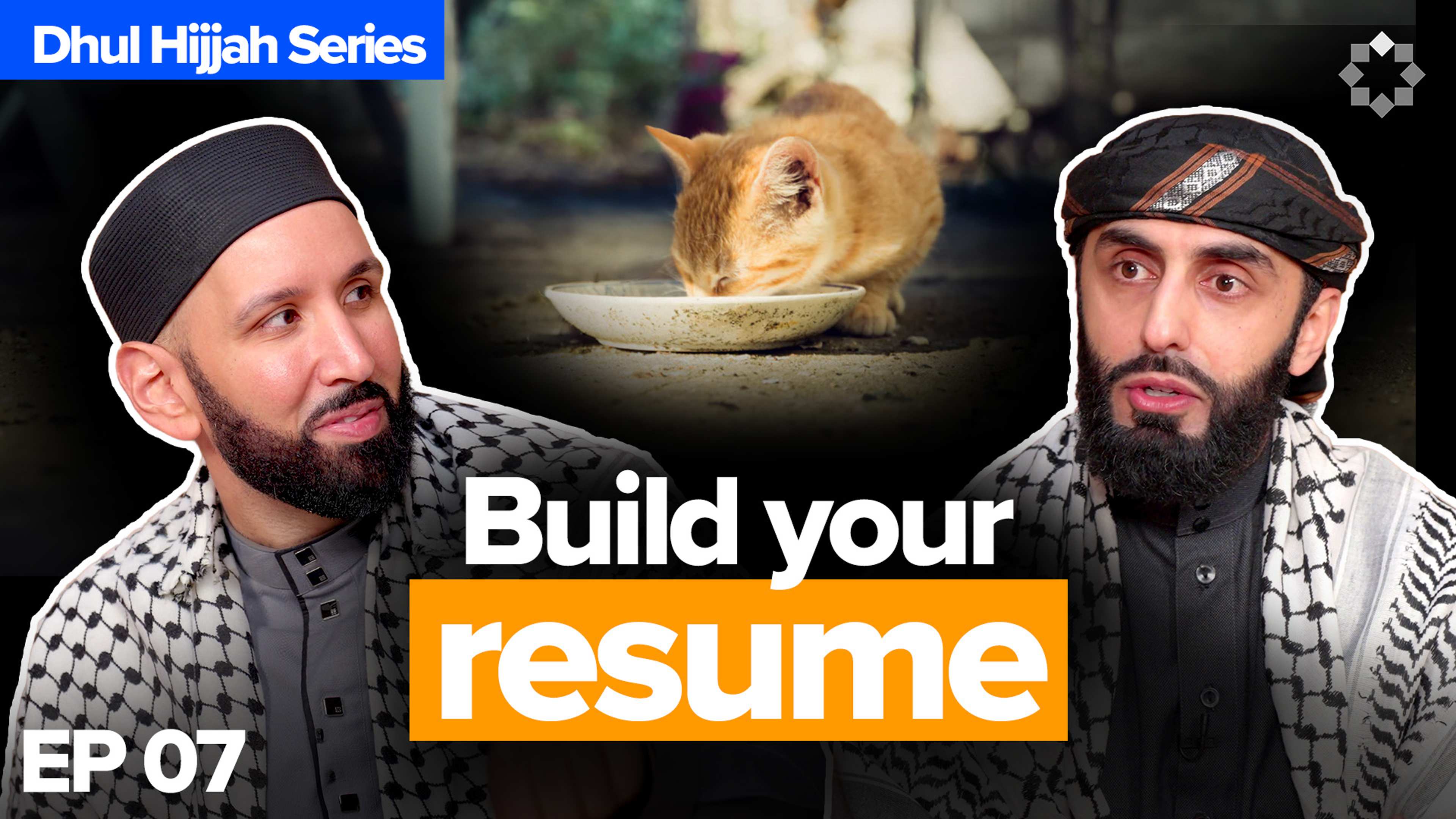
Ep.7 Save Yourself with Small Acts | Dhul Hijjah Series | Dr. Omar Suleiman & Sh. Ali Hammuda

The Book of Heart Softeners Dhul Hijjah 2026

Ep.7 Save Yourself with Small Acts | Dhul Hijjah Series | Dr. Omar Suleiman & Sh. Ali Hammuda
This transcript was auto-generated using AI and may contain misspellings.
00:01So, this is a door that swings both ways of course, brothers. Just as we say, don't belittle
00:12a good deed in your life, also beware of belittling a sin. Saying, Alhamdulillah, I pray and I fast, I recite Qur'an and I'll do tawbah before I go to sleep. No, that could be the
00:24sin that becomes your unravelling, your undoing in the eyes of Allah subhanahu wa ta'ala. How do you quit a consistent sin that you're committing in private? In all of my years,
00:35and we all have things that we wish that Allah 'azza wa jall will overlook on the Day of Judgment, so we all have shortcomings, but I find nothing more effective than the names of Allah subhanahu
00:45wa ta'ala. As-Samee', Al-Baseer, Al-Raqeeb, like thinking about Allah, the all-seeing, thinking about Allah, the all-hearing, thinking about Allah, As-Shaheed, the all-witnessing,
00:57the ever-observing.
01:27Adi ibn Hatim narrates that the Prophet ﷺ said that there is not a single one amongst you except that you will be spoken to by Allah on the Day of Judgment and there will be no interpreter between you and Allah.
01:41ثُمَّ يَنظُرُ فَلَا يَرَى شَيْئًا قُدَّامًا ثُمَّ يَنظُرُ بَيْنَ يَدَيْهِ فَتَسْتَقْبِلُهُ النَّارُ
01:49The Prophet ﷺ said, and then you will look ahead of you and you will see nothing. And then you will look again in front and the hellfire will suddenly confront you.
02:01And then he ﷺ said, فَمَنْ اسْتَطَاعَ مِنْكُمْ أَن يَتَّقِيَ النَّارَ وَلَوْ بِشِقِّ تَمْرَةٍ
02:09So whoever amongst you is able to, let them fear Allah, or fear the fire rather, even with half of a date in charity. Now SubhanAllah, we were just talking about Jahannam, speaking.
02:23And I want to actually start with this point that everything on the Day of Judgment speaks. Your deeds speak, your victims speak, your limbs speak.
02:36SubhanAllah, your own hand, your tongue speaks, but not you in control of it.
02:43Your hands, your legs, the Prophet ﷺ tells us about this long incident where a person disputes with Allah subhanahu wa ta'ala and says that, I didn't do that, and I didn't do that, and I don't accept these witnesses against me.
02:57And Allah says, who do you accept as a witness? Myself, I only accept myself as a witness. Okay, but you can't lie, you can't embellish anything. And that's when the limbs start to come forward and start to testify against the person.
03:10And what do you say to your own limbs? لِمَا شَهِدْتُمْ عَلَيْنَا? Why are you bearing witness against us? I was trying to defend you, I was trying to protect you. If we go to the fire, you're being separated into pieces.
03:21If we go to the fire, then we will all burn and suffer. And what is the answer? أَنطَقَنَا اللَّهُ. Allah caused us to speak. The same one who made everything speak.
03:33So on the Day of Judgment, your deeds speak, your limbs speak, that which you used to wrong speaks. The Prophet ﷺ, he mentioned to us that whoever kills a small bird for play, not out of benefit, will be brought forth.
03:47And the bird will testify, and the bird will say, يَا رَبِّ إِنَّ فُلَانًا قَتَلَنِي عَبَثًا وَلَمْ يَقْتُلْنِي لِمَنْفَعَةٍ Oh my Lord, that person killed me for no reason, out of play, not for any benefit whatsoever.
04:00Places will speak. The place of your sujud will speak in your behalf, bi-idhnillahi ta'ala. Your Mushaf will speak, bi-idhnillahi ta'ala.
04:10The Prophet ﷺ talks about the Black Stone speaking on the Day of Judgment, testifying on behalf of those who made Hajj or 'Umrah. The Prophet ﷺ mentioned al-Rukn al-Yamani, the Yemeni corner of the Ka'bah,
04:23speaking as well on the Day of Judgment. So places speak, possessions speak. Everything is speaking on the Day of Judgment. Paradise is speaking. Hellfire is speaking.
04:35But beyond all of that, dear brothers, is Allah speaking to you. And there is no tarjuman, no translator, no interpreter.
04:46And what that means is not just that you will be able to understand Him fully and that this will be a direct conversation. This conversation is also bare. No one else is involved.
04:59It is you and Allah subhanahu wa ta'ala is the one who is examining you. And you have to rehearse that conversation not a million times. Every single day of your life, as many times as you can,
05:11rehearse that single conversation where Allah Himself is speaking to you. And the implication of there is no tarjuman, there is no interpreter here, is that there are no two sides of the story.
05:22There is no one to say maybe this was misunderstood or to reinterpret the facts. And this is very comforting in an age where genocide has been whitewashed. Right?
05:32But also for us, it is confronting, not just comforting that there is no interpreter. Allah doesn't need an interpreter. It is just you speaking directly to your Lord.
05:43Are you confessing and seeking His mercy as you were in this world in a meeting that you anticipated, which we spoke about in the very beginning of the series? Or did you push it off and hope that it would never confront you?
05:57So with everything speaking, Allah Himself is speaking. Shaykh Ali, at the end of this hadith though, the Prophet ﷺ, as he mentions, hellfire now being brought forth.
06:08And he says, save yourself from the fire even with half of a date. Can you elaborate on this, Shaykh, what this means? Alhamdulillah wa assalatu wa assalamu 'ala Rasulillahi wa 'ala alihi wa sahbihi wa man walahu. So this is another example of a vivid hadith
06:22giving us phenomenal descriptions, clarity on Yawm al-Qiyamah so that no one can claim to have been caught off guard when it happens. But it wasn't just an aspect of painting a vivid picture
06:34of what Yawm al-Qiyamah is going to be like. It takes you to this summation at the end of the hadith where he says, فَاتَّقُوا النَّارَ وَلَوْ بِشِقِّ تَمْرَةٍ in one narration. Therefore, i.e. in light of what you have just learned
06:48about the Day of Judgment and how you will be looking left and right and all you will see is your deeds and then you will see hell in front of you and there is no interpreter. He said, therefore, the thamar, the fruit, the takeaway
07:02is ittaqū an-nār, fear the fire. وَلَوْ بِشِقِّ تَمْرَةٍ Even if it's just half a date that you give in charity. So you have agency. It's within everyone's hand to take solid steps to create barriers and hurdles
07:16between yourself and that inevitable destination for many. Ibn Hajar, he says, commenting on the statement of fear the fire even if it's with just half a date. He says the following words.
07:29A, it means اجْعَلُوا بَيْنَكُمْ وَبَيْنَهَا وِقَايَةً مِنْ أَعْمَالِ الْبِرِّ وَالصَّدَقَةِ وَلَوْ بِشَيْءٍ يَسِيرٍ He said this hadith, this conclusion means
07:41create barriers between you and hell even if it is via small acts of charity or small acts of righteousness. The idea is do not belittle any good deed that is in your disposal.
07:57And we find this theme so salient in our tradition. People who are in the highest places in Jannah with no platform and no packed out stadiums and people who went to hell for the abuse of something like the cat
08:11that has been roaming around us throughout the series that we've been recording. So no one can say that it's outside of my jurisdiction, it's outside of my ability to go to paradise or hell is inevitable for me.
08:25Small things take us here and small things can protect us from that. And I share with you some examples in terms of narrations and in terms of case studies.
08:37The Prophet ﷺ told us a phenomenal hadith that is almost difficult to believe if it wasn't for our certainty that it's at the highest level of authenticity, Alhamdulillah. Where he said
08:51مَرَّتْ بَغِيٌّ مِنْ بَغَايَا بَنِي إِسْرَائِيلَ عَلَىٰ كَلْبٍ يُطِيفُ بِرَكِيَّةٍ That a prostitute from Bani Israel, the children of Israel came across a dog
09:04who was circumambulating around a well because of thirst, he was dying. And so she felt mercy, she took off her leather sock and she went down into the well
09:17and she filled it with water and she gave it to the dog. The conclusion of the hadith is فَاسْتَقَتْ لَهُ فَغُفِرَ لَهَا بِهِ She gave it water so her sins were erased because of this deed.
09:32Imagine a gathering like this, don't belittle this hadith my brothers, al-Zubayr and 'Umar and 'Uthman and the warriors of the Sahaba and the Ummahat al-Mu'mineen, the mothers of the Believers and they hear this story because it's life changing. And he said
09:46صلى الله عليه وسلم لَقَدْ رَأَيْتُ رَجُلًا يَتَقَلَّبُ فِي الْجَنَّةِ فِي شَجَرَةٍ قَطَعَهَا مِنْ ضَهْرِ الطَّرِيقِ كَانَتْ تُؤْذِي الْمُؤْمِنِينَ I saw a man tossing and turning in Paradise because of a tree that he cut down.
10:00It was in the middle of the road and it was harming the Muslims. He earned Jannah because of it. I remember my father telling me in 2014 when he came back from his Hajj
10:13of a phenomenal incident that was difficult to forget. He said we were in Mina, we had no AC units to cool us down and my dad is much like myself,
10:26if there's any semblance of heat in a space forget about sleeping, it's impossible. So he said I'm tossing and turning and I'm just in agony for a long day ahead of us and I'm panicking and you know when anxiety mixes with the need to sleep
10:40and long day ahead of you, it's compounded. He said then all of a sudden SubhanAllah I felt this breeze just pass over me like it was from Jannah and I slept into a very deep sleep. He said what is amazing is that
10:54he woke up just before Salat al-Fajr and it was to the sight of an old Indian uncle. So he's older than my father. My father is calling him uncle so he's an old man
11:07and he's carrying... like a cardboard piece of some sort. He's fanning my father like this. So he saw that my father was startled. He said to him son I saw from the other side
11:20of the tent that you were struggling to sleep so I thought I'd come and give you a hand. He said to him Jazakallah Khayran, how long have you been standing there? He said from
11:30around 12 o'clock midnight. Four or so hours in one position and we're struggling to sit brother. Four or so hours fanning my father. This is a man who's on his own Hajj journey.
11:44He's paid his thousands. His body is not helping him with this ibadah. But guess what? There's no belittling that could be because maybe all of the sacrifice is rejected. Maybe I'm a show-off. I don't know. Maybe my money was haram. Maybe this is the action that Allah
11:58will give me salvation. So this is a door that swings both ways of course brothers. Just as we say don't belittle a good deed in your life also beware of belittling a sin.
12:14Saying Alhamdulillah I pray and I fast and I recite Qur'an and I'll do tawbah before I go to sleep. No that could be the sin that becomes your unraveling, your undoing in the eyes of Allah Subhanahu wa Ta'ala. Because of the Mujassarah or the Tajassara, the audacity,
12:27the brazenness of it that causes a lifetime's worth of hasanat to fall or to disappear. And that's why we know of a woman who entered Hell because of a cat that she
12:37trapped. She prevented it from eating till the cat died. Allah gave her Jahannam because of that. And that is why just before I hand over Shaykh, I love a statement attributed
12:48to Muhammad al-Baqir rahimahullah wa radiyallahu anhu who said that Allah Almighty has hidden three things within three things. Allah has hidden His pleasure within three things.
13:03Within the many good deeds of life so that we don't belittle any good deed. And Allah Almighty has hidden His anger, His wrath within the many sins of life so that we don't belittle
13:16any what? We don't belittle any sin. And Allah Almighty has hidden number three, Allah Almighty has hidden His Wali, His ally from creation between all of the people so that we don't
13:28belittle any person. Back to the hadith, therefore, fear the fire even if it is by the giving of a half a date.
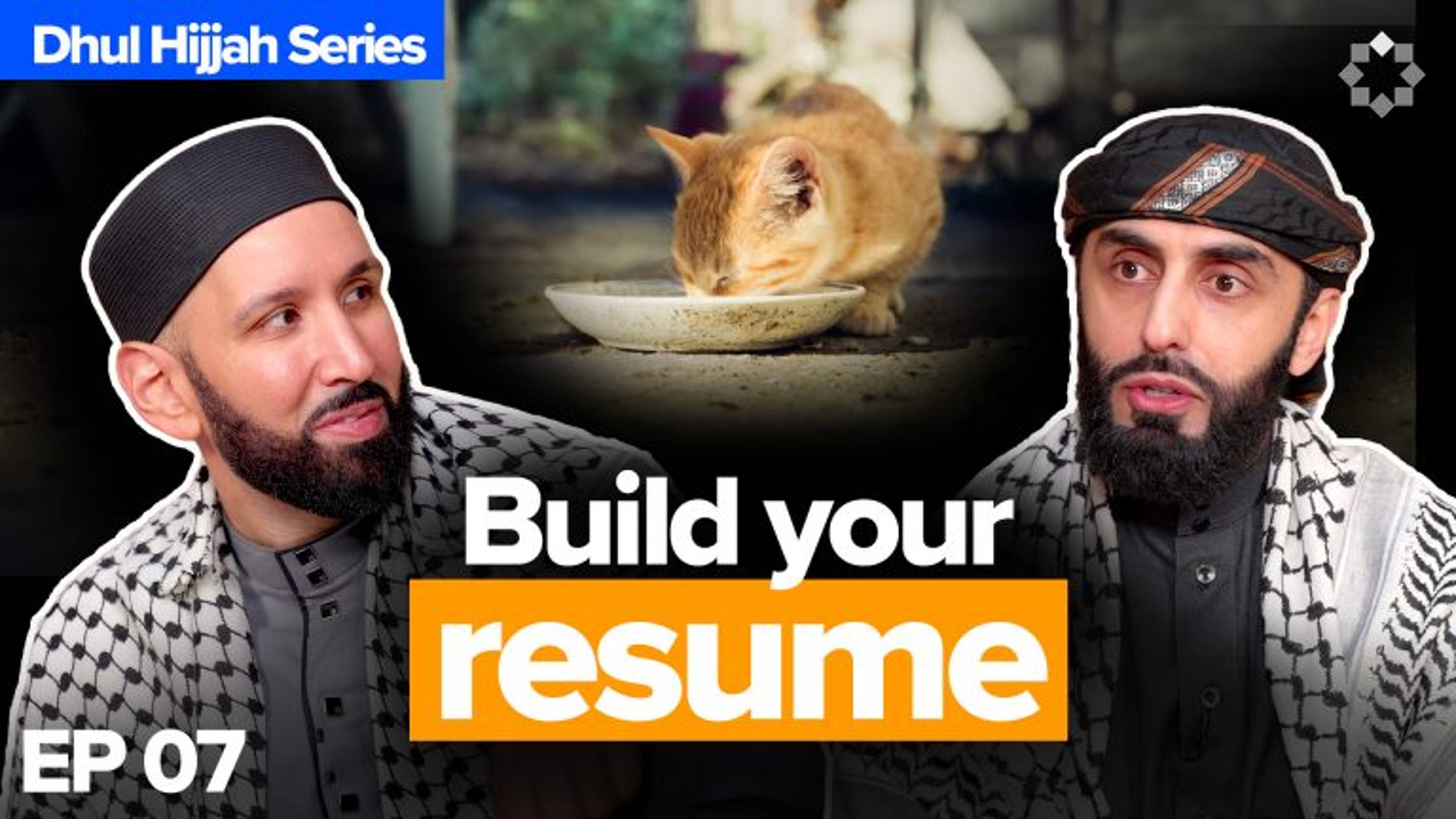
13:39It's like this whole journey, you're thinking about your résumé. As we've been getting to know you guys between sessions, we're talking about your future, what you're preparing for. And I want you to think about it this way, your private righteousness is your résumé
13:53with Allah. That's your CV. Your private righteousness is your CV with Allah that you'll present for this interview. This is the interview now. There was a pre-interview to the interview that made you even worthy of this interview in the first place, right? This is the interview
14:08now. Public righteousness and what the public sees, that's what people think of you. But this is now the real interview. Here's your CV. But here's something I really want you
14:18to think about. I meet a lot of young people, Shaykh, and I don't think we count as young anymore unfortunately. Allah knows best. But people like yourselves, honestly, that have
14:31this dramatic intention to make some major change one day in their lives. It doesn't mean you're bad, but once I finish this milestone in my life, then I'm going to do this amazing
14:40thing for the sake of Allah. So it's not necessarily tawbah from a sin. It's like I have this dramatic intention to do something great. But small, consistent, good deeds that actually happen
14:53on a daily basis mean so much more than dramatic intentions that never materialize. Because the trick of Shaytan is to delay good until you can no longer do it. And so this is an
15:05incredible point that the Prophet Sallallahu Alaihi Wasallam is saying when he's giving us the scene of the meeting with Him Subhanahu Wa Ta'ala. This is it. This is it. You don't
15:17get a redo. This is it. You're in front of Allah. You worked your whole existence for this one moment, and then he says half a date? Like I'm embarrassed to go to someone's house
15:30if I don't have the right gift. Right? Like you got to have a grand gift when you're going to a grand home. You're meeting the King of all kings and the Prophet Sallallahu Alaihi
15:39Wasallam brings up half a date? So a very practical advice I want to give you is guard a private act of worship between you and Allah Subhanahu Wa Ta'ala that you hope to present
15:51on that date. It's not everything. It's not everything. You still, you can't come close to Allah Azza wa Jall by going around the fara'id, the mandatory things. The Prophet Sallallahu
16:01Alaihi Wasallam says in a hadith Qudsi that Allah has said that my servant does not come near to me. My servant does not come near to me with anything more beloved to me than
16:14the fara'id, than the mandatory things. And then they continue to come close to me with the nawafil, with the voluntary things until I love them. And the hadith goes on to what
16:24that love looks like. But what's a private act of worship you guard as that half a date on the Day of Judgment? And the last thing I'll say in this regard is how do you quit
16:36a consistent sin that you're committing in private? In all of my years, and we all have things that we wish that Allah Azza wa Jall will overlook on the Day of Judgment. So we all
16:48have shortcomings. But I find nothing more effective than the names of Allah Subhanahu Wa Ta'ala. As-Samee', Al-Baseer, Al-Raqib, like thinking about Allah, the All-Seeing, thinking
16:59about Allah, the All-Hearing, thinking about Allah, As-Shaheed, the All-Witnessing, the ever-observing. Like to actually, as you are committing those sins, think about Allah's
17:09names that relate to those private sins. And then find hope in those names that relate to Allah seeing those private good deeds. There's something about connecting to Allah
17:22on that deeper level that will allow you, insha'Allah, to disconnect from something that otherwise seems like it has captured you. And that is to be captivated by Allah's names,
17:32knowing that you will one day have to meet Him Subhanahu Wa Ta'ala. Shaykh Ali, do you have any final thoughts in this regard as someone who's taught about the names of Allah as well, and things of that sort, this meeting, this momentous meeting and what it represents?
17:45Allahu Akbar. Jazakallah Khair. You've covered it, Shaykh. I mean, I'm just on this topic of really guarding a hasanah, a good deed of some sort that you can truly hope and claim
17:56that there is nothing in it whatsoever except the desire for the face of Allah Subhanahu Wa Ta'ala. The public deeds that we do, like this one, for example, I don't want to say
18:07discount it or assume it rejected because we think well of Allah Subhanahu Wa Ta'ala. But put your stocks in those things that are not publicly shared. And I remember two incidents
18:19that perhaps we can close with. The first belongs to a person known as al-Junaid al-Baghdadi, a famous scholar and known worshipper in Iraq. And when he passed away, rahimahullah,
18:32people saw him in a dream. And al-Junaid was asked, ba fa'alallahu bik, what did Allah Almighty do to you now that you've met him? And al-Junaid, he said, well, taasahat tilka
18:43al-ibarat, wathahabat tilka al-isharat, wathalassat tilka al-'ulum, wathahabat tilka al-rusoom, walam yanfa'na illa raka'at kunna narka'ha bil-ashar. He said all of the complicated
18:57terminologies that we used to use have disappeared. And all of the metaphors and the symbolisms
19:04have dissolved. And the only thing that benefited us here were a few short units of salah that we used to carry out in the depths of the night.
19:16The second belongs to al-Khalil ibn Ahmad al-Farahidi. And he was the founder of a science called al-'Arud, which is the poetic meter, studying the rhythm and the structure of poetry.
19:27So when he passed away, people saw him in a dream. They said to him, ma fa'alallahu bik, what happened to you? And he said, ghafarallahu li bita'alimi ajuza surat al-Fatihah, Allah
19:38erased all of my sins because I taught an old woman Surat al-Fatihah. They said to him, what about al-'Arud? What happened to that knowledge that you founded? He said, it was
19:51all decked and it disappeared as though it was scattered dust. This isn't to make us think bad of Allah Almighty or minimize the big deeds that fall on our lap, but this is
20:03a case to create hasanat that you really could put your stocks in in the hope that Allah Almighty will save us if all else fails. Jazakumullah khayran for your attention, brothers.
20:14Let us know if you have any questions, insha'Allah, we'll try to assist. What are ways to keep your intentions pure when doing good deeds?
20:25One thing that can be done is to say, Allahumma inni a'udhu bika an ushrika bika wa ana a'lam wa astaghfiruka lima la a'lam. Du'a that the Prophet Saw taught us to say, which means
20:37oh Allah Almighty, I seek refuge in you that I should associate partners with you whilst I know and I ask you to forgive me for those things that I do not know. The second is really
20:51to avoid the perfection fallacy because it's very easy to fall into a type of obsession with this topic whereby it overtakes our thinking and we're no longer able to do anything in
21:05public or secret because we're afraid that we will be insincere. Insincerity will creep into our lives. Perhaps aspects of minor shirk will creep into our lives. Minor sins will be part of our day to day. At times we may even fall into a major sin. That's not
21:20to normalize this but it's to remember that you are a human being and you will make mistakes and Allah Almighty appreciates the process of you being embattled with it and coming
21:30out as a stronger person. The sign that you or I experience insincerity or moments of
21:39showing off is a sign that we fear insincerity because it is only the hypocrite who is never insincere because he's consistently insincere. So he has nothing to worry about. As for the
21:53believer, he will fall into showing off many times. Why? Because he fears it. He's embattled with it and Allah Almighty rewards him for that struggle so long as he does not surrender to it. Allahu A'ala. Thank you, Sheikh.