Imam Tom Live
Remembering Aysenur's Courage | Imam Tom Live
We discuss the martyrdom of Aysenur, reflecting on her legacy and the broader context of Israeli attacks on US citizens. We’ll cover the attack by a Jordanian truck driver on Israeli border guards and discuss the frustration among Muslims in the Middle East towards their governments. In Tafsir Time, we’ll examine Surah Ikhlas and the word الصَّمَدُ (Self-sufficient Master). Finally, we’ll continue our study of Atomic Habits, focusing on how social norms influence behavior.
This transcript was auto-generated using AI and may contain misspellings.
00:00As-salamu alaykum wa rahmatullah, everybody. This is Yaqeen Institute's weekly live stream. I'm your host, Imam Tom Facchine. Welcome to the program. A very, very important show that we have tonight. Obviously, our sister Aysenur
00:10Ezgi Eygi is on all of our minds here in the U.S. Our latest martyr from our community who was murdered in cold blood by the IDF in the West Bank. We'll be talking extensively about that. We're going to have a guest
00:22from CAIR to help talk about the situation who's local to that area. I know a lot of people who have either known her directly or known people who knew her have reached out to me in the past week,
00:35giving me a portrait of her courageous life. And we'll be talking a lot about her legacy and what we can all learn from it. May Allah shower her in mercy and accept her sacrifice.
00:45We're also going to be talking about some of the tensions that are boiling over when it comes to the lack of, let's say, people have run out of patience. There are some people such as in Jordan and in other places,
00:55I think now Egypt, that have taken on sort of vigilante acts despite their government attempting to suppress them. We'll talk about that. We will have our normal segments on the Qur'an and tafsir, going over today Surat al-Ikhlas,
01:09and then also Atomic Habits. We'll be talking about how to make our habits more attractive and specifically the power of social norms. But before that, as always, let's hit the chat. This is your opportunity to ask whatever questions you want.
01:24Let's say hi to everybody. As someone has said, we'll say hi to the whole ummah, because the whole ummah usually shows up. Masha'Allah, Tabarak Allah. Atiyah is first in the door. Wa alaykum as-salam wa rahmatullah.
01:35Zaheer Younis from London. Wa alaykum as-salam wa rahmatullah. Thank you for tuning in tonight. Shema Budadi. Wa alaykum as-salam wa rahmatullah. Ahlan wa sahlan, kaydir ala bayt alayk. Hope you're well.
01:48Commentaries here. Zaheer Younis. Yes, good to have you with us. Nasir Mahmood. Wa alaykum as-salam wa rahmatullah. Wa alaykum as-salam wa rahmatullah from Durham, North Carolina. Alhamdulillah, all, you know, all things considered.
02:01We thank Allah for the opportunity to distinguish ourselves and to try to work to what He is happy with. Sara is back. Wa alaykum as-salam wa rahmatullah. Happy to have your great questions with us as always. And starting right away, Sara asks,
02:16Have you ever heard of Graham E. Fuller? Your opinion on him and his book, A World Without Islam? If so, your thoughts? Nope. I mean, I vaguely, vaguely, vaguely heard of the book. I haven't read it. Not really familiar with the author. So I plead the fifth.
02:28Rick Rashid. Wa alaykum as-salam wa rahmatullah from Canada. Good to have you back with us. Muhammad Aziz Al Rahman. Wa alaykum as-salam wa rahmatullah. What else we have? Muhammad Aziz Al Rahman. Yes, okay. Munira Hayati Mokhtar. Wa alaykum as-salam wa rahmatullah from Malaysia.
02:41Salamat Datang. Wonderful place, wonderful people. Glad to have you with us. Amina. Wa alaykum as-salam wa rahmatullah. Welcome back. Fatima Muhammad from Trinidad. Wa alaykum as-salam wa rahmatullah. Who else do we have? Someone who has a bunch of numbers for your username. Welcome to the program.
02:56Saliha from Atlanta. Wa alaykum as-salam wa rahmatullah. Good to have you back again. I see a lot of familiar faces, or familiar usernames at least. Nabisa. Wa alaykum as-salam wa rahmatullah. Welcome to the program.
03:07Dark Phoenix from Maryland. Wa alaykum as-salam wa rahmatullah. Good to have you with us. Okay, so here, Eunice, is a question. I've been reflecting on Aysenur's martyrdom and its broader implications.
03:20How can we better understand the legacy of figures like Aysenur in the context of current geopolitical tensions? We're going to talk more about this. This is a dedicated segment of the program.
03:28But one of the things that I've been hitting on last weekend, I was in Houston and then to Chicago, meeting with a lot of the youth, meeting with a lot of sort of the Muslim American community's leaders,
03:41and discussing martyrdom as a paradigm, right? We need to be prepared to sacrifice and to pay the ultimate sacrifice. I firmly believe that. I don't think anything gets done if you don't have that attitude.
03:53And that's, I think, one of the main takeaways from Sister Aysenur. And I know that one of her final sort of requests, or maybe not requests,
04:04but something that she said to someone that she knew that she was in contact with, was that we need to do more. And I don't think that you can really effectively make change if you're not willing to pay the ultimate price and to sacrifice everything.
04:16Not that every single one of us will have to end up sacrificing everything, but that is definitely, if we're talking about tearing down the system of the power structures of Zionism and Islamophobia
04:28and everything that is securitizing Muslims across the world and criminalizing Islam and criminalizing us, and creating this sort of plausibility structure within which Palestine can be occupied.
04:40If we really want to help bring it to an end, then we need to be prepared to sacrifice everything. I ultimately believe that wholeheartedly. So that's my biggest takeaway, but I'm sure there's others and we'll talk about it. Suzy Baroud, wa alaykum as-salam, from Seattle.
04:53So I know that Sister Aysenur, rahimahallah, was part of the Seattle community. We have over on our side of the, on this coast, the East Coast, we have some people who are also part of the Seattle community that come here seasonally.
05:07So welcome to the program. Seattle was a nice city, by the way. I was able to visit it this year. Fatima77, wa alaykum as-salam, wa alaykum as-salam. A Qadri says, Wa alaykum as-salam, on the anniversary of 9-11,
05:19I wanted to see what's the best way to engage, want to express sorrow for lives lost, while also being outspoken about the countless Muslim victims of U.S. war on terror. Yeah, 100%. Well, here's the main point and the main takeaway, A Qadri,
05:29and that is that the United States, the most dangerous thing to the United States of America is its own foreign policy, period. Put it up on the wall. Put it in lights. Put it on billboards.
05:41Whatever you need to do. That message has to be, you know, there is no sort of, of course, Islam does not condone the targeting of civilians, true civilians, not fake civilians like some people like Israel try to fudge those boundaries
05:55and use human shields and these sorts of things. We're talking about actual civilians. Islam is completely against the targeting of civilians. However, the United States has to have a reckoning with its own foreign policy.
06:09There is no doubt that 9-11 does not happen without the foreign policy of the United States. How do we know? We have the explicit writings of the person who masterminded the attack,
06:20Osama bin Laden, who wrote a whole manifesto and what he is complaining about, as many people learned this year on TikTok, many young people, Gen Zers and below,
06:30learned that his main complaint was the foreign policy of the United States of America. And as Muslims, we've obviously gone through the process of condemning that particular act. And that's not something that we support. It's not something that's legitimate Islamically.
06:44However, if the United States does not want to make itself a target, then it has to stop destabilizing the Middle East. It has to stop, get out of the Middle East, all the military bases, all of the meddling,
06:57all of the intervention within its politics and the coups and everything that it's doing. It has to get out. And that is the absolute safest way for, or that's, I'd say,
07:09the best way for people in the United States to stay safe. Zahir Yunus says, How can individuals and communities effectively apply the principles from Atomic Habits to create positive changes?
07:22Well, let's talk about when we get there, insha'Allah. I mean, it's a good question, but it's kind of deep. Nusaybah Qasim, wa alaykum as-salam wa rahmatullah. Welcome.
07:32Seamus says, seems like Netanyahu has decided, by the way, wa alaykum as-salam, Seamus, good to see you. Seems like Netanyahu has decided it is perfect time to implement plans that will secure long-term security for IL.
07:45I'm not sure when these people use these little letters, what they mean. They did airdrop mission for Syrian Lebanese border and kidnapped a scientist. You know, stuff that I don't know, Seamus. I haven't been paying attention to that.
07:58Okay, for Israel. Okay, I see. Yeah, I mean, well, there's a game of chicken that's being played.
08:03I mean, it's like sort of a high-stakes situation where Netanyahu is, he is an accelerationist of sorts to say that, you know, he's going for everything. Okay, either he's going to win everything or he's going to lose everything.
08:17And I think one of the hopeful things about the last 11 months is to see how quickly the house of cards of support for Israel is falling apart. That doesn't mean that we're even halfway there. But we've seen the political support and the mask be ripped off and all of these things.
08:31You know, Israel is under the highest scrutiny or the most amount of scrutiny and the most fundamental scrutiny, like scrutiny about the very idea of Israel. Whether it should have existed in the first place. We haven't seen this type of thing, at least in Western discourses.
08:44The Overton window has shifted. Okay, and that's a positive thing and we should welcome that. Nope. Wa alaykum as-salam wa rahmatullah. Your username makes me laugh. Muhammad Ibnu. Wa alaykum as-salam wa rahmatullah. Let's see, we have Wasi Ahmed.
09:03Yeah, I'm not sure exactly what you want us to do there, Wasi. Are we supposed to continue watching this slaughter on our phones and just say meaningless words that fall on deaf ears? I mean, come on, dude. Like, that's very rhetorical. Like, am I going to say yes, actually, we're supposed to keep saying meaningless words?
09:16No, but there needs to be a critical assessment of strategy and how we're going to get to the objective that we want to get to. And there might be discourse involved in that. And those words are not meaningless.
09:28Yes, there are some people that are just saying thoughts and prayers, raise your hands, du'a. And we're not denigrating du'a here, but there are some people that make it a false dilemma saying that the only thing that we can do is du'a.
09:40Where we have rights, we have political options in the United States. The United States is where the genocide is coming from and being supported and funded by.
09:48And we have duties that we have to absolutely do when it comes to building political power and doing everything possible to change the foreign policy of the United States. That is completely granted.
09:57However, people might criticize some of the steps involved in that process and say, well, what you're just doing is useless, etc. And that would not be true.
10:08So if by gathering the 313, if by that you mean getting people together to exercise our political power to stop the genocide, to change the foreign policy of the United States, then I agree with you.
10:26All right, let's see what we got. Julia, Abduljaleel, wa alaykum as-salam wa rahmatullah from KL. Good to have you back with us. Fatima77 has a question. The hypocrisy of the United States leaders is right in our faces. Is there an Islamic perspective on this?
10:40Yes, absolutely there is. And I've just turned over a blog post for editing that should be out early next week, insha'Allah. Talking about the way that American Muslims approach politics has to completely change. That we are in election season.
10:54And in election season, you see this dynamic where people, they are, they're forced to settle. Or at least they are told that out of fear of the other side and what the other side is going to do, that they have to settle for less. You can't have principles.
11:08You can't expect everything to change at once. You can't expect the end of the occupation or, you know, an arms embargo on Israel. You have to just get in line and get behind the one party that, you know, they're trying to tell us to support. And then we'll talk about that later.
11:22And that's completely false thinking. It's thinking that has tricked us time and time and time again. Election after election after election. We need to change the way that we deal with politics. We need to look at politics as an exercise of building power.
11:36And not trying to just ingratiate ourselves, which literally usually means humiliating ourselves, to people who are in power. And expect them to do what we want later on.
11:48And there's a very powerful example from the seerah of the Prophet ﷺ that I use. That I'll go into when the blog post is out. It's the example or the situation where the Muslims were marching on Mecca. And they were about to conquer Mecca.
12:00And Hatib ibn Abi Balta'a, who was a companion of the Prophet ﷺ. And he's a veteran of Badr. And he is somebody who has, you know, esteem. And, you know, his intentions are beyond question. We know that he is in Jannah.
12:14We know all these things. However, he made a political mistake during this time. He had family that were in Mecca. And he attempted to send a letter, you know, secretly through a servant to the Quraysh.
12:26To warn them that the Muslims were about to march on Mecca and conquer it. The Prophet ﷺ was given revelation. And he ordered Ali and al-Miqdad to go chase down, track down the servant. And apprehend them and the letter.
12:38And so, this is something that was a major deal. Once they brought it back, the companions were upset. The Prophet ﷺ asked for an explanation. Hatib explained himself. And he was ultimately forgiven. Because he did it out of a good intention.
12:52However, it was definitely a political mistake. Which is why the Prophet ﷺ acted against it, first of all. And secondly, why companions like Umar ibn al-Khattab wanted to basically execute him for treason.
13:06Even though, again, they were stopped. They didn't actually end up doing that. Because that particular act showed a lack of sound political thinking.
13:16Hatib was basically assuming that if he did a favor for Quraysh. That Quraysh would do a favor for him. Yet he had no leverage or no guarantee that this would be true. It was pure, you know, wishful thinking.
13:28This is exactly the political thinking of the Muslims in America up until now. We think that if we do favors for somebody. Support somebody. Prove our loyalty to somebody. That then they will like us and then they will protect us and do something for us.
13:42And that has not happened. Look how loathsome we are to both parties. Look at how each party and each presidential candidate competes in demonstrating their love for Israel. And demonstrating how little they care about Muslims.
13:56And Aysenur Eygi is a perfect example of that. How little. You know, Biden not reaching out to the family. Nothing going on when it comes to that. Like this is a slap in the face. But we allow them to get away with it.
14:08We allow them to get away with it by not holding out. By not punishing them politically. By not approaching power in the proper way. So there is definitely an Islamic perspective on that. Michelle Rousseau. Welcome to the program.
14:22Who else do we have? Okay. Who else do we have? Yeah, I mean, Wasi, you got a point there when you talk about taking our lexicon back. You talk about jihad and things like that. But jihad, and we'll talk about that. Actually, we're about to do a video with Yaqeen Institute.
14:36If you go into any book of fiqh. Okay, jihad is i'laa' al-din. It is bringing honor to the deen. Bringing honor to the religion. And that has several practices tucked inside of it. Some of those practices are warfare and military. Other of those practices are not.
14:50Okay. There might be a situation where you're picking the most sound and the most likely to succeed tactic.
14:58And that is something like, you know, exercising political power in different ways that are not military or warfare. Okay. We do not characterize jihad. Okay.
15:12Sometimes there's a caricature. The Islamophobes would want us to think that all jihad is just like Osama bin Laden and this sort of terrorism and things like that. That's not true. But then the other side, the other extreme, is to say, oh, jihad is just washing the dishes.
15:26Which is also not true. No. Jihad is bringing honor to the religion. And there are many practices tucked within it. And those practices are selected due to their appropriateness given the circumstances.
15:38But I agree with you that we should not give up that word or surrender it to people who want to tuck it into the war on terror discourse.
15:44Because if they criminalize jihad, and they want to criminalize jihad, then it's just a stone's throw away to criminalizing Allahu Akbar or criminalizing the Qur'an itself. As some people have stated is their objective. Aisha Muhtar.
15:58Wa alaykum as-salam wa rahmatullah. Welcome to the program. Yes, we have a lot to talk about today. Glad you're here with us. Shamus brings up Shireen Abu Akleh. Yes, we're going to talk about her as well. There's a pattern of behavior here.
16:12Aziz, wa alaykum as-salam wa rahmatullah. From Denver. Watermelon786 from Detroit. Wa alaykum as-salam wa rahmatullah. I might be coming to Detroit in October. MOR, wa alaykum as-salam wa rahmatullah. Also from Michigan.
16:26Lateesh Muhammad, wa alaykum as-salam wa rahmatullah. Salam. Wa alaykum as-salam wa rahmatullah. Wa alaykum as-salam wa rahmatullah. Aisha Muhtar. Let's see what we got here.
16:40Yes, that's a good point, Aisha. Aisha brings up, you know, she's talking to Shamus and she's talking about the highlighting of her Turkish heritage as a way to distance the United States from any sort of responsibility and the fact that she was
16:54an American citizen. But that highlights the fact that her life is viewed as inconsequential and unimportant by the United States government. And we'll talk about that. Fatima Ghali from North Carolina. Wa alaykum as-salam wa rahmatullah.
17:08Yes, Fatima77. Iraq had nothing to do with 9/11 whatsoever. Mohammed Abu Ramadan. Wa alaykum as-salam wa rahmatullah. Saliha asks, how can we make our voices stronger? By clicking up, by organizing ourselves. Laura.
17:22Wa alaykum as-salam wa rahmatullah from Al-Maghrib. Ahlan wa sahlan. I hope you're well. Let's see. Abdul Wahid says, convey the message of Islam to all people of the world and to everyone who will come.
17:36Also convey the message of Islam to all world leaders. Yes, however, one of the things we have to make sure we get straight is that politics is not da'wah. If people come to Islam, alhamdulillah, and we always want even our enemies to come to Islam, but the Prophet (ﷺ)
17:50also did politics that was not da'wah. Or was, you know, dealing with the reality on the ground. So we have to, sometimes we make mistakes by assuming that we approach all politics
18:04and political situations the way that we approach da'wah. And this is biryani diplomacy. And that's not good. And we'll talk about that. And I'm writing about that. MB from Hershey, PA. Wa alaykum as-salam wa rahmatullah.
18:18A. Kamil from Minnesota. Wa alaykum as-salam wa rahmatullah. Good to have you with us. I'm in Dallas next weekend, actually. I believe, if I recall correctly, that you're from the Dallas area. There's actually going to be a conference
18:32on educators, or for educators, on educating about Palestine that I'll be part of, insha'Allah ta'ala. Jane Da Silva saying, Vote for Jill Stein 2024. She is for stopping the genocide and stopping all wars.
18:46This is Yaqeen Institute. This is 501(c)(3). I can't tell you who to vote for, but listen to Jane. Nuseiba Qasim says, I would never underestimate the power of du'a either. Yes, very good. Who is really in control at the end of the day?
18:59I'm more reliant on Allah for the smallest of things since 10-7. That's beautifully said. And of course, I would never ever seek to belittle the power of du'a.
19:07What I'm afraid of is certain du'at and religious leaders who push du'a at the expense of taking care of their fard kifayah. Because we also have furud kifayah when it comes to building capacity and building power and doing those other things.
19:21Everybody knows. I've never met a person that says that du'a won't work in the Muslim community. I don't know if that person exists. Everybody agrees that du'a works and Allah is ultimately in control.
19:31However, we are responsible for doing more than that. And there's a lot of people not talking about what those other things are.
19:43What else we got? Shama says, Some tried to use Badri Sahaba's story for an excuse for those who do similar actions today. Yep, that doesn't work. That doesn't work. Let's see.
19:58That's why. Okay, okay, okay. Behind a third party. Okay, people are chopping it up about election strategy. And it is true. Okay, we shouldn't go into that.
20:08There's a lot to say about certain candidates and their politics on other issues. There's a difference. I'll say this, Shamus, because Shamus brings up Jill Stein's sort of attitudes and policies and positions on Syria.
20:21Which she has retracted, by the way, officially. However, there is an important distinction to be made between voting for somebody like you think that you're just turning over everything to them.
20:32And that's the person that you want to implement all their policies versus voting for somebody. Because you know it's going to have a certain effect on the terrain, the entire terrain of political calculus of everybody. So those are two things, right? And there are separate things.
20:45Juju from SoCal. Wa alaykum as-salam. Welcome back. Sam Ahad. Wa alaykum as-salam. Welcome back. Ameen. We have Mariam from Kuwait. Wa alaykum as-salam. Wa alaykum as-salam.
20:57Shafi from Florida. Wa alaykum as-salam. Wa alaykum as-salam. Ameen. Zahir Yunus. Zahir Yunus says, let Aisha Noor's story be a call to action for greater awareness and meaningful change. Allahu Akbar. As we strive to confront the systemic issues that perpetuate such tragedies.
21:10Put it in lights. I like it. Very good. Nope asks, what podcast did Imam Tom say he had shared his election opinion on recently? LOL.
21:20That would be Dr. Shadi Al-Masri's podcast, Safina Society. I think he calls the podcast nothing but facts. Salam says, Imam Tom, was my question inappropriate? I think you skipped me.
21:32Oh, I'm sorry. I didn't mean to. I didn't see your question. Ask it again. Someone told me it's halal, but there's ikhtilaf. I wanted to make sure by asking you. I'm sorry. I didn't see it. Could you ask it again? Thank you, Valerie.
21:43A. Qadri says, really don't understand the mentality of Muslims who are voting for Kamala. Yeah, me neither. Well, actually, I can't say that. I do understand it. It's just wrong. Just because she made token gestures doesn't absolve her of complicity. 100%.
21:55She is actively in power. She is actively part of the administration that is committing the genocide. Right. And she has stated her goals and her support for Israel time and time again.
22:05There's really no mystery going on here. Some people are looking for the smallest excuse to run back to their abusers. Very good. Seamus reminds us of Nur ad-Din Zengi's actions before Salahuddin. Good. Nice.
22:19Juju says, I see Muslims giving others nasihah on social media, maybe with good intentions, but it sometimes comes off as hypercritical. How do you draw the line between nasihah and staying quiet?
22:30Well, what nasihah means literally is loyalty. Okay. That nasihah is sincerity and loyalty.
22:39Right. That's why the hadith of the Prophet ﷺ where he says, what is nasihah? It's nasihah lillah wa li kitabihi wa li rasulihi. Right. So how do you have nasihah to Allah if nasihah is just advice?
22:52That's not the correct. That's an overly specific translation.
22:55Nasihah is loyalty and sincerity. And so part of your loyalty and sincerity to somebody is to, if they're in error, to attempt to guide them away from error in the most beautiful way possible.
23:08In the way that's most likely that they would accept that sort of admonition. Okay. Which I think answers your question.
23:17Furoha Mousi. Wa alaykum as-salam wa rahmatullahi wa barakatuh. MB says, since Zionist lobby is behind the politicians, we will need definitely to change our strategy to make our voices heard.
23:29Yes, there's a scenario where we need to tackle campaign finance. Okay. The reason why AIPAC can buy politicians is because money buys elections. That's it. That's the way that the United States election law is set up.
23:42If you're able to change that so that money no longer buys elections, AIPAC disappears. Iman. Wa alaykum as-salam wa rahmatullahi wa barakatuh. Joining from the Maldives. Excellent. Apologies for the late hour for you, but welcome anywhere. We're happy to have you with us.
23:55Aliya Kojak. You came to see me in Houston. Alhamdulillah. I'm glad that you were able to catch the program. Qadi Aladeen. Wa alaykum as-salam wa rahmatullahi wa barakatuh. Murad from Allentown. Wa alaykum as-salam wa rahmatullahi wa barakatuh.
24:09Yes, 100%. Very good. So we've run through all the comments. Allahu Akbar. Only took us 30 minutes this time. Salam to the Ummah. We do have the whole Ummah in the house and we love the Ummah. We are with the Ummah and the Ummah is with us.
24:23That's true. Seamus brings a good point. Some people treat non-malicious, ignorant Muslims and hostile enemies with the same tone. Wasbir nafsaka ma'a alladhina yad'una rabbahum.
24:34Allah says in Surat al-Kahf to be patient with the people who call towards Allah. However, that doesn't mean that we don't have standards and hold people accountable, especially when they have sickness in their hearts and they love the dunya too much.
24:48Iraj Khan. Good point. It's 5:38. That's not that bad, Iman. It's Fajr time. Part of your Fajr routine. Miracle Qur'an. Wa alaykum as-salam wa rahmatullahi wa barakatuh.
25:00You're 100% right, Leticia. Last point about the mediation team. Yes, the United States, it's a lie for the United States to pretend like it is a mediator in this conflict. The United States is a perpetrator in this conflict.
25:11They do not have an unbiased sort of role to play. They are on one side. And so how are you going to let somebody who's on one side be a mediator?
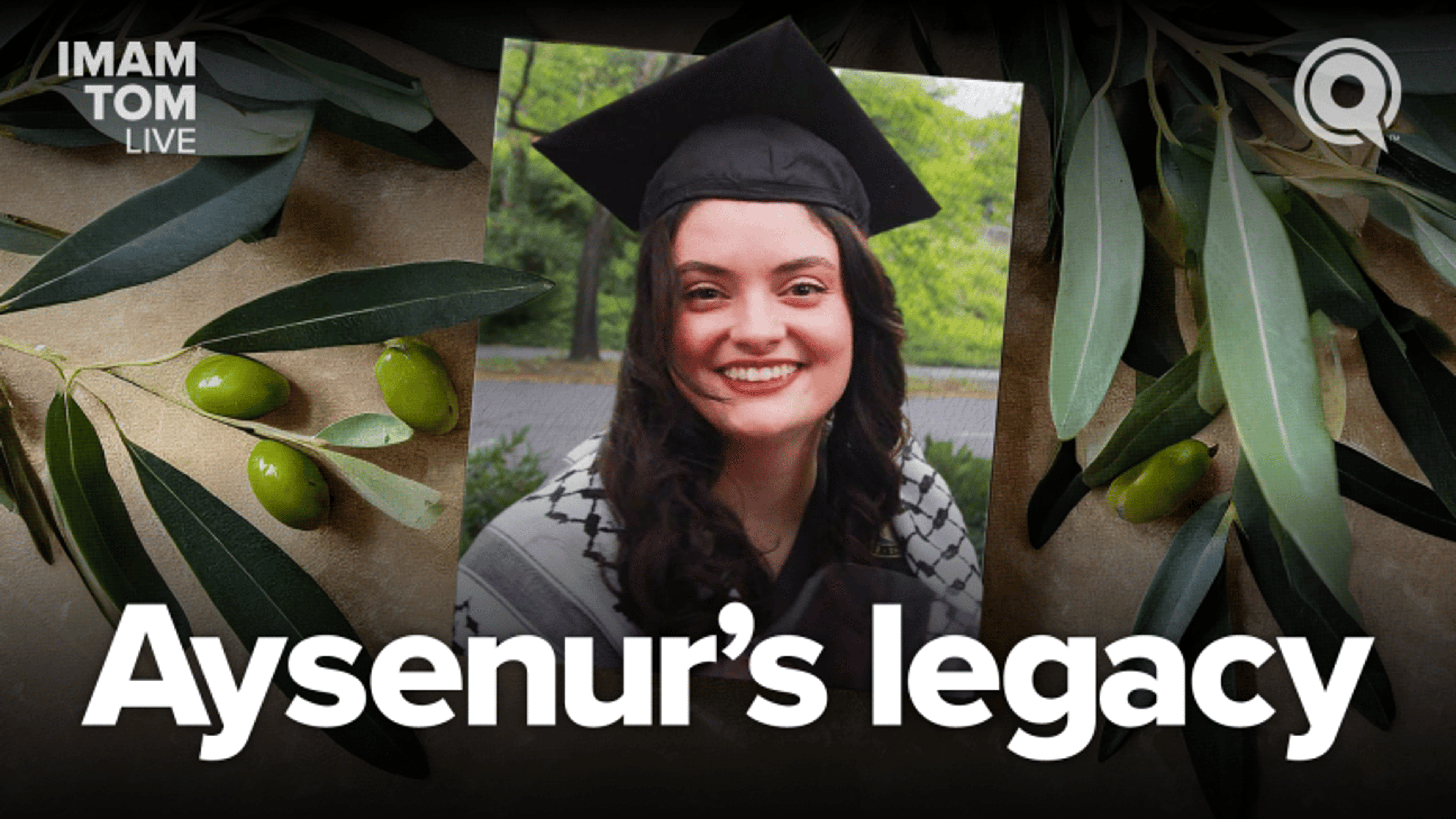
25:25Anyway, here we go, guys. Let's kick it to current events. Our main headline, Sister Aysenur Ezgi Eygi. May Allah shower her with mercy and bring sakinah and solace to her family and to all of those who knew her.
25:39Everybody who I've talked to the past week has said what an amazing and inspiring person she was. Aysenur was gunned down in cold blood by the IDF in the West Bank. She is a US citizen and activist.
25:54She was murdered during a protest by a single sniper bullet to the head. This is not an isolated incident.
26:01This is something that is a regular practice of the Israeli occupying forces.
26:09However, as we're going to see very, very soon, the response has been completely weak because the racket that is the military industrial complex
26:19and its intersection with the occupation of Palestine is too lucrative. It's too lucrative for most politicians to even pretend that they care. So let's go. Oh, awesome. Excellent. Wonderful.
26:32Let's cut folks in the studio. Let's cut to the images or the video of her funeral. So one of the most powerful things that I saw was Sister Aysenur was given her last rites in Palestine.
26:46And I have to say, I seriously got goosebumps when I first saw this. May Allah give us all a good end like Sister Aysenur.
27:00When we look at it from a materialistic perspective, we say that, yes, there is a tragedy to this. However, think about it. You are somebody who went to Palestine in solidarity with the people of Palestine.
27:13And now you die a hero and you're buried in Palestine. This is something that is honestly, it's something to aspire to in a sense. Like it is something that is very, very humbling and touches the heart.
27:27Now, we also have a reaction from somebody who was on the ground with her that will describe to us sort of the circumstances in the situation. Let's cut to that, gentlemen. There were two shots fired from the rooftop.
27:41I've been doing this for 20 years. I know the difference in sound between tear gas, rubber-coated bullets, live ammunition. These were two separate shots of live ammunition shot one after the other.
27:54The first one hit a metal object and then a young man from the village and he's dying. And then I heard another shot.
28:05And then I heard people calling my name in English. I found her lying on the ground beside the tree, bleeding from her head.
28:15I put my, I put my hand under her head to try and stop the bleeding. I took her pulse. She had a very weak pulse. We called the ambulance.
28:29From there, we evacuated her to the village's medical center, where the doctor came into the ambulance and continued to the hospital, where they tried to resuscitate her but failed.
28:47Now, given this horrendous act, which obviously is not horrendous for her afterlife, but is horrendous in the sense of the injustice that her demise is predicated upon,
29:01the response of the United States government has been complete cowardice and unacceptable.
29:10The response of the United States government has been complete cowardice and unaccountable nonsense.
29:17The same sort of deflection and denial and gaslighting that we have seen and come to get used to for the past 11 months was on full display when it came to reporters questioning the White House and the White House staff representatives about what was going on.
29:34Let's cut to the clip where we have a confrontation between the... Well, we have the response from the US White House representative. Each circumstance is unique and different.
29:45And anytime an American citizen or civilian loses their life, it is incredibly tragic. But the circumstances around how that happens is important. The facts matter.
29:57And I'm just not going to get ahead of the process as it relates to this. I understand the family has called for an independent investigation. We just support this.
30:06So look, what you just heard me say to Simon, we expect Israel to make their findings public. We expect those findings to be shared transparently and as thoroughly and as soon as possible.
30:19Beyond that, I'm just not going to get ahead of what those findings determine. And should those require any additional steps needing to be...
30:31So to get this straight, the United States is willing to perpetuate, and the United States president is willing to perpetuate, atrocity propaganda.
30:41Things that never happened on October 7th, such as beheaded babies, such as babies in ovens, such as all this nonsense.
30:49And yet when it comes to one of its own citizens being taken out by a single sniper bullet to the head, all of a sudden we throw our hands up in the air and we become morose. We become overcome with interject.
31:03We have no idea what happened. We're going to allow Israel to investigate itself. How many times has Israel been allowed to investigate itself? This is structurally very similar to when police brutality happens in the United States.
31:16And we allow an internal investigation to take place. And I wonder what is going to be the result of that internal investigation, where people are shuffled around and there's some sort of PR around it. But nothing is done.
31:29Which demonstrates to you the callous nature of the United States government and how indebted and controlled they are by their interests in the occupied territories and the Israeli project.
31:43And this is something that even Dwight Eisenhower, the former president of the United States, way back in the 50s, warned people about as he exited office. He warned people about the military-industrial complex.
31:54He warned what would happen if war became profitable. And you see the money and the guns and the bombs flowing in one direction. Israel is a racket.
32:04The occupation of Palestine is a racket in which many U.S. politicians and their friends make a whole lot of money.
32:13And so when a United States citizen dies, that United States citizen is not worth stopping the racket.
32:20We will do whatever political cover we have to do in order to maneuver around to keep the racket going, the money flowing, the bombs flowing, and everything else. That's not to say that everybody is just about the money. There are other people who are in it for ideological reasons and things of this nature.
32:34But for sure, the Israeli occupation of Palestine is so lucrative to the United States and to the elite of the United States that they are willing to allow American citizens to be murdered in cold blood and not do a thing about it.
32:53Just like we talk about the governments in the Middle East being against the interests of their people, the government of the United States of America is absolutely no different when it comes to being completely indifferent to what is actually good for its own citizens.
33:10Now, this is not, again, an isolated incident.
33:12Aysenur, rahimahallah, belongs to a long list of American citizens that the U.S. government has done nothing about and has allowed Israel to murder in cold blood.
33:26To act with complete impunity and not be held to any standards whatsoever, not even an independent investigation. Just to be told, "Trust us, bro, it was a mistake, we don't know what happened, it was confusing."
33:39So we have Rachel Corrie, obviously, and then Shireen Abu Akleh, and now Aysenur, and there were others, there have been others. So we don't expect much from the United States government when it comes to holding Israel accountable.
33:53However, what we do know is that politically we need to make support of the Zionist occupation of Palestine so politically costly to the politicians of the United States that they will start holding these incidents accountable and will end them and will actually end all support for the genocidal occupation.
34:15And to join us, oh, we have one more thing to cover. We noticed, okay, let's go to the tweet by Sami Hamdi, our brother Sami Hamdi. One of the ways in which the media responded was to attempt to portray her as foreign.
34:27Now, it's true that she is of Turkish heritage, and actually there's a very powerful video of Erdogan, you know, commenting on the issue and expressing his dismay.
34:39You know, whatever you think of Erdogan, the fact that you're being mentioned by heads of state in solidarity is something major.
34:45However, her Turkishness was used to distance her from her American-ness and to basically explain that she was dispensable, that she was killable.
34:57And this attitude was taken even further by the Florida Republican. Who do we have, guys?
35:03Do we have the Florida Republican's tweet, when he said, basically, he called her a terrorist very, very, very brazenly and said, "Let them fire away."
35:15It's basically advocating... to show you how crazy the situation has gotten and how nothing will change until we take back power from the people who are currently in power.
35:27People are actually cheering, United States government officials are cheering on the murder of their own citizens in Palestine in order to tap dance for their masters.
35:40What a world that we live in. But that being said, we have someone, a very special guest with us tonight.
35:48He is somebody who, when we reached out to the family of Sister Aysenur, they directed us to the executive director of CAIR Washington, Imraan Siddiqui.
35:57Imraan Siddiqui is a well-known human rights advocate and advocate for Muslims on the West Coast, up in the Pacific Northwest. And he has joined our program today to help talk about what's going on with the family. How is everybody getting on?
36:11What are the responses that we've seen from the government, and where can we go from here? Welcome to the program, Brother Imraan. As-salamu alaykum wa rahmatullahi wa barakatuh.
36:22So give us a picture. I've heard a lot, but maybe a lot of people aren't familiar with Sister Aysenur. What was her role in the community?
36:34What is she known for, and what is the legacy that she leaves behind? Yeah. May Allah accept her and give her the rank of a martyr, insha'Allah.
36:45This is obviously something that was really difficult for a lot of local activists. I did not know her personally. I moved here at the end of 2020. I was in Arizona prior to this.
36:58But from all accounts, especially of the younger folks that are here, subhanAllah, I mean, just to see the energy of the youth this past year during this genocide. They've really been, I think, leading us.
37:12The older generation, which I probably belong to now, in terms of what they've been doing on college campuses with the encampments.
37:21And to a person, the fact that her name is Aysenur, she was a beam of light to a lot of the folks in the activism community.
37:32Going back, not only standing for Palestine and Muslims, she was standing against police brutality during the George Floyd protests. Back in 2020, she was doing that.
37:45And she was probably in her early 20s during that time frame. During these latest encampments on campus, she was there, very visible. So many of the activists that I know through my work at CAIR, that I interface with a lot,
37:59they've come across her. SubhanAllah, my nephew was up here visiting just a few months ago, and he attended a book talk, and he actually met her at that event.
38:09So every person that came in contact with her really speaks to just her level of determination, her principledness.
38:18And the thing is that we don't really think about what level of thought and care she put into this.
38:26She went into this situation where a lot of us don't have the intestinal fortitude to even put ourselves, you know, the things we love in this dunya, in harm's way, or to sacrifice to go out there.
38:39And she didn't go to Gaza. She went to the West Bank, you know, and even in the West Bank, she knew that her life was in danger.
38:48And she had somebody appointed, somebody who I know, who I'm friends with, who I've done a lot of work with, a campus leader, who was her point of contact in case any harm came to her.
39:00So she even thought, if I die, if some harm comes to me, I'm going to have all my ducks in a row, and I'm going to make sure that, you know, I have the correct spokesperson for me. I don't want my death to be made into something that it's not.
39:15I don't want the eyes to be taken off the genocide that's happening to our brothers and sisters over there. Now, that's extremely significant. So maybe walk us through that tussle, because as we know, when something like this happens, the government is trying to spin its own narrative.
39:29The family is trying to represent, and the appointed representatives are trying to do justice and represent what happened in the way that the deceased wants it to be represented. How has that been?
39:41How has the response been from either local government or federal government? And how has the family been trying to challenge the sweeping under the rug, essentially?
39:52Yeah, I mean, unfortunately, what we've seen over the past 11 months during this genocide, I don't think anything is necessarily surprising to us in terms of the words that come out of the government officials' mouths.
40:06So, I mean, first and foremost, I don't think anybody expected there to be just some miraculous turn of events. And this goes back, you know, you mentioned Rachel Corrie, for example, who was martyred 20 years ago.
40:20Her family was on a call with me and many of the other local activists, trying to talk them through, okay, this is what you have to do here, you know, leading us through their trauma from the past.
40:32And when Rachel Corrie was brutally murdered 21 years ago, the government didn't really say anything.
40:40There's a whole long line of people you've seen: Shireen Abu Akleh, Furkan Doğan during the 2010 Freedom Flotilla.
40:49You have Tawfiq Abdel-Jabbar, who was killed in Gaza as well, and another American that was killed there as well.
40:56The government always, unfortunately, has a second set of principles when it comes to those who are Muslim or those who stand for Palestinian rights.
41:06And so I was just looking back at Twitter right now, when there was a little scuffle that was taking place between Syria, Lebanon, and Israel.
41:20The Biden administration sent out a tweet saying, if you harm an American, we will respond.
41:25And so when they're directing that ire towards a Muslim country or those who they deem to be their enemies, their tenor becomes, oh, we're going to take care of every American that's out there.
41:38But when it's an actual American that's killed by their ally, where is that same energy? It doesn't exist.
41:46And there's been a response from some select members of Congress, Pramila Jayapal and some of the other local members of Congress, the first few days afterward. I mean, you would expect something if an American is killed overseas.
42:00As those of us who were born and raised here, I think we've been told that myth growing up, that if something happened to me, I have this American passport. And that's like, you know, this is like gold basically across the world.
42:13But we have to really demystify a lot of these thought processes. You know, there's a second set of rules when it comes to us. And yeah, I mean, you know, the Biden administration was very slow and deliberate.
42:25I think they've issued a few things today. It's still very much weasel words when it comes to how they're talking about it. You know, "we deplore the death of..." They won't even use the active voice when Israel kills an American.
42:39They try to provide all levels of plausible deniability when it comes to Israel, and allowing them, while they're conducting a genocide, to investigate themselves is one of the most laughable things.
42:51And so I think the family, from day one, you know, centering the family has been extremely, extremely important. That's why we've taken very careful steps in how we've approached media and not trying to be too out there and in your face.
43:04The family really wants there to be an independent investigation. They don't want Israel, obviously, to investigate its own crime, and, like you said, America's providing the weaponry. It's providing the cover.
43:17They don't want America to necessarily investigate either. They want an independent investigator, and they want some type of accountability on a world stage. And they've been communicating through a variety of channels.
43:29You know, we have these young activists who are acting as their spokespersons. And so we're just trying to push the envelope as much as we can.
43:38And so, yeah, Michelle, I'm amazed at how deliberate it seems like Sister Aysenur was with everything. Like, usually it's a moment of chaos. But like you said, you really can tell that she had everything lined up.
43:53That's really, really amazing.
43:56Now, when you talk about the family and the solidarity between the families of, say, Rachel Corrie and Sister Aysenur, is there any sense, or have you ever picked up on any sense, of progress?
44:09I mean, Rachel Corrie was murdered at a different time. And right when there was a lot less scrutiny on Israel, there was no social media.
44:17Right. And so these sorts of things, I guess, let's say, are much more easily accessible. And media has been more democratized since then.
44:31Do we get any sense that any progress is being made, or is it pretty much the same stuff all over again? I think it's progress that's being made.
44:41I think the machinery of both parties, both major parties, to be quite frank, the leadership within each of the parties, continues to just run interference for the occupation and will continue to do so.
44:56You see a continual growth of voices who try to at least stand up, I think, within the political system.
45:04And you try to see people who are, you know, even on a local level, like a lot of times we look at, you know, sort of the federal level elected officials. They're sort of, you know, stuck in their own thing.
45:17They receive funding from AIPAC and a lot of these different sources. But we need to, that was one of the things that was in the chat as well. I mean, we do need Muslim PACs as well.
45:25We need Muslims who are involved at all levels, you know, trying. If there are PACs that are out there spending billions of dollars to do evil. I think AIPAC spent one hundred million dollars in this last election cycle to spread evil.
45:39We have the money and the resources within our community to try to, you know. Promote candidates who are doing good as well. I think that's one lesson, and I mean, it may not work out at the end, but it's not about that for us.
45:52You know, at the end of the day, it's the effort, inshallah, that we make that Allah subhanahu wa ta'ala rewards us for.
45:57So even if we're not necessarily seeing the progress, you know, in our lifetime or in front of our faces, we at least have to use every mechanism at our disposal to try and move the meter.
46:09And I think, you know, just last thing I would say on that is that, you know, here locally, I would say it's changing.
46:16You know, 70 percent of, you know, at least the Democrats over here in this state in Washington supported a ceasefire, which a ceasefire is not necessarily the best thing in the world. It's like stopping the, you know, the mass killing that's taking place.
46:31And they voted to, you know, at their local Democrat convention, to pass a ceasefire resolution. So that means that I think a lot of people on the ground level, at least their conscience is shifting.
46:43So the mass conscience is shifting because they have more access to information. They have more access to social media in terms of the truth of what's coming out of Gaza and worldwide. So inshallah, hopefully it's heading in the right direction.
46:56But, you know, there's a lot of corruption still in the system. Yeah, absolutely. I mean, some of your points are really important. We have the duty to try, right, regardless of, you know, whether we win or not.
47:07We definitely have, I believe, a religious obligation to try. Super PACs and advocacy are one route, you know, electoral is another route.
47:14And there are other routes for building political power. We need to stop spectating and get in the game and do what we're.
47:22And I agree, very capable of doing. If you look at the money that we've splashed into relief, the money we splash into our messages or our banquets or our big conferences every year, we definitely have the juice.
47:35As they say, we definitely have the ability to be putting 15 percent of our current expenditure into political avenues. I want to throw an open-ended question to you, and you can take it or leave it.
47:48You don't have to answer it. But imagine for a second we reach a day where U.S. politicians behave fairly when something like this happens, right, that there is justice, that they are treated the same.
48:03What is it going to take? Yeah, I mean, that's a tough one. I think it has to become politically toxic.
48:11I mean, it has to become politically toxic for somebody to just continue to support these things that we've seen. I mean, we've all gone through collective trauma these past 11 months.
48:25We've seen images, and our kids have seen images, that no human being should see. And our sense of fitrah tells us that this is horrible. This is horrific, and this is not normal for us to witness. And our eyes are not lying to us.
48:39And I think the vast majority of people out there understand that our eyes are not lying to us at this point.
48:46But at the end of the day, the people within the party machinery and the leadership within these parties, they don't think that it's politically toxic to take these positions.
48:59You saw this with Vedant Patel and the Matthew Millers of the world, who are standing in front of people and they just spit out the talking points because they don't feel like they're going to lose anything.
49:10But there has to be a tipping point where. Supporting a genocide, supporting these... It's happening on a world scale already, and you've seen changes already happening in places like the UK, where in the elections you see,
49:23you know, pro-Palestine and Muslim candidates that are winning in these areas. But there has to be a tipping point where this is politically unacceptable.
49:33We're living through a very historic time where we've witnessed one of the worst atrocities, and it's been broadcast in front of our eyes. So we cannot let these people forget. And we have to continuously remind them.
49:46Absolutely. And so, SubhanAllah, exactly what you said about being politically toxic. We have failed to punish this behavior politically. Right. And as long as we fail to punish it. We really can't expect anything different. That's exactly what you said.
50:00It has to be so. We have to get to a point and reverse engineer it. What are all the steps to make it so politically costly to support the occupation of Palestine that no politician would touch it unless they were crazy and wanted to lose an election?
50:15But until we get to that point, we don't ultimately have any right to expect anything different. And I don't think we're going to see anything different. So, you know, this is a super important dynamic with the upcoming election.
50:29And, you know, people are trying to say, OK, get back in line. Muslims, get back in line. Don't make too much noise. But there's going to come a tipping point where we bite the bullet and we basically say, this is our red line.
50:41This is where you stop pushing us around, and we will tolerate short-term harm for a long-term gain if it means actually making people respect us and realizing that you can't just do anything to us.
50:57Any comment on that or any other final points that you'd like to add before we part? Yeah, I mean, I agree with you. I think we just got to continue, specifically on this story.
51:08I think, you know, continue to make noise with these people.
51:13When you see, you know, these mouthpieces have a separate system of humanity for a person like Aishenur or other Muslims that have been killed or those who have been put on the side.
51:30Don't, you know, we've got to continue to push them forward. And that means your elected officials as well. For those of you who are in the US, you know, why hasn't your member of Congress issued a statement?
51:42This is an American, you know, like if this is supposed to be the land of the free and the home of the brave, as they purport it to be, then we have to hold them accountable. But yeah, I mean, it's going to take a lot of work.
51:56And I think we as a community have to be strategic. We have to continue, like, you know, the ulema and the activists. We have to get together.
52:04We have to also have some type of, you know, sessions like this where we sit down together and really strategize, you know, on a granular level, how we plot out, you know, the political power of this community.
52:16And so that's something we're trying to do from a CARE perspective. I know there are many, you know, nascent organizations that are starting, and Yaqeen is doing some great work in terms of the education. So insha'Allah, we'll be able to continue the conversation with you all.
52:29And I'm always happy to come and join you all as well. Look forward to it, Imran. I agree. We are all we have, right? After Allah subhanahu wa ta'ala, we have us. Allah gave us each other to plot our way out of this mess.
52:43I believe that wholeheartedly, and it was a pleasure meeting you, and I look forward to following up with you at some point and continuing the conversation. Thank you so much for joining us today, Imran. As-salamu alaykum. Wa alaykum as-salam wa rahmatullah. So there you have it, folks.
52:57Now we have some... I see that the guys in the studio have prepared some other things that we've discussed. OK, when we talk about reflection on Sister Aishenur's legacy and her martyrdom.
53:10So let's just bring up real quick that tweet from the Republican congressman. OK, he's from Florida, which wouldn't shock a lot of people. No offense to our wonderful people from Florida, but we know that some of the politicians in Florida be wild and out a little bit.
53:25So he said, "One less Muslim terrorist." And then he did a hashtag, "I know, fire away," and these sorts of things. And just to expose the corruption, whether this person is a true believer, ideologically motivated or not.
53:39The only type of person that acts like this is a person who does not fear any consequences for acting like this.
53:46And Muslims will not stop being humiliated until we organize and impose political consequences for acting and speaking like this. So that's an extremely important thing to keep in mind.
53:57And you have to consider, in everything you do, from how you vote in November to everything that you do locally and politically to build power, where you put your money, as we were discussing with Brother Imran.
54:07What are you doing to create a scenario in which it is politically costly, so people can't get away with this sort of stuff? We also, I think, have a quote from Aishenur. Can we run that, guys?
54:22OK, so this was... I highly encourage, by the way, our dear brother Muhammad Jalal from the Thinking Muslim in London, UK, has a great write-up on martyrdom. He offers reflections on Aishenur Ezgi Eygi and notes on martyrdom.
54:36Read it. It's really... and she's holding a quote there. You can really tell, SubhanAllah, you can tell that. I mean, I didn't know the sister personally, but she is super smart. And you can tell she is super sharp.
54:48You look at, I mean, at such a young age as well, all the things that she was taking into account. She understood international solidarity. She understood the way that many, many issues intersect. And she was fearless.
55:02SubhanAllah. May Allah have mercy on her. OK, oh, here's the... oh, so what that card says that she's holding is "wasat." So she's talking about, you know, the statement of Allah in the Qur'an about being ummatan wasatan.
55:16Wasat to me is the ummah I need to support my journey in full submission to Allah, a community, excuse me, dedicated to supporting each other on the straight path. And that's your sister and her advice to you.
55:31So may we all live up to that. Now, SubhanAllah, when I was reviewing the Qur'an and thinking about what was going on this past week, these verses came to mind.
55:41And we've talked about them before, but I want to bring them up to look at how they fit together. They're verses you've heard before.
55:48But as we know, sometimes, even with the Companions, things you've heard before and things that you know, when different scenarios happen and play out, they take on new meaning. So Allah subhanahu wa ta'ala says, and you know, this is true:
56:01wa la tahsabanna alladhina qutiloo fee sabeeli Allahi amwata Don't say, or don't even think, that those who have been killed in the way of Allah are dead. bal ahya'un inda rabbihim yurzaqun That they are, instead, alive.
56:16That Aishenur is more alive than you and me right now. That she has witnessed, as a shaheedah, somebody who has witnessed the reality and gone through the steps, that she is more alive than you or I are right now.
56:28And then Allah subhanahu wa ta'ala says, farihina bima atahumu Allahu min fadlihi That pleased, she is pleased. They are pleased. The martyrs are pleased by what Allah subhanahu wa ta'ala has given them of His bounty.
56:41wa yastabshiroona billadhina lam yalhaqu bihim min khalfihim That the martyrs of old, all of them, all the way back, are gladdened by the martyrs of today.
56:51And are, we have a translation here, they're receiving good tidings about those who will be martyred after them.
56:59So even the people that will come later, after Aishenur, Aishenur will be gladdened by the fact that there are other people who are going to be joining her. alla khawfun alayhim wala hum yahzanoon. This is the promise of Allah subhanahu wa ta'ala.
57:12The next ayah, okay, because we're going somewhere with this, okay? yastabshiroona bini'matin minallahi wa fadl. Okay, they receive good tidings of favor from Allah and bounty.
57:23And Allah does not allow the reward of the believers to be lost. Those believers who respond to Allah and the Messenger after injury has struck them. And I found that significant when going over these ayat.
57:35alladhina istajabu lillahi wal-rasuli min ba'di ma asabahumu al-qarh. That we understand that there is going to be pain. They understand there is going to be loss. We understand that there are going to be martyrs, that we understand there are people going to be arrested.
57:49People are going to be thrown into jail. People are going to be put in solitary confinement. This is the dunya. And the Prophet (ﷺ) said that the dunya is a prison for the believer and it is jannah for the disbeliever, the rejecter.
58:04Sometimes we act as if we want jannah right now. If you want to stand up for what Allah loves, if you want to do something for Palestine and work towards a free and just Palestine,
58:15then you need to be ready to sacrifice, and you need to be ready to sacrifice everything. This is a celebration of Aysenur's success, Aysenur's victory.
58:26And what is on you and me now is to follow her example of her willingness to sacrifice and to do it gladly, realizing that the dunya is absolutely, absolutely nothing. Go to the next one.
58:42Now, this is amazing that this ayah comes after this. And this is the last ayah we're going to end on. The last ayah in this ruku' at the end of the page, if you're using the Madinah Mushaf.
58:57Allah is contrasting this person, the martyr, somebody like Aysenur, with somebody who is hypocritical. They have disease in their hearts. They love the dunya too much.
59:11What's that person's attitude? They run to us and they try to spread fear. They try to spread fear. They're fearmongers at the end of the day. And they say to everybody, Look at how many people you're up against.
59:25Look at how many people, how much money they have, how strong they are. You'll never change anything. You'll never do anything. You better just fall in line and do this thing and save your own self. If you look in the Qur'an, that is the attitude of the hypocrites. Time and time and time again.
59:41Just save yourself. We're afraid of fitna. And then Allah says, We didn't go out and sacrifice everything because we were afraid of falling into fitna. No, you just fell into fitna.
59:54That is the attitude of the hypocrites: to succumb to fear. The attitude of the martyr, the attitude of those whom Allah is pleased with, is the opposite.
01:00:05They understand that no matter what they are up against, no matter the odds, Allah is in control. Nobody is in ultimate control other than Allah.
01:00:15And if the situation happens, if Allah has decreed it, that you or I have to die for a good cause, then alhamdulillah, Allah has decreed for us good. Alhamdulillah, Allah has given us husn al-khatimah.
01:00:28Alhamdulillah, Allah has given us a good end. And we rejoice and consider ourselves among the successful. So this attitude shift is absolutely important. And you're going to see a lot of people that are cowards. And that's just facts. Sorry, I have to say it bluntly.
01:00:43You're going to see a lot of people come out between now and November, now and after November, that in their hearts, they are afraid, and they will come to you like this. This is what they're essentially saying to you. Look at all of what you're up against.
01:00:58Don't be brazen. Don't be too idealistic. Don't be impractical. The practical way is to take the deal. The practical way is to support first and then hope for some crumbs later. And that's not what Allah subhanahu wa ta'ala wants from us.
01:01:14I know there's probably a lot of people pinging us in the chat. Let's go see what we've got here. We've got some people from Minnesota. Welcome. Sara says their dead are in hell while ours are in heaven. Allahu akbar. Completely true. Their dead are in hell and ours are in heaven.
01:01:30Ameen. Latisha says, may Allah grant victory to all the oppressed and get rid of the evil oppressors. Ameen. Ya Rabb. Salmon roll. Assalamu alaykum wa rahmatullahi wa barakatuh. From Malaysia. Awesome username. Salmon rolls are delicious. Ryan Christian. Wa alaykumu s-salam wa rahmatullah. You saw me in Houston.
01:01:44I'm glad that we were able to catch each other. Barakallahu feekum. May Allah accept. Watermelon786 hits on it perfectly. Yes. The attitude of the government is Israel first, even before American lives. 100%. That is what they are teaching us.
01:02:01And their stock holdings, like Fatima points out. People pointing out the lack of accountability. About the murderer investigating himself. Exactly it. You guys are sharp.
01:02:18Relying on Israeli findings. Exactly. Yeah, it makes my blood boil too, Zaheer. Be Happy puts it nicely.
01:02:32This guy is the epitome. You're talking about the White House correspondent or the White House representative. The epitome of a habitual gaslighter. A mouthpiece for Zionists. He will get what is due to him very soon. Inshallah. Yes.
01:02:44And Iman also anticipated us talking about the Turkish origin in order to sort of distance herself from being an American. Who presumably their life would matter. But even if she's an American, her life doesn't matter because it's not lucrative.
01:02:58It goes against the lucrative Zionist project. Yes, Shema. They only care about their own interests. And I want to put this out here. Nusaybah, you win. You win, Nusaybah. Put this up.
01:03:12What's worse is that Muslims amongst us would still pursue lucrative careers in Raytheon and others such as Lockheed Martin, saying that deen and dunya are separate. Put it up in lights.
01:03:26A hundred percent. Correct, Nusaybah. Thank you so much for pointing that out. How can we expect anything to change when we don't hold our own accountable?
01:03:34When we look and see someone's working for the Department of Defense, who's signing off on all of these arms shipments going abroad, and we see that as a success. Nobody will question you at the iftar parties and say, oh, mashallah. He works at the Department of Defense.
01:03:49Mashallah, tabarakallah. Astaghfirullah. This is something that is a shame.
01:03:53It's a shame on the Muslim community that we would be so addicted to this dunya and so addicted to status that we turn our nose down at someone with a humble
01:04:04halal job, whether they're a janitor, a street sweeper, or anything, and we would praise somebody and not find it problematic for somebody to be responsible for the murder of Muslims across the world.
01:04:19Where are our priorities? We have to fix that first. I completely agree with that. Mariam has another good point. It's not just that Muslims don't get the same treatment.
01:04:32We are accused without proof, and Israel, yes, well said, is defended despite the proof. 100%.
01:04:40You know, Shai David, I can say that the Columbia students are terrorists with no proof and their academic jobs can be, you know, put into jeopardy, and we can have all the proof in the world against the IDF and it doesn't mean anything.
01:04:55A Qadri is right. They will not value our voice until we withhold our vote and our support. Yes. Agreed. Iman brings up a good point. Yes, Israel tells us who they are.
01:05:08Rachel Corrie was run over by a bulldozer, and after her death, Zionists made pancakes with her face and mocked her. What have we seen in the last 11 months?
01:05:25Yes, Madiha, that's a good point as well. Just trying to run through the chat. We got a lot of things.
01:05:45The Israeli exception. That's a nice term, A Qadri, the Israeli exception.
01:05:59Seamus brings up a good point. Seamus says politically, the Muslim community is very reactive and not proactive, unfortunately. However, I would like to say I do have hope that the future is going to change, and I have two reasons.
01:06:10The last 11 months, I've seen a huge shift, and a lot of people have started paying attention and they're open to new ideas. Secondly, I have seen the youth, the Muslim youth of this country, and I have high hopes for them.
01:06:26They are people who are not content with the Bryani diplomacy. They're not content to do what everybody has been doing for the last 20, 30, 40 years. That hasn't gotten us anything, to be frank, it has not gotten us anything. And stay tuned.
01:06:38Insha'Allah ta'ala, next week, my blog piece will drop going in on Bryani diplomacy and going in on how accepting our failure politically is an essential first step to getting it done, to changing it.
01:06:53Now, Madiha says, I don't agree. We will never be able to out-donor AIPAC, and I want you to put that comment up here because she's not wrong. Madiha, you're not wrong. However, will we have to out-donor AIPAC?
01:07:04Okay, the truth requires a lot less support than falsehood. Falsehood requires so much work, so much money, so much bribery and buying people off to prop it up.
01:07:18But the truth, it has grassroots support. It has automatic support. Once it's a ball rolling downhill, it will have much more momentum.
01:07:30I agree, Madiha, in her next comment, we need to work towards outlawing corporate donations. I completely agree with that. Citizens United has to be reversed. The entire election law has to be revised.
01:07:39And I think that this is, I know it's not an attractive, right, political issue to get involved in, you know, dealing with the issues of immigration and other issues are much more kept front and center for us.
01:07:51But I really do think that strategically, one of the places where Muslim Americans should start directing their political attention and building a coalition around is electoral reform.
01:08:03Because if you can change the way that decisions are made, you change the entire terrain. If you change just one decision, okay, you've changed that one decision. But if you change the way that decisions are made, you change a hundred decisions.
01:08:21Omar Delane asks, I feel that I'm not doing enough for those suffering. How can we set an expectation for what Allah subhanahu wa ta'ala expects us to be doing for? How do we know we're doing enough to not be held accountable on the Day of Judgment?
01:08:35I mean, I think it just has to be, first of all, you have your heart, okay, you have what do you feel? Does this keep you up at night? Okay, now you don't want to numb yourself with like, you know, we talked about that last week. However, you should feel angry. You should feel disturbed.
01:08:50You should feel frustrated. These are perfectly acceptable feelings. Now, what can you do or what is expected of you? It depends on your capacity, right? Anybody who has a higher capacity has a higher responsibility.
01:09:03And so the Prophet (ﷺ) said, if you see a munkar, you see something that is evil, change it with your hand. Change it with your hand.
01:09:10Whatever you're able to change with your hand, whether it's in your family, it's in your job, it's at, you know, like with people who are around you, social media, whatever, then you have that responsibility to change it with your hand.
01:09:20And if you can't, then with your speech and what you say and what you write and even things, and then if not, then at least you hate it in your heart. Yes, Valerie, I also agree. Thank you, Muslim. He's the man.
01:09:34Actually, stay tuned for this, guys. Crossover coming up. In October, Muhammad Jalal is going to be coming to the US in build-up to the elections. And we're going to be doing an interview, insha'Allah, I'll be doing an interview with him. And he's going to be interviewing other people.
01:09:46So, much love to our brother, Muhammad Jalal. May Allah protect him and his family. Selma Z asks, I wonder if there's legal ground for Aishah Noor's parents to sue that Congressman from Florida? Whether there is or isn't.
01:10:02I think, you know, unfortunately, an even larger question or a larger issue is what is the atmosphere that has created it? Is that the atmosphere that has made it possible to say such things in the first place? Right?
01:10:16Again, someone who says that does not fear being politically punished. They think that they're going to get away with it.
01:10:23We have to make sure they don't get away with it, whether it's through a law, which I'm kind of, I guess, pessimistic about, because the law is sort of not neutral. But even just when it comes to votes and donations and things like that.
01:10:47Yeah, that's true. Eraj Khan demonstrates the lengths that the Biden administration will go to make it seem like an accident, right? This is getting to be like the guy who accidentally ate a shawarma while he was fasting, right? He fell on the ground and the shawarma just fell into his mouth, right?
01:11:02That's basically what the Biden administration and the government is telling us when it comes to people who are obviously murdered. Mohammed Fatouh asks, do you think America is manipulated by Israel or that America merely shares their interests? Example, I think that's a good question.
01:13:23 I don't have an answer to that question, Abdullah. Sometimes you might feel guilty by that. I agree. But I don't know. We believe that Allah is Ar-Razzaq.
01:13:37 That's all I can say. We believe that Allah has determined our wealth and where it's coming from and every single penny that we're going to get. So that too is part of our test.
01:13:48Zaheer says, "Her legacy calls upon us to unite and amplify our voices and work tirelessly for meaningful change." Salmonroll, do you have any comments regarding the protest against the weapons expo in Melbourne, Australia?
01:14:01I did not see the weapons expo or the protests, so I'd need to know more information about it before commenting. Okay, making our way, making our way. The comments.
01:17:59Okay, so Samuel is educating me regarding a Melbourne weapons expo. Pro-Palestinian activists and anti-war protesters gathered to protest the role of the displayed weapons in global conflicts, particularly Gaza. Protesters accused
01:18:11companies at the expo, especially Israeli firms, of profiting from violence against civilians. That's a hundred percent, right? I mean, you know, the entire military industry is implicated in these conflicts and others,
01:18:26especially in the occupation of Palestine, and weapons are one of the biggest industries in the world, one of the most lucrative industries in the world, and
01:18:34we absolutely have to not normalize it. We have to stop it from being normal, people just coming here, you know, and showing their weapons as
01:18:45some expo, as if it's like a tech expo, and these weapons are now going to end up being turned on our brothers and sisters abroad. That's absolutely uncalled for, and we have to stop it. So props to them, to the protesters.
01:19:01Zaheer asks, what role can religious leaders and scholars play in ensuring that the legacy of martyrs like Ihsan Or is used to promote peace and reconciliation rather than further division? By peace and reconciliation, I infer from how you phrase your comment that you mean within the Muslim community,
01:19:16because, as we know, quote-unquote "peace and reconciliation" is often the term that is used for gaslighting us when it comes to foreign policy. The so-called peace process in Palestine was a sham. It was only meant to give political cover to
01:19:31taking more Palestinian land and delaying and subverting, sort of dividing the Palestinian factions and resistance and things like that, to create this dynamic of good Muslim, bad Muslim, good Palestinian, bad Palestinian. These are the good Palestinians that will work with
01:19:46them, they're the ones who are amenable to Israeli interests, such as the Palestinian Authority and Mahmoud Abbas and others, and the bad Muslims and the bad Palestinians are the ones who are outside of that. So that's not the type of peace and reconciliation we want, right? What we want is religious leaders
01:20:02demonstrating courage, standing up for the legacy of Ihsan Or, calling out their government officials, and helping guide their community to a sensible, reasonable
01:20:15political strategy that will create a scenario in which, just like Brother Imran said, supporting Zionism is toxic.
01:20:28Leticia asks, why do Americans think they should only vote either Democrat or Republican? I think if there is no suitable candidate, just don't vote or protest vote for somebody else. Yes, 100%, you're right, because
01:20:39people misunderstand what voting is for. I had a sister approach me with a question in Houston last weekend, and she was having this dilemma. She's like, "Well, I want my vote to count," and I had to tell her, like, "Sister, do you realize that the
01:20:52process of appointing the president of the United States is not through popular vote? It is through the Electoral College." Your vote, strictly speaking, doesn't matter in the way that you think it does, in the sense that your vote does not actually put somebody in power.
01:21:07The Electoral College and the elites put people in power. They've made sure to put safety valves and escape hatches in order to make sure that you don't have too much power. Okay, what is the election for? What does your vote do, then? Your vote is an exercise
01:21:22demonstrating your ability to organize. Okay, when it comes to the Muslim American community, this is why I say it's better than staying home from voting. I don't think that staying home is necessarily the best thing, because we need a
01:21:36quantifiable way to register our dissent and a quantifiable way to register that we are not happy, and not just Muslims. Do you know that the majority of voters in the United States of America are independent? They are neither Republican nor Democrat.
01:21:49However, you would never know that, because of the way that the legacy media talks about it. It only talks about it in terms of the two parties. The two parties are bought by elite interests, and they don't want that to get out.
01:22:00They don't want the people uniting behind a third-party option or a different option, because that wrecks it for them. This is just like Coke and Pepsi, right, colluding, you know? They set the prices themselves. They are very, very similar.
01:22:14They're hardly distinguishable whatsoever. The entire interests of the elites in the United States of America, the political elite, revolves around the we say the chokehold of the two-party system. So they want you to think that
01:22:30your say doesn't vote, your vote doesn't have any say, or you don't have a say, or all your vote doesn't count, or these types of things, and until we act otherwise, courageously, boldly, then it's just going to be the same situation over and over again.
01:22:45As American Israel preparing for the job right now, I don't know how BB, I don't know. Hey Ali, why don't you slam enough to law? It might not be that deep, see him, it might just be about
01:23:00interests. But anyway, we need to move on to our next segment. We've got some current events. Thank you, everybody. Excellent commentary as usual. We have a very special segment of the Ummah that watches this program, and I really cherish your questions and your commentary.
01:23:15Moving on to current events, you know, we're talking about the differences between governments and their populaces. Well, that is on display very, very strongly in the Middle East, where we've seen sort of wildcat acts of
01:23:28violence against IDF soldiers. Okay, we have there was a gunman in Jordan, or a Jordanian gunman, who killed, or he gunned down, three guards at the West Bank crossing.
01:23:41And this is an indication that the Jordanian people, who we know, and we've seen the protests, the Jordanian people are with the people of Palestine. However, it is the government of Jordan that holds them back
01:23:53time and time again. So you see the Jordanian government's reaction. They condemn the attack. "There's just an individual, please, Israel, don't think that this is a change in policy on our part. It was just a lone wolf, a lone actor. He has nothing to do with us. We're free from them.
01:24:06We have nothing to do with them." Look at how controlled they are by Western and Israeli interests. Of course, they coordinated with Israeli authorities to investigate and retrieve the body, and they're using the word "escalation" as
01:24:18a scare tactic to basically say we don't want this type of behavior anymore. Now, in the public, of course, he's treated as a hero,
01:24:27okay, because he had the courage to do something that even his government didn't have the courage to do. Many people who, you know, viewed it as permissible, there's a difference of opinion, but they led Salat al-ghaib, they prayed janazah prayer over him in absentia.
01:24:41And of course, they criticized the government of Israel, excuse me, the government of Jordan, for siding with Israel. May Allah accept him as a martyr, to be honest. His name was Maher Diab Hussein al-Jazi,
01:24:56a 39-year-old Jordanian citizen from southern Jordan. He drove his truck to the crossing. He got out of his truck, and he he unloaded.
01:25:10We've got some comments. Yeah, yeah, no, we covered that already. Okay, good, mashallah. Let's see, Iman says, "Two Moldovan women were arrested for protesting in front of various embassies and their residences.
01:25:23Religiously, ambassadors are people given protection. Does this mean we should not protest against them?" Sorry, I'm trying to follow here.
01:25:32They're protesting in front of embassies. Religiously, ambassadors are people given protection. Sorry, Iman, I don't understand the question. What the who should we, or who should we not, protest against? I lost it.
01:25:46Madiha points out AOC smearing Jill Stein means they would rather you stay home. Yes. Thank you. Thank you. Thank you, Madiha. Good point. They would much rather you stay home, because they're not going to report on how many people didn't vote. You never hear about voter turnout, which in some elections is quite low, right?
01:26:01What you're only going to see is so many percent voted over here, so many percent voted over there, so many percent voted over here. Okay, so that's how they also control that narrative.
01:26:12Nusrat Uri asks, what do you recommend sub subject? What do you recommend subject children should read in college to have political knowledge? They have to take a lot of electives besides their major. Nusrat,
01:26:24I'm offended by the question because it presupposes that they can't be political science majors, and I was a political science major. So we need more political science majors. Break the Trinity
01:26:34Break the Trinity of Dr., Lawyer, Engineer. That Trinity in the Muslim American community doesn't make any sense Strategically, first of all, Dr., Lawyer, Engineer, you're not as powerful. You're just an employee
01:26:45Okay, and what good has being just an employee done us when it comes to Palestine? Not very much. If you want political understanding, then you should be a political science major You should go into political theory and do these things and study these things and you will understand
01:26:57We have a very, very low political IQ in the Muslim American community Your average Dr., Lawyer, Engineer is not going to be able to figure out a political strategy, right? And that's no shade to them They can save people when they have a heart attack, and they can build bridges, and they can, you know,
01:27:12litigate and help us out legally, but when it comes to political strategy, we need more people from the Muslim community, bright minds, valedictorians, people who ace their tests, straight-A students. We need them in political science. We need them in other areas as well
01:27:31Al-Qaldari hits it on the head as usual: "My observation of American Muslims..." I'll let you read it. True Okay, so Iman's trying to make me understand that ambassadors are people given protection by the leader of their nation
01:27:43So does that mean that people of the nation can't protest? No, you're not attacking them This is a protest. A protest is your demonstration of your disapproval, so this is not
01:27:56analogous whatsoever to attacking messengers or ambassadors or things like that And in fact, you're not even necessarily... Now, there's a situation if you're, like, throwing objects at an ambassador,
01:28:06you know, this is something that is, you know, then you could say maybe you have an argument, but when it comes to you know, protesting at an embassy or protesting an ambassador, you're really protesting the government because they're representative of the government, and that's something that is understood politically as normal
01:28:21Yeah, you see AOC and the other supposed progressive Democrats that people, even Muslims, used to be so in love with going hard against Jill Stein and trying to scare Muslims into running back to our genociders
01:28:36Al-Qaldari, you're a disappointment. No, I'm just kidding. You're not, at this point We love you, but you were political science, but then ended up in finance, LOL I imagine like a tear rolling down your cheek when you say that, LOL There we go, we got Abdullah. Yes, we need filmmakers, we need educators, we need educative
01:28:51administrators, we need people writing curriculum We will not survive or thrive as a community unless we have people covering all bases So let your children be filmmakers. Abdullah will take care of you
01:29:05Yes, a lot of parents will say, "Then what can you do with that anyway?" I'm living proof. Do we believe Allah is our Razzaq? No, do we, like, seriously believe? Do we believe that Allah is our Razzaq? We act as if
01:29:19becoming an art major or becoming a major in the humanities is like a sign Have you met somebody who's homeless? Like, I really want to know Like, I've never seen a Muslim whose kid lives on the street in a tent
01:29:34because they decided to major in the humanities or political science or anything like that 100%, Sara
01:29:43Imam Tom Mariam says, could you recommend a few fundamental books on politics, political science, to build a decent base? Uh-huh Let me think about it There's definitely a lot
01:29:57But I'll have to think about it to make it concise Because I could just start rattling off things off the top of my head, but I would like it to be concise Very good, excellent stuff, like Sara said
01:30:10Very good, excellent stuff, like Sara says, Allah always exposing people, always exposing people, to a Sara, last 11 months Allah has done us the favor of showing people
01:30:19They're showing us people's true colors, whether it's our own community or elsewhere. There is no pretending anymore Okay, and so it's up to us to realize it. Exactly
01:30:32Neutrino says, I believe the recent trend in most votes is that if every opinion is counted, "did not vote" would win Yes, you're right. It seems to be a trend across the globe. People have stopped drinking the Kool-Aid. Yes
01:30:42However, the problem with that, Neutrino, is that that does not translate into political power And this is one of the things that actually exposes the lies of liberalism. Okay, because liberalism is, you know, among other things, predicated upon this idea of social justice
01:30:58Liberalism is, you know, among other things, predicated upon this idea of social contract theory. John Locke and others wrote about it This idea that we enter into an agreement with the nation-state We give up some of our rights so that we receive protection and the government is responsive to us. I ask you
01:31:13I ask you sincerely, if everybody stayed home and didn't vote, would the government say, "Well, I guess we don't have any popular support. I guess we have to quit"? No, it's never going to happen. Okay, so that's a nice idea and it was a nice justification for the nation-state
01:31:27But it's not descriptive of actual reality. The actual reality is that the nation-state is about force. Okay, and it's about exercising a monopoly of force and violence Which is what it is. Every nation-state is like that, you know, but we don't do ourselves any favors by pretending that it's not
01:31:42So if that's the reality, then does not voting really do anything? Well, voting doesn't do a whole lot either, don't be tricked into that, but
01:31:51registering your vote in a strategic way in order to sort of at least take away the two-party monopoly is a probably a good place to start 100%, Imam, 100%
01:32:07All right, let's go on now. We've got some other things that I suggest that you read, talking about reading suggestions Um We have a blog piece now. Yeah, we do have a blog piece at Yaqeen Institute
01:32:17about martyrdom. Okay, "The Martyrs of Gaza Are Soaring in the Heavens." I recommend this by Dr. Omar Suleiman. I recommend it It's something if you have to brush up on uh, what it is to be a martyr in Islam, what are the sort of, um, the, the, um,
01:32:31the reward of a martyr, like what's the attitude of a martyr, then you can go to that We'll drop that, try to drop it in the description or even the chat so that you can open that up and review it, and we also had a very, very nice
01:32:44uh, guest article for Al Jazeera drop today. Um Dr. Omar Suleiman again at it again, very, very prolific op-ed writer and an effective op-ed writer
01:32:56I highly recommend you read this: "Israel Continues to Kill Americans With Impunity." It just dropped this morning So if we could also, gentlemen, uh, in the studio, link to that somewhere, either in the chat or in the description And with that, let's do some tafsir
01:33:11So Pope Reese says we should have more media-related strategies to counter the propaganda. 100% right, and one of the great organizations that has come out of the last 11 months is the Unity Lab out of California
01:33:23They have been doing work with billboards in very, very busy places, in Times Square in New York and also in New Jersey and also in LA. They have made such a dent and such a, um,
01:33:36what would I say, they have made such waves that now they're being targeted by Zionists because they're afraid Because they run billboards saying things like "Stop funding Israel" "This is how much Israel has been getting," and it's starting to make a difference. It's starting to actually get to people
01:33:50So they're trying to, they're going through, being doxxed and things like that So if you're looking for a place to channel your money as worship there are many good causes. Unity Lab is one of them. I know the people who run it. They do good work
01:34:05But Yes, it calls to bring us a good point The Seerah, 100%, but, MB, I will say this: when we talk about the Seerah and the Qur'an, we need to have scholars that are going to
01:34:20tease out the political implications, and that's a lot of the work that I've been doing over the past 10 months, and you're going to see a lot more stuff being published soon, inshaAllah Sarah says the nation-state only accepts your religion as long as they're okay with it Otherwise it's a no-go. The deen is being forced to submit to the state. 100%
01:34:36You know, I have a feeling that you've seen my videos on blogging theology Al-Qadri says yes. That's also why I love this generation. This generation's fearless, the generation coming up
01:34:48Yeah, let Canary Mission, Sada, let Canary Mission do what they... I got my Canary Mission profile in my, uh, you know, last week or two weeks ago Let them do it. Let them do it, you know
01:34:59It's like, you know, we're not afraid anymore. Back in the days before social media, this stuff had a lot more power because you weren't able to tell who else was being doxxed You were very alone
01:35:10And so they get you to self-censor because you feel like you're the only one going through it. Now we're able to link up and to support each other and to expose the exposers and to watch the watchers All right, tafsir. Let's go. What do we have this week? We have Surat al-Ikhlas
01:35:25Okay I A'udhu billahi minash-shaytanir-rajim. Bismillah ir-Rahman ir-Rahim. Qul huwa Allahu ahad. Allahus-samad. Lam yalid wa lam yulad.
01:35:39Wa lam yakun lahu kufuwan ahad. Surah you all know and love, when you're, you know, in your salah. It's one of the go-tos. Say, "He, Allah, is One, the Eternal. He
01:35:54neither begets nor is begotten, and there is none comparable to Him." So we started the poll. Okay, there's a poll What is the unique word? What is the unique word that is found in Surat al-Ikhlas, of the choices that you have?
01:36:13That's good to hear, Sara. Glad that you're watching those. I have to get back to, you know, Paul, if you're watching, I owe you a text. Sorry about that We have to keep going with Restating Orientalism. I've been very, very busy, but I owe him another session
01:36:36Give a couple minutes for the poll One of the mistakes, I'll say this about reading in political science and political theory, a lot of people make the mistake of
01:36:50thinking that you just have to read the classics, like now you have to read everything by Locke and everything by Rawls and everything by you know, Marx and everything by, like, you know You'll never finish. One of the important things about getting familiar with any discipline is
01:37:05to lock in on the most important works and the works that will save you from reading other works Okay, so that's how you are efficient when you're covering ground So, for example, you know, you can understand a lot of Foucault by reading Talal Asad
01:37:20Okay, Asad is based on a lot of Foucault's thought. If you read Saba Mahmood, you can understand Judith Butler without necessarily reading Judith Butler, you know, which is not very fun to do, by the way
01:37:33Saba Mahmood, may Allah have mercy on her, is a lot more fun to read So those sort of strategies, but I'll give us some thought and try to come up with a syllabus. Or, all right, poll's done. Here we go. We have three choices: Ahad,
01:37:46Yakun, or Qul. We had 81%. We take it easy on you guys, to be honest with you I mean, this is a pretty easy question. Ahad, 81% of people said that Ahad is the unique word They would be correct. 15% said Yakun, which is not correct
01:37:59Allah says "wa lam yakun min al-mushrikin" when He's talking about Ibrahim several times in the Qur'an, and then "cool" 3% of you, like Deacon, said "cool" when we had a call in the last weeks and the weeks before
01:38:12So absolutely not a unique word, but maybe you didn't understand the question And of course Mariam, so Mariam brings up a good point, sorry real quick, we'll go to this
01:38:25There's the Western political tradition, which we shouldn't sleep on, just to understand it And then there's also obviously the Islamic world There are very important works that need to be
01:38:36Need to be mined and represented, like the thing about our traditions is that a lot we have So much that's there, but it needs to be extracted, distilled, repackaged, and applied to today's situation
01:38:49All right. So as-Samad, as-Samad is a very, very unique word We don't know how to pronounce it. We don't know how to pronounce it But we know that it's a very, very unique word and it's a very unique word All right, so as-Samad, as-Samad is a very, very unique word, not just in its
01:39:05Occurrence in the Qur'an, but also in its meaning Okay, as-Samad covers a lot of different meanings that are not necessarily possible to translate Within one word in English
01:39:15If you go to a website that collects English translations, like Islam Awakened You will see multiple translations for as-Samad. As-Samad has to do with being eternal
01:39:27It also has to do with being the one whom everybody relies on It also has to do with being the one that is self-sufficient
01:39:38Okay, so there's this idea of everything returning to Allah For aid and assistance and sustenance, and Allah not needing anything else or anyone else
01:39:51Okay, it also has connotations of sort of like a leader As I said, sort of this eternal character So all of this is here in as-Samad. Some people translate it as the Absolute Some people translate it as the Self-Sufficient Master
01:40:06You can sort of see how it charts and maps onto these different connotations within the Arabic However, for our purposes, you know, I think that one of the significant things we were talking about earlier a student going to law school becoming an art major or a political science major or
01:40:21You know, paying the ultimate price and going and, you know, putting yourself in a risky situation For a righteous cause, right? When we realize that Allah subhanahu wa ta'ala is
01:40:35The ultimate authority and the eternal and the one upon whom everyone depends, even when we're talking about AIPAC Okay, we're talking about AIPAC. Oh no, they have so much power. They don't really, first of all, but that's another discussion
01:40:47We have to realize that everything happens by the will of Allah subhanahu wa ta'ala, and Allah subhanahu wa ta'ala has the ultimate power. Sometimes We get spooked by not knowing the how. We know what we want to do, right? We know what the right thing to do is
01:41:02We know the issue, we know we want to support Palestine and end the Israeli occupation of Palestine, but we don't necessarily know How. Now there's a certain degree to which we have to theorize and put our heads together and plan but there's another sort of
01:41:16type of Thought that maybe can get dominated by too much relying on material means Maybe basically not recognizing Allah's hand of providence, to use a phrase, in all of this
01:41:32That Allah subhanahu wa ta'ala will deliver results in ways that you cannot anticipate. Okay, so some people, they look at You know, the situation, they say oh, we're too disempowered. There's no possible way we're ever going to do it
01:41:45That's a similar attitude, by the way, of Bani Isra'il When Bani Isra'il was led out of Egypt by Musa 'alayhi as-salam and was led to the gates of Palestine And then were promised it, all they had to do was go in and fight and take the means And they were promised that they would win
01:42:00And what was their reaction? No "Idhhab anta wa rabbuka" — you and your Lord go and fight, we would rather stay home Okay, this is an attitude that demonstrates a
01:42:14Lack of awareness of who Allah subhanahu wa ta'ala is Okay And if you have a lack of awareness of who Allah subhanahu wa ta'ala is, you will have a lack of reliance
01:42:25Upon Allah subhanahu wa ta'ala. Okay, that's the main point here. So sometimes we don't have to figure out every single thing Some of the things, sometimes we have to just worry about knowing what the first step is We know that we need to be righteous
01:42:39We need to fear Allah alone, and we know what the first step is, and we take the first step and then Allah will open doors in ways that we can't even perceive. You can also notice this in the attitude of Musa 'alayhi as-salam
01:42:54In the story as it's told in the Qur'an, where I believe in Surat an-Naml when he is first Or is it Shu'ara? I believe it's Shu'ara actually. Yes. It's Surat ash-Shu'ara where he is given his prophetic mission at first he
01:43:09Demonstrates Not unwillingness but skepticism, right? He's finding all these sorts of Reasons why it can't work Now by the end of the story
01:43:18He has seen Allah's providence and Allah's sustenance and Allah's support and aid so much That when his back is up against the wall, or literally against the Red Sea
01:43:28And the forces of Fir'awn are coming and his people are freaking out. They're saying, "Oh no, we are mudrakun." They're going to catch us Musa 'alayhi as-salam says no "My Lord will guide me," and that is the type of reliance that we're looking for
01:43:43So sometimes we have to realize that we have to trust in Allah, and meditating upon Allah's name as-Samad Will help us develop that realization and also develop that reliance
01:43:54Be Happy says, my son has been trying to get into the film industry for the past 20 years He books small parts, but when he gets a good part, his part gets cut for the most stupid excuses that you can think of Maybe you can hook up with Abdullah, Abdullah
01:44:09Help him out Abdullah, I'm gonna hit the connects, insha'Allah
01:44:22All right, we're going on almost two hours Let's finish up tonight's session with our personal development section on Atomic Habits We had a very, very interesting chapter on the pull of social norms. But first I want everybody, if you can, to share your experience with the homework. The homework was
01:44:38The idea of temptation bundling Taking the thing that you do That you want to do, watch Netflix, eat ice cream, right, chocolate, whatever it is And tying a positive habit to it
01:44:52Okay, after I Do that. Now there's a couple ways to do it One of the ways is after I do the thing that I have to do Then I will reward myself with doing the thing that I want to do. Okay
01:45:04Um, I do this at work all the time. Like I'll set my timer for like, uh, 20 minutes or 30 minutes or 40 minutes or an hour, and if I can shoot through for that amount of time
01:45:16Without looking at any distractions, especially when I'm writing, and today I cranked out a blog piece, right, for Yaqeen Institute that if I'm able to
01:45:25I'm able to sustain this with 100% focus, then I'll give myself like a five-minute break to check messages or to, you know Go get a snack or something like that. So did you have any experiences? Did you try this? Was it effective?
01:45:38What did you do? Let us know in the chat And while you're letting us know, we'll talk about today's lesson Abdullah trolling me with decaf. Come on, man
01:45:56So today's lesson Is Part of making it attractive We're under Law Two. Law Two about building good, lasting habits is making it attractive Okay, the first is make it obvious. The second is make it attractive
01:46:11And the second point about how to make it attractive is to use our social natures as human beings For us and not against ourselves
01:46:22Okay. So now when it comes to the pull of social norms, he breaks it down into three main categories Looking at who we follow Okay
01:46:31Who do people follow and imitate in life? Like, we follow people who are close to us, number one. That's the first category Number two, we follow the many, the majority
01:46:42Okay, and number three, we follow the powerful and the famous. These are the three main types of people That we imitate When you see the hairstyles Or the clothing styles or anything else that we have
01:46:57Okay That these are the types of people that you see the youth follow, and even adults, they follow them as well So when it comes to the close, obviously that means the people who you are around, the people you surround yourself with Okay
01:47:11um If you want to be a good basketball player, you need to befriend good basketball players You need to hang out with other good basketball players If you want to be a person who is... and I saw there was a question here about
01:47:22From a Muslimah's point of view, if you want to get closer to the deen and learn Islam Socially, you should surround yourself with other people who have that same goal, who also want to learn about Islam It will become very, very easy and automatic to do so Okay
01:47:36Um, if you want to be a good student, just good at studying, then you're not going to hang out with the The flunkies, the people who don't take their studies seriously. You need to hang out with people who are
01:47:49Serious students, and so on and so forth The second, you know, uh, talking about the many, that people tend to follow the herd And so you have to recognize that when you're trying to construct a habit
01:48:01That the habits that go with what society is already doing are way easier to establish than Than habits that cut across the grain of what society is already doing So for example, when beards became popular, there was a very, very distinctive time in
01:48:16American fashion where beards for men became very popular, and people would joke, but it was A valid point, that now that the kuffar are growing out their beards, this is the perfect time, brother You should grow out your beard too, right?
01:48:28Now obviously the hope is that the beard stays no matter what, but just to get your foot in the door Just to get your foot in the door, this is a good opportunity to take advantage of. Okay? If
01:48:40dressing modestly becomes the next big thing in American society Then the sisters who are struggling with hijab, who are struggling with dressing modestly, here's your chance Now is your entry point to start doing that habit, and hopefully then the habit will stick to the point where
01:48:55no matter which way society goes, it'll be easier for you as well. And then the third point, about the powerful Okay That was an interesting time. Yes And the sunnah pants, the pants that were above the ankle, as well. That was kind of funny
01:49:09Um, the powerful. Okay, people are addicted to success for good reasons and bad reasons. Okay. There's an assumption there And it's an assumption that Allah
01:49:24refutes in the Qur'an There's an assumption that most people have that the people who are successful deserved it Okay Um, we're taught in Surat al-Qasas the story of Qarun
01:49:36who was the most successful person of Bani Isra'il, and yet it was because he was a sellout And so we know that this isn't true. But unfortunately the situation is that most people follow celebrities, most people follow and imitate powerful people
01:49:50Why do all the soccer players or the football players get imitated? Because they are seen as successful. Why do celebrities get imitated? Because they are seen as successful. So again, that's another sort of thing where we can pay attention to the good
01:50:03Like, there are things that can be used. For example, some professional athletes, and I'm very critical of sort of how sports is so monetized in our society and the role it plays in our society. However
01:50:16there are really interesting parallels to the discipline and the habits that professional athletes have to have with being a good Muslim And so sometimes you can enter that door, you can say, "Well, huh, I wonder how my favorite athlete approaches their day
01:50:31What does their regimen look like? How do they balance, uh, their various commitments?" Like, you can use that for you So this will be the homework this week Um
01:50:43And we'll circle back to the chat and see how you did with the homework last week But the homework for this week is going to be is going to be to befriend somebody or spend more time with somebody
01:50:55who is good at the thing that you want to be good at, or who already has the habit or the quality that you want to have Okay, you understand that? So if you want to be a person of the Qur'an
01:51:06the following week, this coming week, you need to spend some time, more time than you normally would, with somebody who is good at the Qur'an Okay, that's going to be your challenge, and I'll think of something that I'll do as well But I saw some interesting comments in the chat. Let's go back. Uh
01:51:21and see what people's experiments were with the previous homework So Nusaybah says, "Treat myself with YouTube Shorts after cleaning, which I abhor." May Allah
01:51:33make it easy for you, Nusaybah. I don't think I've met anybody who likes to clean But yeah, that's a good example Murad says, "I usually do 50/10: 50 minutes of deep work, 10 minutes to check messages." That's nice, very nice So that's a very common tactic
01:51:48Ayman says "Wa alaykum as-salam from the greatest country on earth, Texas." Coming to you from the Dallas area. Inshallah, I'll be in Dallas this coming weekend No, stop. Not this weekend, two weekends. I apologize
01:52:02Not this weekend, the following weekend. What is that, the 22nd? 21st, 22nd Inshallah, I'll be in Dallas. So if you're in the area maybe there's a chance to hook up I'm not sure
01:52:21Good Okay, Al-Qaldari says "I'm an extroverted introvert, so I'm trying to go to more physical halaqas and then reward myself with Yemeni coffee." Allahu akbar, Yemeni coffee is a great reward for anything Mashallah
01:52:35MB says, "We need to stop associating education with a college degree." 100% Schooling gets in the way of education more often than not You can read Paulo Freire's, uh What is it? On schooling society. Is that the book, or is that Ivan Illich?
01:52:49Anyway, Deschooling Society is an important book, and it shows you how the education system is kind of a racket "There are many out there with PhDs that can't think and have no knowledge, and vice versa."
01:53:04"My father never got a college education, a very, very intelligent man." May Allah guide him to us now Okay Okay, we'll end with this. Popery, okay
01:53:16So last chance for questions. Anybody have any questions or final thoughts, you can send them now Popery says, "Please make du'a for my son Ali. May Allah have mercy on him and grant him Jannah. Ameen."
01:53:25Ameen, may Allah have mercy on Ali. Uh, sorry for your loss. May Allah make it easy for you and grant you patience Abdul Hakim Hassan, wa alaykum as-salam. You're coming in right at the end
01:53:39of the show Anybody have any final thoughts, questions? You're also free to share your plan. Let me think, what's going to be my uh thing that I'm going to do? Who do I want to be more like, and who am I going to hang out more with?
01:53:56I want to be more like, uh, Sheikh Muhammad Shahnawi. I'm going to hang out more with him this week
01:53:59That should be easy, right? Inshallah. Okay, well, there's nothing else left. We've gone for two hours solid, so thank you everybody again for your excellent participation, your questions, and your comments, insightful as always. We will see you next week, inshallah ta'ala. I look forward to it. Until then, stay safe and take care. Subhanakallahumma wa bihamdika, ash-hadu an la ilaha illa anta, astaghfiruka wa atubu ilayk. Until next time, salamu alaykum