PaperGeneral Psychology
Paper
Facing Our Fear: Reflecting on Modern Society's Death Anxiety
This article reflects on the modern world’s relationship with death, and what it means for Muslims during the COVID-19 pandemic.
Dr. Tarek Younis
Published: July 23, 2020 • Dhul Hijjah 2, 1441
Updated: July 22, 2024 • Muharram 16, 1446
12 mins • General Psychology
For more on this topic, see Faith in the Time of COVID-19
Note
Many will be touched by death in this pandemic; thus, it is important to emphasize that this piece is not intended for those grieving. Rather, it shares some reflections for those whose hearts are unburdened by immediate loss, but who feel a particular dread around death nonetheless.
Introduction
Unquestionably, COVID-19 has wreaked havoc across much of the Global North. Though many long for ‘normality,’ there is much meaning to be gleaned in the throes of this pandemic. This paper will begin by reflecting on death anxiety and what that means for Muslims before considering the modern world’s relationship with death more broadly. Both individual and social reflections are necessary; ‘outer’ chaos inevitably produces ‘inner’ chaos as well. In particular, I will suggest that some of the therapeutic techniques circulating during the COVID-19 pandemic—relaxation, mental hygiene, etc—may not only overlook the fear of death but, in fact, play a role in its maintenance. I will refer to this unique fear of death as ‘death anxiety’ but this does not necessarily mean it is a diagnosable condition, and most certainly not one that can be reduced to psychological or psychiatric frameworks. I mean rather a very real—and as I’ll explain, utterly modern—dread that is embodied in anticipation of our own mortality.
This article thus serves as an extension to the fantastic infographic of general reminders outlined by Yaqeen Institute, by delineating why death is a particular fear we need to address in this day and age. Though death’s spectacular moral significance is frequently invoked in the Qur’an, it cannot simply be assumed that Muslims are unaffected by modern structures and technologies (including therapeutic practices) that erase, abstract, or otherwise promise to overcome fear of death altogether. What follows then is a reminder that it is ever more necessary to reflect on our own mortality and not presume that ‘being Muslim’ settles the issue. Please note that this is a short reflection piece. Given how comprehensive a subject death is, do not expect great depth here—the purpose is simply to spur some reflections.
More Like This
The Art of Gratitude: Qur'anic Themes on Shukr
Raising Resilient Muslim Youth: Strategies for Building a Strong Muslim Identity in Children
How to Overcome Addiction through Faith: Ibn Al-Qayyim's Rehabilitation Program
Faith in Mind: Islam’s Role in Mental Health
The Divine Gift of Gratitude: The Secret of Happiness in the Modern World
An age of death anxiety
For many, proximity to death is disturbing and often traumatizing. Today, psychologists are already preparing themselves for a ‘wave of mental health issues,’ while some have rightly criticized this rhetoric for medicalizing a natural reaction to crisis. As the prominent psychiatrist Irvin Yalom explains, death anxiety is overt and easily recognizable for some and for others very subtle, only to be found through introspection.
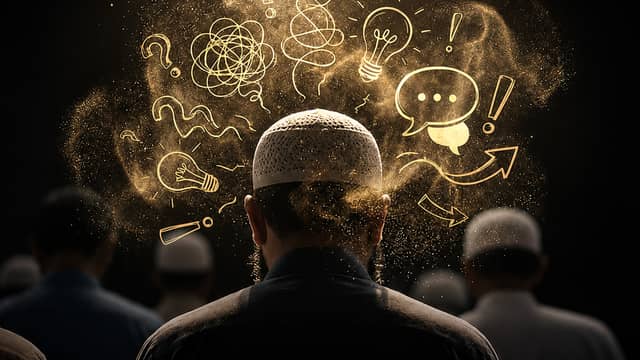
We are increasingly given opportunities to distract ourselves from our own mortality. Modern urban life and its technologies keep us eternally distracted from existential realities. Postman called this ‘amusing ourselves to death,’ likening entertainment’s effects to those of an existential drug. Our aversion to death can also be observed in its depiction in popular culture: horror and war movies have distorted, glamorized, and dehumanized death beyond recognition—making it lose all meaning. Modern Muslims are just as much products of their era as anyone else. For urban Muslims across the Western world, modernity has re-shaped our relationship with death, despite its spiritual significance in the Qur’an and Sunnah.
In fact, the theme of death is persistent in the Qur’an, serving to ‘ground’ the reality of our earthly presence, while acknowledging our trepidation with it. For example, Allah (swt) says, “The death that you are running from will inevitably come to you’’ (62:8). He also says, “And worship your Lord until there comes to you the certainty (death)” (15:99). So, we can already affirm an existential aversion to death; in some individuals more than others and, as I will describe later, in some eras more than others. But death constitutes our most solemn certainty in this life. These two Qur’anic themes of angst and (un)certainty will serve as ideal lenses to understand the impact ‘death’ can have on an individual.
Clinically, it is not difficult to conceive how death anxiety translates into individual pathology. For example, death anxiety has been found to be related to anxiety disorders, depression, obsessive-compulsive disorder, and eating disorders. Some psychologists thus argue that the subject of death supports a transdiagnostic approach; i.e., the need for a paradigm that replaces ‘syndromes’ (e.g., depression, anxiety, etc) with particular features common to many—fear of death being one such feature.
Considering the significance of death, let’s take the example of a Muslim young adult who (for the sake of reducing complexity) is neither grieving nor experiencing any significant financial or social pressures. This young adult admits to me a vague anxiety that has spiked since the corona pandemic and, upon further discussion, we broach the subject of death. The young adult also admits feeling trapped, unable to help the community like they usually would—their ability to be ‘the helper’ is severely frustrated. How can we make sense of this anxiety and how might it relate to their community activism? Here are several reflections to be had.
The first draws upon an understanding of anxiety which sees the ‘intolerance of uncertainty’ as central to its experience. In other words, the inability to tolerate the uncertainty of a situation—e.g., will I pass my exam?—is directly associated with confronting one’s lack of control. As a result, people who cannot tolerate uncertainty may compensate by trying to exert a higher degree of control (perfectionism) or by avoiding the situation altogether (procrastination). If all this is the case, then surely death is the ultimate symbol of uncertainty and loss of control. This Muslim young adult would then be incredibly averse to being isolated and confined against their will as is now the case due to the pandemic.
Incidentally, Yalom discusses exactly such a case: he describes a client who sought therapy for anxiety but who increasingly felt apprehensive when not given immediate tools to overcome his anxiety, which quickly revealed itself to be related to his thoughts about mortality. Eventually, this client dropped Yalom and sought a muscle-relaxation technique instead—to relieve the symptoms. While symptoms are important, the ultimate symbol of uncertainty, death, was simply unbearable for Yalom’s patient. The space to discuss death anxiety requires both the therapist and client to engage in a certain degree of depth and if the conditions don’t allow this (institutionally, or if the client only wants to alleviate their symptoms), this is what occurs.
Similarly, I have seen Muslims engage in self-help, which promises to help you shed your old, anxious skin and become something and someone much better—all under their own control. In psychodynamic therapy, we might explore the defense mechanisms that help an individual avoid attending to their death anxiety. Let me give an example that comes up often enough among Muslims: altruism. It is well-recognized that altruism, or acting in the service of others, is a very effective (as well as socially laudable) means of ‘forgetting about oneself.’ When someone’s ability to serve the community is thwarted—as it may be during this crisis—they begin to feel antsy sitting at home. The challenge then becomes to provide the space for the client to re-think their relationship with altruism but, more deeply, to consider how it might serve as an escape from death itself.
This might lead us down a road, paved most prominently in the modern age by Viktor Frankl, of providing space to consider the meaning of life and death itself. As Yalom reminds us again, “although the physicality of death destroys us, the idea of death saves us.” Herein lies the need to centralize death as a key symbol in our approach to suffering, especially during these times. It is very possible for Muslims to develop a (largely intellectual) relationship with Allah, without a recognition of their own mortality. And if the pandemic should serve as a reminder of Allah, as articulated by my colleagues in a recent article, they might remember Allah but avoid their own deaths. This is a sign of modernity.
The modern world and the erasure of death
Is death anxiety a uniquely human dilemma, similar across culture and time? Most likely not. It is not clear if earlier populations—for whom death was a central symbolic feature of their lives—experienced ‘death anxiety’ the same way, and transcultural research has come back to this claim.
Ibn Qayyim al-Jawzīyah (rA) for example, in observing a Muslim’s fear of death, relates it to being in a “state without repentance.” But then he immediately explains how this fear—associated with sin—ought to be followed by an experience of regret and, ultimately, repentance. I would argue, however, that Ibn Qayyim’s “fear of death” is not the same as the death anxiety I am speaking of here, where death serves as a particularly disturbing reality without its moral significance (“I may die a sinner”). It is the fear of fear, where fear itself is the problem. Arguably such death anxiety is perhaps very particular to our times, and so its clinical understanding is baseless without briefly addressing death in the modern world.
To begin, the modern Western world is established upon a principle: ‘history is progress.’ This principle suggests that history moves continuously towards technological, social, and moral improvements. According to Hallaq, this ideology has inculcated a common sense that celebrates the present and shuns the past—discarding centuries of traditions. But the technological present has very little to say about death whatsoever. This has been reflected even in Freud’s own thoughts on death, which he described as a state of “non-thinking,” reflecting his inability to give any meaning to it. This has led some prominent atheist philosophers such as Alain de Botton to reflect on the need to preserve European Christian rituals in matters of death—even without God. Furthermore, the technological and hyper-medicalized present also underscores a view of life as one that ought to be painless. As the process of dying is often associated with suffering, this intensifies the meaninglessness of death altogether.
The meaninglessness of death and its impression on Muslims cannot be disassociated from European colonization either. As Pandolfo relates, speaking on the spiritual impact of French colonization of Morocco, the consequence was ‘soul choking’; “when life shrinks, death is generalized to a banality that makes it unthinkable, and the divine message is no longer heard in the heart.” Furthermore, as the sociologist Bauman argues, the forces of globalization and capitalism have eroded social infrastructures across the Global North. We are no longer a ‘community’ but a ‘network of individuals’—there is no moral bind that holds us responsible for one another. It is important to underline the cosmic significance of this observation. As we can see during this pandemic, there is no moral glue binding us together besides charity work (which is often almost entirely reactive) and a stubborn reliance on our governments to make the ‘right decisions’ for us all.
Moving forward: Reflect upon death and our community
The Prophet ﷺ encouraged the visitation of graves, stating, “Visit graves, for it reminds one of one’s death.” But even while standing by a grave it is important to distinguish between recognizing the idea of death and confronting one’s own mortality. While the former is strictly intellectual, the latter bears heavily upon our fulfilled or wasted potential on this earth. To end on a forward-looking note, it is important to emphasize that it is never too late to contemplate our own death or to discuss it with our loved ones—as difficult as this might be. If the thought of death causes you dread, then know you’re not alone. I would argue this anxiety serves an existential purpose: as you confront death and all its dimensions—its earthly finality, its uncertainty—the ill-feeling serves as an embodied signal to return back to Allah. In other words, it is only by confronting the uncertainty of death that one can truly recognize that Allah is al-Bāṭin, the Knower of the Hidden, the One in Whom certainty is sought. Anxiety can thus serve as a spiritual compass towards Allah, but only if one faces it and recognizes its meanings.
If the thought of death remains difficult, I urge you to find someone to talk to about it, and I say this knowing full well how awkward and stigmatizing it may be for a Muslim to admit their fear of death. Surely, some might think the fear of death reflects a deficiency in faith. One might, for example, be recommended to read the Qur’an. However, it is important to raise a point of caution with such a recommendation: telling someone to ‘read the Qur’an’ may backfire, for if they remain anxious, then their relationship with the Qur’an might change for the worse. Rather, it is important to recognize the meaning of one’s anxiety—which in our discussion is death—and relate that to Allah through the Qur’an. In most cases then, it helps to seek support for the purposes of self-reflection on one’s anxiety, though the associated stigma of admitting one’s fear of death to others can be especially overwhelming. I hope, as I’ve made clear above, death anxiety is also very much a sign of our times, so if the thought of death is a cause of despair, this is not only normal, it is to be expected. In learning to reflect more upon our own death—not death as an abstract concept—we develop the greatest insights into the nature of this world. As the Prophet, peace and blessings be upon him, said, “Remember often the destroyer of pleasures”—by which he meant death.
Our reflections on death must also lead us to challenge the imagined status of Western Muslims as ‘middle-class’ with large and accessible family networks and stable incomes. In reality, many Muslims across the Global North are migrants and refugees, whose families and livelihoods are not blessed and privileged with the same sense of stability and security as others. For them, the fear of death poses very immediate concerns: what will happen to their children if they die? In the UK, for example, there is a lack of Muslim foster parents and many children often just go through the system. Perhaps then death anxiety should not only be understood as a personal trial, but also as a reflection of a community whose social fabric has weakened. We need to reinvigorate a sense of communion around death. No one should have to fear death out of the very legitimate fears they have regarding what will happen with their children. Death is a communal responsibility—the personal only brings this to light.
Notes
1. ^ Denis Campell, “UK Lockdown Causing ‘Serious Mental Illness in First-Time Patients,” Guardian, May 15, 2020, https://www.theguardian.com/society/2020/may/16/uk-lockdown-causing-serious-mental-illness-in-first-time-patients; Miranda Levy, “We Are a Sedated Society: The Rise in Antidepressants During Lockdown,” Telegraph, May 17, 2020, https://www.telegraph.co.uk/health-fitness/mind/sedated-society-rise-antidepressants-lockdown/.
2. ^ Irvin D. Yalom, Staring at the Sun: Overcoming the Dread of Death (London: Piatkus, 2012).
3. ^ Neil Postman, Amusing Ourselves to Death: Public Discourse in the Age of Show Business (London: Penguin, 2006).
4. ^ Lisa Iverach, Ross G. Menzies, and Rachel E. Menzies, “Death Anxiety and Its Role in Psychopathology: Reviewing the Status of a Transdiagnostic Construct,” Clinical Psychology Review 34, no. 7 (2014): 580–93, https://doi.org/10.1016/j.cpr.2014.09.002.
5. ^ Irvin D. Yalom, Existential Psychotherapy (New York: Basic Books, 1980).
6. ^ Viktor E. Frankl, Man’s Search for Meaning: The Classic Tribute to Hope from the Holocaust (London: Rider, 2008).
7. ^ Yalom, Staring at the Sun, 30.
8. ^ Pittu Laungani and William Young, eds., Death and Bereavement Across Cultures (London: Routledge, 1997).
9. ^ Ibn Qayyim al-Jawzīyah, Ranks of the Divine Seekers, trans. Ovamir Anjum (Leiden: Brill, 2020), https://doi.org/10.1163/9789004413412.
10. ^ Frank Furedi, Culture of Fear Revisited: Risk-Taking and the Morality of Low Expectation (London: Continuum International Publishing, 2007).
11. ^ Wael Hallaq, The Impossible State: Islam, Politics, and Modernity’s Moral Predicament (New York: Columbia University Press, 2014).
12. ^ Laungani and Young, Death and Bereavement.
13. ^ Raymond L. M. Lee, “Eternity Calling: Modernity and the Revival of Death and the Afterlife,” in Death Across Cultures: Death and Dying in Non-Western Cultures, ed. Helaine Selin and Robert M. Rakoff (Cham: Springer International Publishing, 2019), 369–84, https://doi.org/10.1007/978-3-030-18826-9_22.
14. ^ Alain de Botton, Religion for Atheists: A Non-Believer’s Guide to the Uses of Religion (London: Penguin, 2013).
15. ^ Stefania Pandolfo, Knot of the Soul: Madness, Psychoanalysis, Islam (Chicago: University of Chicago Press, 2018), 8.
16. ^ Zygmunt Bauman, Liquid Times: Living in an Age of Uncertainty (Cambridge: Polity, 2013).
17. ^ Ṣaḥīḥ Muslim, no. 976.
The COVID-19 pandemic has profoundly affected individuals worldwide, with many experiencing an increased proximity to death, stirring up profound existential anxieties. This reflection examines death anxiety, particularly within a Muslim context, exploring how modern therapeutic practices might fail to address this unique fear. It is essential to understand why death's spectral presence in our contemporary era necessitates mindful and spiritual contemplation rather than mere psychological coping mechanisms.
Death anxiety is an inherent dread linked to the anticipation of one's mortality. It is a fear that transcends simple psychological or psychiatric labels. The Qur'an frequently underscores the notion of death, urging Muslims to remain aware of life’s temporality. Yet, modernity, with its various distractions and technological advancements, has reshaped our relationship with death. It allows for continuous escapism from the confrontation with mortality, leading to a society more adept at "amusing ourselves to death," as Neil Postman described.
This contemporary aversion to death is starkly evident in its portrayal in media and cinema, which often glamorizes or dehumanizes death, stripping it of its profound significance. Muslims are equally influenced by these depictions, which detract from the spiritual understanding of death emphasized in Islamic teachings. The Qur'an addresses death's inevitability and advises worshiping Allah (Glorified and Exalted be He) until death arrives (Qur'an 15:99), integrating both angst and certainty regarding this natural and unavoidable phenomenon.
Irvin Yalom, a prominent psychiatrist, notes that death anxiety can appear overtly or subtly within individuals, revealing itself only upon deep introspection. Clinically, this fear intertwines with various mental health issues, such as anxiety disorders, depression, and obsessive-compulsive disorder. Psychologists argue for a transdiagnostic approach to these fears, indicating that fear of death may underlie multiple mental health syndromes.
Consider the example of a young Muslim adult experiencing heightened anxiety during the pandemic, lacking significant social or financial pressures. This individual's anxiety could escalate when their usual community activities are curtailed. This scenario underscores anxiety's core theme: intolerance of uncertainty and lack of control. Death, being the ultimate unknown, magnifies this discomfort, which can be temporarily mitigated by activities such as community service, but resurface sharply when such activities are constrained.
Yalom's exploration of a case involving a client who sought therapy for anxiety stemming from mortality thoughts is illustrative. The client's preference for symptom-alleviating techniques over addressing deep-seated fears points to a broader issue within modern therapy: a tendency to offer comfort without confronting the root existential dread. Such therapeutic practices might inadvertently sustain death anxiety by avoiding meaningful dialogues about mortality.
A similar pattern emerges within the Muslim community, where self-help narratives promise transformational personal control, often overlooking deeper existential fears. Altruism, for example, can serve as a noble yet avoidance-based mechanism, allowing individuals to escape their awareness of death by focusing on serving others. When such outlets are unavailable, as during the pandemic, underlying anxieties resurface.
Viktor Frankl's logotherapy, which centralizes the search for life's meaning, aligns closely with the need to reflect on death's significance genuinely. Death's contemplation can lead to a richer, more spiritually grounded life, acknowledging our earthly temporality while seeking solace in Allah’s certainty. As Yalom reminds us, “although the physicality of death destroys us, the idea of death saves us.”
The modern world's relationship with death profoundly impacts Muslims. Historically, death was a central theme in many cultures, framed within moral and spiritual contexts. In contrast, modernity, particularly within the Western narrative of continuous progress, marginalizes death as meaningless. Freud’s inability to conceptualize death as anything but a "non-thinking" state highlights this modern detachment. Furthermore, global crises and pandemics expose the erosion of social infrastructures, reducing communities to networks of isolated individuals reliant on governments for solutions, thus exacerbating existential anxieties.
Reflecting on the spiritual impact of colonialism, scholars like Pandolfo observe how colonization led to a moral and spiritual dislocation, making death an unthinkable banality. As sociologist Bauman notes, the forces of globalization and capitalism have further eroded communal bonds, emphasizing individualism over communal responsibility. The pandemic starkly reveals these frailties, demonstrating a lack of collective moral unity.
Moving forward, the Prophet Muhammad (peace and blessings be upon him) encouraged grave visitations to remind oneself of death, urging a deeper, personal confrontation with mortality rather than an intellectual acknowledgment. Recognizing death’s reality can guide individuals back to Allah, aligning anxiety with spiritual purpose. Opening dialogues about death within supportive environments can mitigate its dread, emphasizing that such fears are natural and historically contextualized within modern life's framework.
Community reflection on death should go beyond personal anxieties to address communal responsibilities. The socioeconomic realities of many Muslims in the Global North, such as migrants and refugees, underscore the need for communal support systems. Ensuring children’s welfare after a parent's death is a communal responsibility, highlighting the necessity of strengthening social fabrics around death.
In conclusion, reflecting on death within the Muslim community during this pandemic goes beyond individual coping strategies. It involves recognizing the complex interplay of modernity, spirituality, and communal bonds. By confronting death anxiety, Muslims can deepen their spiritual connection and foster a more cohesive and supportive community, ultimately adhering to the prophetic tradition of remembering the “destroyer of pleasures”—death.
This summary is auto-generated.
Rate this summary:
Cite this paper
Younis, T. (2020). Facing Our Fear: Reflecting on Modern Society's Death Anxiety. Yaqeen Institute for Islamic Research.
Feedback
We'd love to hear your thoughts on this unit!
Related