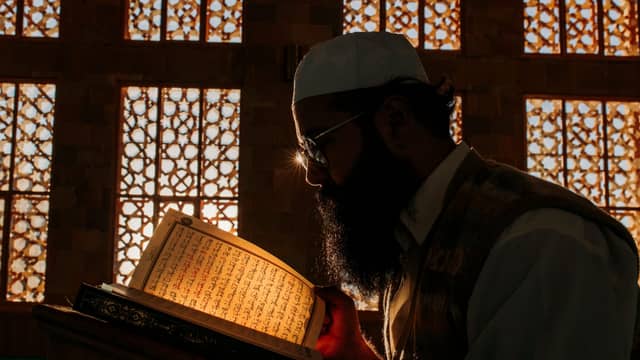
To Allah belong the most beautiful names, and He has instructed us to call upon Him through them, as He says: "To Allah belong the best names, so call upon Him with them." This calling encompasses both supplication in the specific sense and worship in the broader sense, for the word duʿa in the Qur'an bears both meanings according to context. To call upon Allah through His names is not merely to invoke them with the tongue, but to embody their meanings and to live in the light of the knowledge they impart. Worshipping Allah through His name al-Rahim, for instance, entails showing mercy to creation, as the Prophet ﷺ said: "The merciful will be shown mercy by the Most Merciful. Be merciful to those on the earth, and the One in the heavens will have mercy upon you." The Prophet ﷺ also taught that Allah possesses ninety-nine names, and "whoever preserves them will enter Paradise"—and this preservation is not merely memorization but comprehension and application.
Knowing Allah's names therefore demands understanding, not rote recitation alone. As al-Razi observed, "Supplicating to Allah with His names is not possible unless one knows the meanings of the names." Each name carries a distinct meaning, even where meanings overlap, allowing every servant—regardless of circumstance or emotional state—to draw near to Allah in a manner suited to their need. Yet the linguistic definition of a name is only the foundation, not the totality, of this knowledge. Just as one cannot cultivate a deep relationship with a person on the basis of a single line of description, so too must the servant progress from definition to experiential knowledge (maʿrifa). Al-Ghazali, in agreement with many scholars, declared: "The science of highest nobility is the experiential knowledge of Allah Almighty, for all other branches of knowledge are sought for its sake, while it is not sought for anything else."
The Qur'an itself provides the means for this deeper knowledge, for every word within it is deliberately placed to guide us to Allah. The verses contextualize His names, situate them in relation to one another, and reveal how they manifest in our lives. Among the notable features of the Qur'an is the pairing of names (muqtarina) at the conclusion of verses, as well as the particular sequence in which they appear—both of which contain divine wisdom and an intimate awareness of human psychology. This attentiveness is necessary because human language and imagination are bounded by lived experience. The word "king" may evoke a tyrant to one person and a just ruler to another; the quality of "mercy" may strike one as weakness and another as strength. The danger arises when we inadvertently impose these human limits upon Allah's attributes. The pairing of names guards against such anthropomorphism, affirming that Allah is al-Quddus—the Holy, free from every blemish and infinitely beyond human inadequacy.
The conclusions of verses, termed al-fawasil, carry significance both in eloquence and in meaning. Al-Zarkashi defined the rhetorical period (fasila) as "the final word of a verse, like the rhyme in poetry or the paired word in rhymed prose." Al-Qurtubi noted that these endings beautify rhythmic speech, without which "one could not distinguish verse from prose," warning that failing to pause upon them diminishes the recitation. Ibn ʿAshur likewise observed that pausing at them moves the souls of listeners through the beauty of their symmetry. Beyond eloquence, these endings bring clarity to the entire verse. In Surah Hud, when the people of Shuʿayb mockingly called him "such a tolerant (halim), sensible (rashid) man," the verse first mentioned their worship and then their management of wealth; the concluding pairing mirrors this, for hilm complements worship (obligatory upon reaching puberty) and rushd complements the proper handling of wealth. Such congruence is extracted only through contemplation of both the words and their arrangement.
The pairing of Allah's names opens new dimensions in the servant's relationship with his Lord. First, complementary names illuminate the expansive scope of their meanings, as "al-Ghafur al-Rahim" (recurring seventy-one times) and "al-Samiʿ al-Basir" (recurring forty-five times) demonstrate that Allah not only forgives but shows mercy, not only hears but sees. Second, pairings preempt doubts that may arise in our minds. His name al-ʿAziz is joined with al-Hakim, assuring us that His might is never hasty or transgressing but always exercised with perfect wisdom. In Surah al-Shuʿaraʾ, al-ʿAziz is coupled with al-Rahim; al-Tabari explained that none can escape His power once He decrees punishment, yet He is merciful to those who repent. Al-Razi noted that the Almighty is mentioned first to dispel any notion that Allah shows mercy to rebels merely out of inability to punish them—rather, He is All-Powerful yet chooses mercy.
The pairing of names also clarifies the completeness of Allah's love and forgiveness. Whereas a human being may forgive without affection, Allah declares Himself "the Forgiving (al-Ghafur), the Affectionate (al-Wadud)." Wudd is a tender love expressed without need or dependence upon creation. He further says: "Ask forgiveness of your Lord and then repent to Him. Indeed, my Lord is Merciful (Rahim) and Affectionate (Wadud)"—reassuring the repentant that Allah returns to loving them, for He loves those who repent (Qur'an 2:222). Unlike some destructive human love that spoils and harms, Allah's mercy always brings genuine benefit and wards off harm, in this life and the next. Similarly, the name al-Shakur (the Appreciative) reassures us that Allah values even the smallest good. The Prophet ﷺ said, "Do not belittle any good deed, even meeting your brother with a cheerful face." Allah declares Himself "Forgiving and Appreciative," forgiving even the gravest sin—shirk—upon repentance, and rewarding the humblest deed. The Prophet ﷺ related the account of a woman forgiven for giving water to a thirsty dog, the man forgiven for removing a thorny branch, and the man granted Paradise for cutting down a tree that harmed passersby—deeds unseen by people but known to al-Shakur, al-ʿAlim.
The sequence of the paired names likewise carries divine wisdom. In Surah al-Aʿraf, upon the command to seek refuge from Satan, Allah is described as "All-Hearing and All-Knowing." Al-Razi explained that He hears our spoken refuge, while al-ʿAlim reminds us that the tongue alone is insufficient—the heart must be present. Al-Saʿdi added that Allah knows our weakness and the sincerity of our recourse, and so protects us. The pairing al-ʿAlim al-Hakim appears in one order in some verses and reversed in others, according to context. When the angels questioned the creation of humankind, Allah responded, "Indeed, I know that which you do not know," and after teaching Adam the names, the angels acknowledged, "It is You who is the Knowing, the Wise"—the order emphasizing His encompassing knowledge which they had implicitly questioned, and affirming that Adam's creation was purposeful. In Surah al-Dhariyat, when the angels foretold a child to Abraham despite his wife's barrenness, they said, "He is the Wise, the Knowing"—placing wisdom first to affirm that this was no error but a purposeful decree, followed by knowledge that encompassed even her infertility.
A sustained example appears in three consecutive verses of Surah al-Hujurat. The first prohibits suspicion, spying, and backbiting, likening backbiting to eating the flesh of one's dead brother, then closing with al-Tawwab al-Rahim—offering hope to those who fall into these subtle sins that Allah accepts their return and shows mercy in totality. The second addresses all humanity, affirming common origin and declaring that nobility lies in taqwa, not lineage, concluding with al-ʿAlim al-Khabir—the One who knows the outward and the hidden, and thus discerns true God-consciousness from mere outward nobility. The third rebuffs the nomadic Arabs who claimed belief, instructing them to say "we have submitted," for faith had not yet entered their hearts, and concludes with al-Ghafur al-Rahim—al-Rahim following al-Ghafur because mercy is the root of forgiveness, being broader than it.
Thus understanding the Qur'an requires contemplation, for it is guidance, light, mercy, and healing. Whoever immerses himself in knowing Allah through His words is, as has been said, "in an expedited Paradise before the Paradise of the Hereafter." Upon encountering each pairing, the servant should ask why these particular names appear in this particular order at this particular place, and how he may draw nearer to Allah through such knowledge—for every word of the Qur'an has been given its best place to clarify reality and guide us to Him.