Signs of the Hour
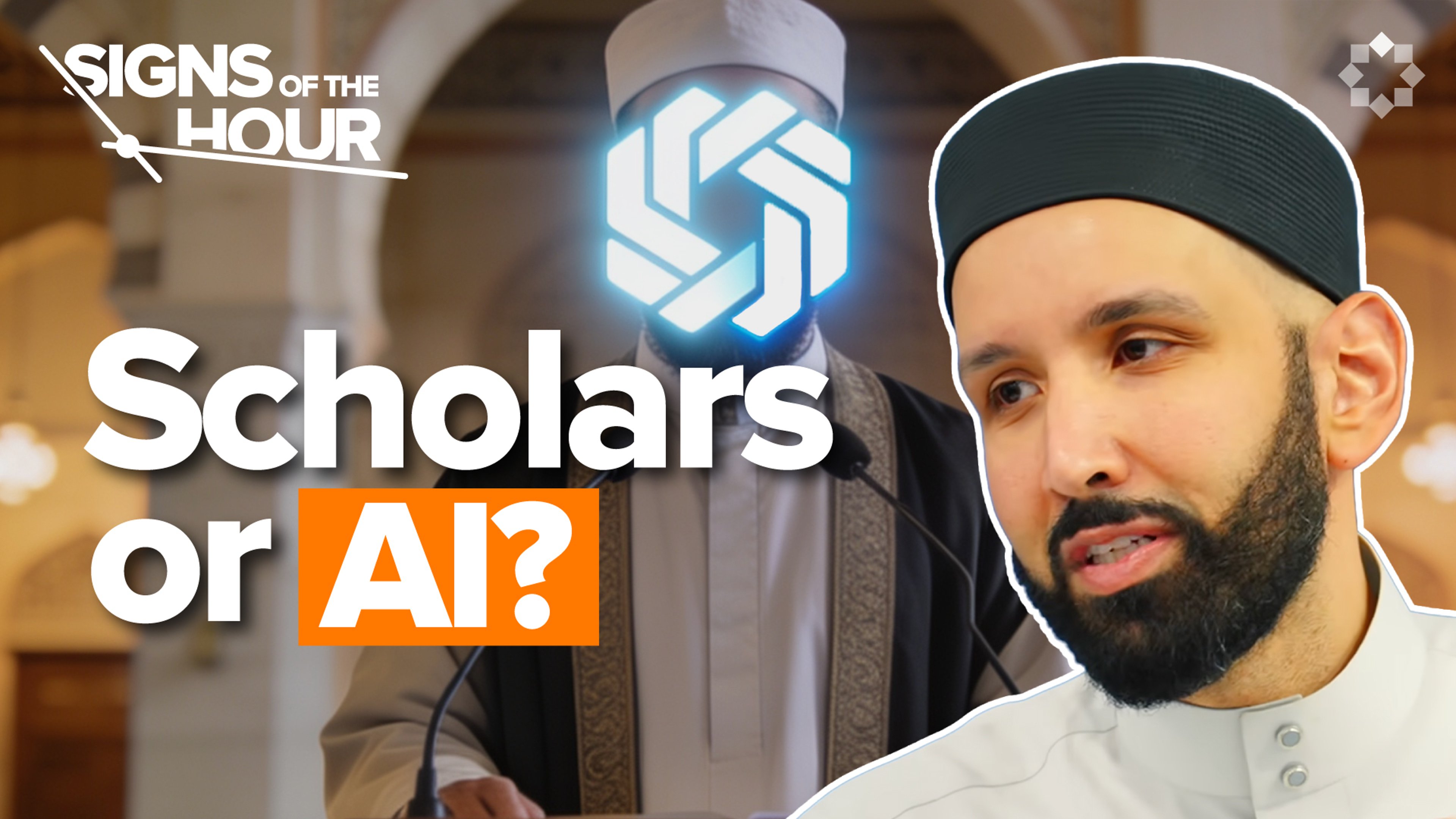
When AI Replaces Your Imams | Signs of the Hour Ep. 9
The Prophet ﷺ gave us a chilling warning: a time is coming when knowledge will quietly vanish, leaving ignorance in its wake.
And where knowledge fades, chaos and immorality will thrive. Are we already living in this era?
Learn why protecting sacred knowledge, and the scholars who carry it, is our final line of defense.
This transcript was auto-generated using AI and may contain misspellings.
00:00Are we appreciating our local scholars and imams in our communities or are we belittling them and degrading them because they don't offer anything of that dunya that we value to us? This is the most consequential sign of the minor signs of the Day of Judgment and it's actually the quietest one.
00:14Allah does not press delete and everyone forgets the Qur'an or forgets the sunnah or forgets this deen. He takes it from them by taking away the scholars.
00:22Scholars who are memorizers of not just the Qur'an but six books of hadith that have fiqh, that have understanding, that are incredible libraries with a heartbeat. But the ulama die quietly and one by one they start to disappear.
00:37You've probably witnessed the last generation of students of knowledge and scholars that are not going to be AI-dependent or were not AI-dependent in their learning journey, which is a very scary thought.
00:47Be a scholar, be a student of knowledge, be a follower or be someone who loves the scholars but do not be of the fiqh or you will be destroyed.
01:01Insha'Allah ta'ala we will continue now in the signs of the hour. I'm not feeling the greatest so I'll see if I can pull all the way to the end bi-idhnillah ta'ala but even if not then insha'Allah we'll finish up a good chunk of this next part of the section.
01:16Which really will take us into the next three or four halaqas where the Prophet ﷺ is now moving us in a post-Sahaba world, a post-companions world.
01:30And I want to take you back to a few lectures ago where the Prophet ﷺ gave us this portrait of the sky.
01:37And just let's start from that place where the Messenger of Allah ﷺ mentioned that the stars are a sign of the security of the sky and so once the stars go what was promised to the sky will come to it.
01:52And I am a source of protection for my companions.
01:58So once I go ﷺ then what was promised to my companions will come to them and my companions are amanah.
02:07They are a source of security and safety for the ummah and so when they go what was promised to my ummah will come to it.
02:15And so all of these stars in terms of the prophets and then those that directly interacted with the Prophet ﷺ have now left this world.
02:26And so what you have now is the transmission of knowledge and you have to hold on to the transmission of knowledge otherwise everything falls apart. And it's extremely important to start from this place. Why?
02:41Because the Prophet ﷺ gives us a few premises for how we look at collapse in society.
02:50The very first one that we take from a historical perspective is we go back to the era of Jahiliyyah.
02:57The era of ignorance because the time that resembles the end most is the time right before the coming of the Prophet ﷺ. That is the time that resembles akhir az-zaman most, right?
03:09And so you ask yourself did they lose their scriptures overnight? Did they lose their text overnight? Allah revealed not one scripture to them, multiple scriptures to them.
03:23Multiple prophets, multiple written scriptures. Did they lose that knowledge overnight? Like how did they manage to lose that?
03:30And Allah gives us the process and there are multiple roles in society that were played in order for that to happen.
03:38Undoubtedly there are those that were malicious, that purposely hid or distorted.
03:45But there are those who were also too careless to ask whether or not there was distortion that was taking place in the first place. And so you have a dual role here.
03:55You have those that immediately and intensely sought to distort the scripture, right? And then you have, وَمِنْهُمْ أُمِّيُّونَ لَا يَعْلَمُونَ الْكِتَابَ إِلَّا أَمَانِي
04:06You have the illiterates amongst the people that just went with the flow because they didn't care enough about the religion to preserve it. And so you have a dual function of misguidance that's taking place here.
04:17Now undoubtedly there is then where the text is known by a critical mass. But what happens? Is the text lost first or is the meaning of the text lost? The meaning is lost, right?
04:31So first the meaning is distorted and then the text is lost. Both of them are done by the same actors that Allah Subhanahu wa ta'ala mentions to us in the Qur'an,
04:42which are the scholars who intentionally manipulate and hide, right? مَثَلُ الَّذِينَ حُمِّلُوا التَّوْرَاة Right? Those who came before you who were entrusted with the Torah and they did not carry it properly.
04:56كَمَثَلِ الْحِمَارِ يَحْمِلُ أَسْفَار Were like donkeys that were carrying books on their backs. The books were there but there was no internalizing of the knowledge. And so the knowledge itself was weaponized in society.
05:09It was intentionally distorted in society and society itself went along with it. And so moral collapse happens after the loss of guidance. Why do I mention this here?
05:20Because I'm trying to follow the scheme that the Prophet ﷺ gave to us at the end of times. And we talk about all these violent signs.
05:33The Prophet ﷺ actually starts with the loss of righteous people. And a very specific class of righteous people, qabda al-'ulama' The loss of scholars which also means the loss of scholarship.
05:46And this actually makes us different as Muslims. That we believe that loss of guidance precedes loss of morality and loss of humanity. And that there is no way to actually maintain a proper standard of morality
05:58and a proper standard of humanity without the presence of guidance. And there are carriers of guidance. Now there's something else to talk about here that when Allah ﷻ talks about ulul-amr
06:12Those who are entrusted amongst you. That can have a spiritual dimension or it can have a political dimension. Likewise you'll find many hadith where the Prophet ﷺ mentions leaders. And it can mean either spiritual or political or both.
06:24Sometimes it carries both meanings. But it's important for you to know that because when you hear the word imam What do you think of? You think of someone that leads the prayer. You think of someone that teaches you the religion.
06:38And plays a spiritual function in your life. Some of those hadith where the Prophet ﷺ mentions the word imam He's talking about it exclusively from a political dimension. Right? So when you hear the term leader and especially this gets lost in translation.
06:51Ironically we're talking about how things get lost here. Meanings get lost. When you hear the term leader from an ayah or from a hadith Especially in a translation it's important for you to know
07:03That it can carry a spiritual function, a political function and sometimes both. So for example when Allah ﷻ mentions يَا أَيُّهَا الَّذِينَ آمَنُوا أَطِيعُوا اللَّهَ وَأَطِيعُوا الرَّسُولَ وَأُولِي الْأَمْرِ مِنكُمْ
07:14O you who believe, obey Allah, obey the Messenger ﷺ And those who are entrusted with the affair amongst you. Okay?
07:28The ulama of tafsir will mention here that ulul-amr here means your political leaders and your scholars. Your religious leaders. Because they both hold authority amongst you. And so what that means is that when you disagree amongst yourselves
07:41About something that is related to ilm, related to knowledge You don't figure it out on your own. There are established scholarly authorities That are supposed to be able to guide that process for you.
07:52Right? Likewise when it comes to political stability Yes, there is a preference in Islam for a stability That does not tolerate oppression and injustice. And finding that balance is something that Allah ﷻ calls us to constantly.
08:06In the Qur'an and the Messenger of Allah ﷺ calls us to constantly in the sunnah. But notice here in the verse, the ulama of tafsir will mention أَطِيعُوا اللَّهَ وَأَطِيعُوا الرَّسُولَ
08:20Allah ﷻ mentions Ati'u obey Allah, obey the Rasul And he does not repeat ati'u when he speaks to ulul-amr minkum Those who are entrusted with authority amongst you. The scholars interpreted that in a few ways.
08:33There are benefits here. Some of them said well that's because ulul-amr are speaking like The Prophet ﷺ إِنَّ الْعُلَمَاءَ وَرَثَةُ الْأَنْبِيَاء Which we'll talk about. The scholars are the inheritors of the prophets.
08:47So technically speaking, the scholars should be speaking In accordance with the vein of What has been commanded by Allah and the Messenger ﷺ And so they're being lumped in. Either in the political sense or in the scholarly sense
09:01With the Prophet ﷺ in this regard Because they are supposed to be ambassadors of the Messenger of Allah ﷺ The scholars are supposed to take what the Prophet ﷺ handed down And give it in a way that's digestible
09:14And that's clear and coherent And does not depart from guidance. Some of them said no, actually what it means here Is that following ulul-amr has conditions. It's conditional. Whereas obeying Allah and the Messenger ﷺ is unconditional.
09:27And they point to the next part of the ayah فَإِنْ تَنَازَعْتُمْ فِي شَيْء فَرُدُّوهُ إِلَى اللَّهِ وَالرَّسُول And then who else? No one, exactly.
09:40إِنْ كُنْتُمْ تُؤْمِنُونَ بِاللَّهِ Until the end of the ayah. So if you disagree then, if you dispute amongst yourselves Then go back to Allah and the Messenger ﷺ And ulul-amr is missing here. Those who are entrusted amongst you is missing here.
09:53So again, there are ways to look at this ayah. So again, there are ways to look at this ayah. One way to look at this ayah is well if the dispute is with someone who's in authority himself then there's a process that has to be worked out there
10:05and you go back to Allah and the Messenger ﷺ But certainly what we can take from this ayah at the end of the day is that there is a limit to human authority
10:15The Messenger of Allah ﷺ only spoke what was divinely inspired وَمَا يَنطِقُ عَنِ الْهَوَى and he was an extension ﷺ of divine authority because he was divinely appointed.
10:29After him ﷺ you have people that make their best effort and you have to have a culture and a community that keeps that effort honest because if the culture and the community
10:42permits either by complacency or by itself being corrupt and wanting corruption then a class will come in of that scholarly layer that will represent that corruption. Right?
10:55So it is a whole society that's moving in a direction You don't simply say that the 'ulama are so corrupt and they're this and they're that It's just how people complain about the political authorities
11:08and in many cases you complain about the corruption of the political authorities but if you were in that person's position you'd do the exact same thing you'd be just as corrupt You're just mad that he got there first Right? Or he has the ability to do that
11:20So there are societal currents or undercurrents that work in parallel with the loss of scholarship Right? Another thing that's important here and why I put it here is that
11:34which one is more dangerous? The loss of spiritual authority or the loss of political authority? Spiritual authority Why? Because if you die with your deen oppressed and you did not relinquish your deen
11:47Alhamdulillah you died a shaheed you died a martyr Right? If you look at Ashab al-Ukhdud they're a model of success the people of the ditch because they held on to their deen
12:01They didn't have any political authority they were not in a position of power but they did not relinquish their spiritual clarity and so spiritual clarity is more important than political power On the other hand if you achieve power and political authority
12:15but you lose your spiritual clarity and you lose your spiritual authority then that could actually be a testament against you on the day of judgment and actually lead to your destruction And so when Sufyan says
12:28two groups of people if they are righteous the whole ummah is righteous and if they are corrupt the whole ummah is corrupt Who are they?
12:40He said the rulers and the scholars If these two are righteous then there is a downstream effect and sometimes society ushers righteousness onto those classes
12:51It's actually not a perfect yin-yang type of deal here Right? It's not a perfect dichotomy Okay? Sometimes you have 'Umar ibn 'Abd al-'Aziz rahimahullāh figure that comes in
13:04and he puts righteous scholars that exist amongst the people in their place and he rules with righteous authority and the whole society transforms That righteousness has a downstream effect and then sometimes the people turn back to Allah subhanahu wa ta'ala
13:18and they are disgusted by wickedness they are disgusted by the lack of righteousness and Allah 'azza wa jall rewards that stream with something that represents it at the authoritative level
13:31But we can agree that what's worse is losing the scholars and losing the spiritual authority And this is how the Prophet salallahu alayhi wasallam responded to this question and it is incredible
13:45When the Prophet salallahu alayhi wasallam would be asked about the signs of the day of judgment his most frequent go-to alayhi salatu wasallam was when al-amanah is lost when trust is lost
13:58Now when you hear when al-amanah is lost you might think of a certain thing Right? But let's look at how the Prophet salallahu alayhi wasallam broke that down because when the Messenger of Allah salallahu alayhi wasallam was asked well how does that look ya Rasulullah
14:12and he mentioned people are put in positions of authority that don't belong there Right? People that are undeserving are put in that place Now in some narrations he stopped there salallahu alayhi wasallam
14:25In some narrations he continued and he said su'ilu and they will be asked iftā bi-ghayri 'ilm and they will give fatwa without knowledge faḍallū wa aḍallū and so they are misguided and misguiding
14:39And so that's the spiritual authority Right? The loss of the amanah is the spiritual loss and the political loss So your political leaders are corrupt that's one dimension of the loss of the trust because the Prophet salallahu alayhi wasallam
14:52left behind a trust an amanah of how to steward this ummah and how to see it through and so when those that are placed in positions of authority don't steward properly they've lost the amanah And so when the Prophet salallahu alayhi wasallam
15:05said to Abu Dharr radiallahu ta'ala anhu about leadership that it is amanah innaha amanah that it is a trust and it is on the day of judgment it is on the day of judgment
15:19a source of regret and humiliation if a person didn't do right by it That's one form of amanah but the greater trust is the Qur'an is the Sunnah Is this beautiful tradition that we have That can inspire our ummah
15:33Through triumph and trial That can inspire us And how to act when we're oppressed And how to act when We take the reins from our oppressors Because Because the days will switch back and forth
15:47Until the final day Right The last days will be days of victory For the Muslims but the days will switch So it's the clear guidance in that regard So he taught us Salallahu alayhi wa sallam
16:01This methodology And here's the thing That he mentioned in terms of the order of collapse And this is what I was thinking about Subhanallah in terms of Last week and what we were talking about With natural disasters
16:21It's not like Allah
16:21takes away the knowledge by ripping it away from the people. Allah does not press delete and everyone forgets the Qur'an or forgets the Sunnah or forgets this deen. But he said, Salallahu alayhi wa sallam, He takes it from them by taking away the scholars, By the death of the scholars. Here's what I want you to pay attention to. This is the most consequential sign of the minor signs of the Day of Judgment. And it's actually the quietest one.
16:52It's very quiet, right? If you think about earthquakes and you think about the things that we talked about in terms of all these disasters And these intense signs that are happening
17:04The death of a scholar kind of goes without much fanfare, much regard It shows up on your newsfeed for half a day If you even know who that person is
17:17But the decline of the interest and seriousness of the general community for that 'ilm means the disregard of the 'ulema So they can't even distinguish who those 'ulema are Was it a person with a lot of followers online?
17:31Because that 'alim was an influencer too And I don't say that to be derogatory because there are some people who are 'ulema that have a lot of followers But I'm saying, is that the judge?
17:43Oh no, this person who had so much, so well known, died But because the community stops recognizing what 'ilm is They stop recognizing who an 'alim is
17:55And so scholars who are memorizers of not just the Qur'an But six books of hadith that have the glorious chain of sanad and isnad That have fiqh, that have understanding
18:08That are incredible libraries with a heartbeat They die and you go, if you see it, I don't know who that is It's not that important Then somebody passes away And I hate to say this because it feels like shaming
18:22But it's a collective shaming and I include myself in the shaming Someone passes away that's of influence for all the wrong reasons Inshallah they died Muslim, I'm so sad Heartbroken
18:35And everyone is attached Why? I'm not saying that we should have apathy No, we care about human life and generally if you're more exposed to someone's life Then maybe you have more of a human connection to that person
18:49That's human But 'ulema die quietly And one by one they start to disappear And now you start to see the turning of the page
19:02How? You know when they say this is the last generation of doctors That aren't using ChatGPT when they do your surgeries
19:12You've probably witnessed the last generation of students of knowledge and scholars That are not going to be AI dependent Or were not AI dependent in their learning journey Which is a very scary thought
19:25Because we joke about will AI replace imams? It doesn't have to physically replace the imam It could also just be that the khutbah is entirely written off of a prompt
19:35And that becoming a scholar or becoming an imam A leader in the community is entirely based on How well you can prompt and how well you can prep And how well you can preach And absolutely nothing on knowledge
19:48And when the community can no longer with baseline literacy Hold that accountable Then that's going to be encouraged And it's going to keep going This is a very scary thought Because you think about seminaries
20:01And I remember subhanallah The way that we would be humbled By those who taught us Like oh you guys have your laptops And you can type this all up and save it We had to write this stuff in our notes And sometimes we didn't have ink
20:15And we thought Like we got Google now We got Maktaba ash-Shamilah We can search things up quickly I could put together a great halaqah By finding the hadith with its takhreej And finding if it's authentic or not
20:29If it's weak, what degree of weakness is there Whether it's acceptable to use as supporting evidence And what this scholar said about it so quick And the scholars that came before The students of knowledge that came before Their rigor was so much more To where you could argue
20:43Just by basis of the technology itself That who was considered a student A mere student A hundred years ago A good student of knowledge Would surpass the highest caliber of scholars
20:57In the generation after them Because of the ease of the tools And naturally we're going to use those tools Right To try to collect Now that student of knowledge Might have had more weak hadith
21:11In their writings Fine But the depth of their knowledge Would have certainly been greater Because of what would have to be done In order to actually acquire That knowledge
21:25And so the Prophet salallahu alayhi wa sallam Talks about this quiet Right, loss of scholarship Amongst the community Where the scholars start to pass away The books don't disappear The Qur'an is more accessible than ever
21:39You have books of hadith You have more information, more literacy than ever But the Prophet salallahu alayhi wa sallam Mentions That knowledge is removed Not from paper But it's removed from people
21:53Because people are the carriers of knowledge The same reason why Allah 'azza wa jall Did not answer the objection Or to the objection of the people Why didn't he just send an angel to teach the people But he sent Prophets, he sent human beings That taught and embodied that message
22:07And served as examples So the hadith can remain But the meaning is lost The books can remain but the meaning is lost The information remains The information remains But those that can properly interpret the information
22:21And process it are gone And that's when the Prophet, sallallaahu 'alayhi wa sallam, said Until there is a point where you don't have There is no scholar left on the face of the earth May Allah protect us So every generation
22:35The righteous decline In the general sense Worshippers decline Righteous people decline There is khair in every ummah In every generation of the ummah But as righteousness declines
22:49Religious knowledge declines People of religious knowledge decline Now in the meantime Do people stop asking questions? No Do people stop looking for some sort of information? No
23:03But with that The Prophet, sallallaahu 'alayhi wa sallam, mentions a vacuum that gets filled By people that don't deserve to fill that vacuum So he mentions People take ignorant people As leaders
23:17Right And those leaders Are people who tend to be public voices They tend to be people who have no problem Answering quickly And that's one of the things the Prophet, sallallaahu 'alayhi wa sallam, is condemning here
23:31That they are asked And they give verdicts without knowledge And so they go astray And they lead others astray as well Alright, let's go through this, insha'Allah How do we protect ourselves As a group of scholars, I actually was really thinking about
23:45How can we make this practical as we look through The way that the Prophet, sallallaahu 'alayhi wa sallam, talked about the disappearance of knowledge At the end of time Number one: When the Prophet, sallallaahu 'alayhi wa sallam, mentioned That the scholars are
23:59The inheritors of the Prophets And Allah 'azza wa jall says That verily those who fear Allah, subhanahu wa ta'ala, truly are the scholars Allah 'azza wa jall And the messenger of Allah, sallallaahu 'alayhi wa sallam, has been defining the scholars by
24:13The qualities of their fear And awe of Allah, subhanahu wa ta'ala, And their inheritance of the mission Their inheritance of the mission Of the Prophet, sallallaahu 'alayhi wa sallam And so knowledge without khashya Is a cancer
24:27Knowledge without humility Knowledge without fear of Allah, subhanahu wa ta'ala, Can become a weapon Right, and that's why Some of the 'ulama would describe it It's like giving a dagger to a thief Right
24:41Knowledge without khashya can become a performance It can become riya And that's the example of Putting jewelry on a pig Right Knowledge without khashya Can actually become a means
24:55By which you enter into hellfire When the Prophet, sallallaahu 'alayhi wa sallam, mentioned That whoever takes the path Of knowledge Salaka tariq That person took a path of knowledge Someone that actually dedicates
25:09Themselves to a system of knowledge This could be a means of Posturing in your social gathering Or posturing in your digital social gathering But it's a means of posturing Right Or to shame
25:23Someone who is ignorant To shame, to put someone down Then it becomes a place of kibr Right, pride Or to argue with the scholars To argue with people that are actual 'ulama Right
25:37I don't like what you're saying You don't know what you're talking about Let me get this ChatGPT right quick Get my prompt No, but there's a hadith that says this, this and this You don't know what you're talking about Putting people down
25:51So you're either using it for riya Or you're using it for kibr Or you're using it for 'ujb And the Prophet, sallallaahu 'alayhi wa sallam, is mentioning to us that that person Will enter into hellfire So what was meant to be a path to Paradise
26:05Becomes a path to hellfire instead It doesn't define scholarship by what you know It actually defines scholarship By how much you internalize The same way that the Qur'an speaks of divine revelation Because 'ilm is the carrying of revelation And it is
26:19The transmission of revelation And what is derived from revelation Right And so the minute that you depart from that internally Then the exterior becomes as superficial As the world around you And that can become a means by which you use
26:33Things for the wrong purposes Alright The next thing that we mentioned here I don't know if I was on number two or number three But the importance of saying I don't know Why would you say
26:47I don't know Now by the way, you know who's never going to tell you I don't know Your AI is never going to say And that can become a means by which you use Things for the wrong purposes Alright
27:01The next thing that we mentioned here I don't know if I was on number 2 or number 3 But the importance of saying I don't know Why would you say I don't know Now by the way, you know who's never going to tell you
27:15I don't know Your AI is never going to say I don't know Could you ever imagine your AI saying I don't know And Allah knows best Why won't your AI say no to you
27:29Why will it not say I don't know Because you live in a consumer world And so You're telling it what to give you And it's going to give you What you want to hear And it's going to package it in a way that you think you want to hear it
27:43It's not going to say I don't know AI is not going to know intellectual humility Right And on the back end, the prompts will be revised To make sure that it's more refined And it doesn't make as many sloppy mistakes Now
27:57For you as a person What's the hesitation Of saying I don't know When you're in a conversation and there's a discussion about religion There's a discussion about deen Why would you hesitate Why would you not want to say I don't know
28:13Let's have a conversation You guys are like I don't know Why would you not want to say I don't know Because it will make you look like you're weak It will make you look like you don't know any better Oh you don't know the religion It puts you down
28:27Right And that's why Imam Malik Someone travelled from a far distance He asked him 40 questions He said la adri to 36 of them I don't know This is the Imam of Dar al-Hijrah
28:41The Imam of Medina Imam Malik And he said I don't know for 36 And he only gave the answer to 4 Someone came to him from far away And he said I don't know And the man said Abdullah ibn Umar doesn't know
28:55Like what's wrong with you Right What will I say to the people Say to them you asked Abdullah ibn Umar And Abdullah ibn Umar says he doesn't know It's okay This is the opposite of riyaa'
29:09Because it's the fear of the amanah It's the fear of the trust of this knowledge That you don't want to get it wrong for someone else Now what does that look like You might not be a scholar but you might be perceived As the most religious person in the gathering Or the most religious person in your family
29:23And your friends naturally look to you Oh you're the sheikh, you're the sheikh in this group Hey is this halal, is this haram And you feel pressure like I need to answer this Or else people are going to say I don't know what I'm talking about That's going to make me look lowly
29:37But the amanah, the trust of this knowledge Will hold you back Abu Bakr al-Siddiq said What sky will shade me What sky will shade me When you're talking about the Book of Allah What is not true
29:51So your fear of Allah Your khashyah will hold you back From speaking about the religion In a way that you don't know And so there's the importance of intellectual humility To admit you don't know to other people And also to be okay
30:05With not knowing for yourself sometimes Okay Also not to quickly Try to find an answer So that you can sound smart When you give it Also it's important here
30:19That a person Does not validate Something that they don't know Should be validated or not Okay and I'll talk about this insha'Allah ta'ala a bit Number four When the Prophet, peace and blessings be upon him
30:33Talks about the increase It's one of the most fascinating ahadith in this regard The increase of literacy Paralleling the decline of knowledge Okay So this is what he said So one narration he said
30:47That before the hour Giving salam only to people That you know Then he said
31:01The widespread The widespread trade So people really get into trade And business and everyone starts to Compete over money Until a woman
31:15Would feel compelled to have to support Her husband and get involved in trade as well In business as well So this is the idea of Two income households Become the norm because that's how you keep up Everyone has to get into this
31:29So the whole family has to be a part of Right then he said And the severing of Family ties And the false Testimony
31:45And the concealing of true testimony Then he said And the spread of the pen Now the spread of the pen Is in another narration
31:59It also says the spread of the pen The pen Is not the pen As in the physical instrument of the pen In the Arabic language As you'll find That the ulama mention about this
32:13That the pen is The increase of writing Of what is written And the increase of those who write And it was understood Even back then
32:27That what the Prophet Was talking about here was Plenty of information, the spread of information And so the pen is your keyboard Because that's how you write That's how you spread
32:41And in fact, even in our English language, say you're going to write something.
32:43When you said you were going to write something 1,400 years ago, there was only one understanding of that. But now it's very well understood that writing something means that I'm going to write something, type something, I'm going to put something out there. Some of the ulama distinguish between al-qalam and al-lisan. Al-lisan is something you say in every means of expression, so your fingers can be lisan, all these things can be lisan. Some of the ulama mention that qalam is something that sticks. The difference in the Arabic language is when you use a pen, it sticks—so it's either written here or it's stuck here or it's typed here,
33:13whereas the lisan could be a passing expression that is only captured by the ear or by the eyes. One of the reasons why they use that shows you, subhan'Allah, the richness of our tradition. When the Prophet ﷺ said to one
33:27of his wives who did this to signify the shortness of someone else, he said, "You have said a word, you have said a word." So the lisan is an expression that is seen
33:42or heard. The qalam or kitabah is an expression that is written somewhere. It has some sort of permanence on a text or a screen. And subhan'Allah, the Arabs used to say al-qalamu
33:57ahadu lisanayn—that the pen is one of the two tongues. So it's really just giving more legitimacy or more spread to something that is being
34:06said. And subhan'Allah, you can see the paradox already. You can summarize, you can get access to millions and millions of books in a moment, and you
34:19could summarize those millions of books in minutes. You could churn out text, you could access text, and the Prophet ﷺ is talking about the complete disappearance of knowledge. I want to stick with this for a moment, insha'Allah
34:32ta'ala, because this is probably one of the most significant parts of what the Messenger of Allah ﷺ is actually telling us about. In that process of abundance of text, throughout
34:42history, how did that show? Number one, it was the errors that would be made.
34:54So you just think about, like, the printing press or the first time that you have massive printings of copies of books of hadith or books of fiqh or things that were meant to be written, and there was something that was understood.
35:07There's a missing haraka that would be understood by a scholar that's reading that, but then someone else didn't get it right and their grammar was off and they got something wrong there, and then that dot or that kasra or that fatha changed the meaning, and then that got
35:19reprinted. This prints, right? Which, by the way, even till now, Shaykh Yasir and I, subhan'Allah, almost every single Ramadan, I'm not going to say whose book is often wrong or which one of us uses the proper publisher,
35:31but when we choose the text that we're going to read in the last time, his printed version versus my printed version, there's some sort of discrepancy, right? A word, and sometimes that word changes the meaning of what's being said, right?
35:44So imagine when this first hits and how the scholars grappled immediately with this hadith. There are many errors, so now what happens when that print becomes digital?
35:55And then what happens when that digital becomes repeated? And then what happens when that digital becomes data and that data is fed to large learning models that then perpetuate, right?
36:08So that's one of the things that the ulama mention in the hadith here: there has to be some way to go back, there has to be a critical mass of scholars in society that can go back and rectify and make sure that that's not lost.
36:20The second thing: yes, there were books. Now we were not like—and this is very important— we were not like other religions that try to hide their actual holy text.
36:30The Qur'an was never meant to be hidden; the Qur'an was meant to be distributed, read, memorized, understood by as many people as possible.
36:42There was never any gatekeeping of the Qur'an in terms of access to the Qur'an. And then, of course, there are hadith of the Prophet ﷺ, sayings of the Messenger of Allah ﷺ, that are meant for general consumption no matter what level you are at. Like, you give Riyad al-Saliheen by Imam al-Nawawi—it's, why does it have so much tawfiq, why
36:56does it have so much goodness? Or Arba'in al-Nawawi, even the forty hadith of al-Nawawi, because it's something that every single Muslim can benefit from. All right, then there was a concern—a genuine concern—about some of the more scholarly works
37:08being spread without proper processing of that. Now, you have to figure out here: is it better that the works get spread?
37:19Because there's going to be a vacuum in the pumping out of information, or is it better that they're guarded? At what point do you make the decision that you can't actually guard this work anymore?
37:32Right? You can't actually guard this. At what point do you make the decision? And by the way, I'll say this: subhan'Allah, it's really important here that even as imams, sometimes you want to deal with a shubhah,
37:41a doubt that has now crept into the minds and hearts of many people, because a text that was obscured is now suddenly made widely available, and now it's causing doubts.
37:52But if you miscalculate, you could actually give the people the shubhah by making something that was obscure popularized. Right? So that is a judgment call that righteous, collective shura has to constantly look at
38:06and constantly, like, at what point is something too widespread to put guardrails on it in terms of its understanding? But then the third part of that comes back to a person knowing their limits: that when
38:20you access things, you know your limits—that I could be reading something that's not rigorously authenticated, and I don't have the tools to authenticate it; therefore, I'm
38:32going to be careful with how authoritatively I speak about it. Number two: that I will not spread something unless it has been confirmed through a source
38:43that I trust. Right? So it's important for us in this regard. Now, the Messenger of Allah, sallallahu alayhi wasallam, when he talked about the vacuum that
38:55is being filled—alayhi salatu wasallam—he said something else that's really, really important in terms of the methodology here.
39:09He mentioned, alayhi salatu wasallam, that inna bayna yaday al-saa'ah ayyaman yurfa'u feeha al-'ilm— he said, sallallahu alayhi wasallam, that there are days in which knowledge will be lifted, wa yanzilu feeha al-jahl, and ignorance descends, wa yaktthuru feeha al-harj, and killing increases.
39:24Remember what I said very early on: that what precedes the collapse of morality and humanity is the loss of guidance.
39:38Either that knowledge becomes weaponized, to where people start killing each other on the basis of misinterpretation or malpractice of those texts, or the ignorance that fills the vacuum leads them to a certain place.
39:51There's also something else that we find from Ibn Mas'ud, radiyallahu ta'ala anhu. A narration: Sayati alan nasi zamanun—so listen to this narration:
40:02Sayati alan nasi zamanun, yakthuru feeha al-qurra', wa yakthuru feeha al-fuqaha', wa yuqbadu al-'ilm, wa yaktthuru al-harj. There's a weakness in the chain. Since this is, ironically, a class about that, but it's
40:16still used as supporting evidence because it's not an intensely weak narration. And there are aqwal to the salaf—there are sayings of the salaf that match what is being said here—that there comes a time where you have kathratu al-qurra' and qillatu al-fuqaha':
40:28the abundance of reciters and the scarcity of scholars.
40:35Two things to take from this: the qurra' historically were the most prone to arrogance or riya' or performance.
40:44And there are still some elements of this as well. And by the way, I'm not putting a blanket
40:55accusation on the qurra' of the Qur'an. There are some that allowed themselves to be used as mouthpieces for evil; they can be thrown under the bus.
41:08I'm talking about the idea of people that love the Qur'an, recite the Qur'an. The general assumption you have of your brother who recites the Qur'an with tajweed, and you love his recitation, is good. But if you think about throughout history and you think about even the platforms, now,
41:22one of the quickest ways to gain some traction is to be a really good reciter with that sweet voice. It's like the equivalent of singing in the Muslim community in some ways.
41:32And again, because we don't have honest standards, there could even be like an abandonment of tajweed in that process—throw in some audio effects into the recitation, but it sounds
41:41great. However, I would say that the broader definition of qurra' here is not just the recitation of the Qur'an, but knowledge that has some level of public nature to it.
41:55So I'll even put myself in that. I don't have a nice voice when I read. When you think about public preaching, right? So the preachers over the scholars—may Allah protect us.
42:08When performance trumps deep scholarship, when performance trumps deep scholarship, right? And so the appearance of preaching and popularity that comes with eloquence or the popularity
42:20that comes with melody or what is pleasing, right? It's aesthetically pleasing; it gets your ears, right? But that's what's being followed.
42:35And so there's an indictment both of the intention of the person—if that person is not checking themselves with proper scholarship—and an indictment of those that are following if they're not following a certain level of standard with what they choose to platform
42:46and uphold. So the Prophet ﷺ is paralleling—just as he paralleled the increase in literacy with the death of knowledge, with the decline of knowledge—he's also, or we are taking from this collective narration here, that there is also an increase in performance
43:00over the Qur'an itself, and knowledge itself not actually being absorbed and actually being
43:09practiced and preached properly. This is one of the most important narrations I'll share with you tonight, insha'Allah, from a practical perspective. So you have to, first and foremost, as we said, know your limits. Be very careful—we're
43:23talking about that. But now we're talking about what happens on the other end. Mu'adh, radiyallahu ta'ala anhu—and he's the leader of the scholars, the master of the scholars—said, "Inna min wara'ikum fitna," he said, "Verily, what will come ahead of
43:36you are trials." He said, sallallahu alayhi wasallam, or he said, radiyallahu ta'ala anhu, yakthuru feeha al-mal, wa yufta'hu feeha al-Qur'an—that wealth will increase and the Qur'an will be opened.
43:50When he mentions "open" here, he means widely open. And he said, radiyallahu ta'ala anhu, hatta yuakhidha al-mu'min wa al-munafiq, wa al-rajul wa al-mar'ah,
44:02wa al-saghir wa al-kabir, wa al-hurr wa al-abd. So he said until everyone has access to the Qur'an. So he said, until everyone has access to the Quran.
44:16So there's widespread access to the Qur'an. The believer, the hypocrite, the man, the woman, the young, the old, the one who is free and the one who is enslaved, everyone has access.
44:25But then he goes on to say, fa yushkik qa'ilun an yaqul, ma li-nnasi la yatabi'uni wa qad qara'tu al-Qur'an, how come people aren't following me, though I'm reciting the Qur'an?
44:39So someone that's trying to amass followers or trying to amass something through the recitation of the Qur'an or through that part of knowledge.
44:48And then he realizes, ma'hum bi-mutabi'i hatta abtadi'a lahum ghayrahum. They will not follow me unless I add something, I innovate something other than it.
45:01I've got to add something to it. And so here's the warning here. So be careful from that which is innovated because every innovation is a misguidance.
45:13Now when you think innovation, a lot of times this conversation gets reduced to certain practices that are cultural and that take hold of the people and the people follow along.
45:22But if you look at the intention here that's being spoken about, one of the greatest ways to accumulate a following or to gain attention to yourself when you speak about matters of
45:35the religion is to say stuff that people haven't heard before. Right? So I've got this interpretation of the Qur'an and this interpretation of the hadith that no one has ever come up with before. I've got it.
45:49Or what if this hadith really means that? Or unpopular opinion, throw it out there, right? But the point is, I've got something that no one else has got before.
46:01And a person starts realizing that by poking curiosity, they're actually gaining an audience. And that's extremely dangerous. And again, don't just think social media platforms because I presume most of you are not social
46:15media influencers. Think about even in your conversations amongst people, right? Like I've got this idea, like I understand this hadith definitely means this, or this
46:26ayah means this, or maybe this means that, and then you kind of double down on new and weird interpretations, right? And so this is what Mu'adh radiallahu ta'ala anhu was talking about. The Qur'an is everywhere.
46:39But then people start throwing things right and left. And they're doing that because they're realizing that walking within the tradition, sort of, it binds you, it limits you, right? It limits you.
46:53So if I can go beyond qala-llahu wa qal rasul, I can give people this permission in fiqh that's never been given before, I can make something halal that has always been haram, I'm going to be super popular. I've got this.
47:06Or I can say, you know what, riba, it's not that bad y'all, major sin, I've got a way for you, halal for you now. Or if I made, you know, a particular type of drug halal, then I'd have a whole society
47:20of weed heads that would follow me, right? I'd massively increase my following, right? Make things halal, or come up with an interpretation, or like, this guy gets it, man, he's talking about the Day of Judgment in a way no one else has talked about it before.
47:34He understands, because this agrees with my logic. The Qur'an and the Sunnah don't agree with my logic. Now this guy, when he talks about Dajjal, when he talks about, he gets it. You know, I didn't like this hadith, this guy gets it.
47:45When he starts talking about Bukhari and Abu Hurairah, yeah, and I'm not even making this up. I actually had someone, I was like, you know, Abu Hurairah, he didn't know what he was talking about, Abu Hurairah, he kept saying Abu Hurairah, you know, and I heard this, and then how do you know?
47:59And then he immediately pulled up, this is before AI, may Allah guide that person, but he pulled up a YouTube video of a famous person who does this type of stuff in the Middle East, right, in the Arabic language, to pull this out and to show me, right? See what he's saying? It makes sense.
48:13So the new is actually usually a problem, especially if that's a habit, a habit both in terms of the production and the consumption.
48:25So the ilm mentioned here, someone that frequently comes up with new interpretations and someone that frequently looks for new reinterpretations, there's a problem both from the giver and the receiver here.
48:38That goes back to a marad in the qalb, that could be something in the heart, because ultimately we're carriers of the Sunnah, we're carriers of the tradition. Yes, there are new realities and complexities, and sometimes disagreements about what's authentic
48:52and what's not. All that is true. But the minute that you start going here and going there, look, it's one thing when you have, you know, as our scholars would teach us, most ulama in history had some shadh opinions, they had some...
49:05opinions, and that's okay, but it wasn't their norm. They were transmitting the tradition holistically, and we're not perfect people. But when you're constantly looking for the new, then that can
49:17actually be a sign of a disease of the heart in this world, a new interpretation, a reinterpretation. And so, you know, think of the Prophet Sallallahu Alaihi Wasallam's emphasis of holding on to the Qur'an and the
49:28Sunnah. He wasn't saying that to the ulama, he's saying that to you as well. The transmission, stick with the majority, stick with the community. Sticking with the jama'ah does not just mean,
49:39you know, praying with the jama'ah, right? There's an element here of if you find yourself constantly on the periphery, then you're probably not doing it right. And you can convince yourself
49:52that you are as much as you want, but it's probably not going to hold up as an excuse for you on the Day of Judgment. Another narration, the Messenger of Allah Sallallahu Alaihi Wasallam mentioned that
50:01one of the signs of the hour is that knowledge is sought from the little ones. Now, by the way, young ones here, the little ones here, does not necessarily mean age,
50:17because Islam, of its brilliance from very early on, is that the scholars were often young ones. Right? Imam al-Shafi'i was teaching this religion, you know, before he even hit the age of puberty.
50:33Right? We have a tradition of young people that were mountains of knowledge and old people that were full of ignorance, right? And full of tales. So the asagir here is not referring to the young,
50:47it's referring to people that were unqualified, people that don't have grounding, people that are new in knowledge, they're babies in knowledge, and people go to them for ilm. You understand? That's an important way to read this hadith. They're babies in their knowledge. Like,
51:00how much did you study? How long you been doing this for? You know, person just picked up a book, and, you know, immediately, folks started coming to them. I'll give you something, by the way, I remember my mom, Allah yarhamha, I remember her laughter the first time I said la yajuz,
51:16that it's not allowed. And she's like, I can't believe my son just said la yajuz to me. Right? So ilm is sought from asagir, from people that are new and unqualified
51:27in their knowledge. And perhaps like you'll see someone that gets too far ahead before they were grounded. And may Allah protect us, because that could be any one of us, honestly, I will not exempt
51:41myself from that category. But sometimes you see someone who's very young, not necessarily in terms of age, but someone that really put together some great khutbah, some great clips, and they seem like really good people. And then it's like, uh-oh, that's what we'll say, like, he just,
51:56now he's messing up, like, he wasn't grounded properly. And now he's starting to mess up and go here and go here. Right? Because he didn't have his foundations properly. And so what does that mean for you? Right? One of the signs of the Day of Judgment is to go to the famous before
52:11going to the formed, right? The people that actually have got this down. Sometimes the formed can be the famous, but not always, that's not always the case. Right? So you, you know, disregard
52:21your local imam who studied for 15 years, because he doesn't have a platform. And instead, this person makes a lot more sense, and this is who you seek. In that regard, by the way, and this is one of the
52:35greatest warnings that you find in this baab, in this chapter, is that naql al-fatwa, fatwa.
52:43To transmit something, to validate something, is like giving it in the first place. And so all of the fear that the Prophet Sallallahu Alaihi Wasallam mentioned of people that pass things on without
52:58having done their proper research. Now, naql al-fatwa can be forwarding a clip. Naql can be liking something, because this is how transmission works. Transmission is you share something.
53:12Transmission is you like something. And I know that person to be a religious person. If that person liked it, if that person shared it, then it must be something that is within the realm of
53:20acceptability. So be very careful what you repeat. Be very careful what you pass on. Okay? I'm going to go through a few of the narrations as well that the Messenger of Allah Sallallahu Alaihi Wasallam mentioned in this regard. He mentioned, Alaihi Salatu Wasallam, that,
53:35that what I fear from my ummah is misguiding imams. Again, imam here can refer to scholarship,
53:43or it can refer to those who lead people in the authoritative sense. So there's the imam and political authority, and there's the imam of guidance. So when Allah 'Azza wa Jall says,
53:56that we made them imams guiding by our command, then that's referring to people with leadership, or imams calling to the fire are people that
54:09obviously carry the spiritual authority. Why can a misguiding preacher be so dangerous? Because
54:15this can be a person who really, in many ways, has more pull, has more call than a dajjal themselves.
54:27Right? And that's why the Prophet Sallallahu Alaihi Wasallam puts them in that category. And may Allah 'Azza wa Jall protect us from being of that or from following that in any way. Allahumma amin. So where do we come to? I'm going to give you practical tips inshallah. Number one,
54:41ask the people of remembrance if you don't know. transmit. Slow down in what you like. Ahl al-dhikr are people that are grounded in scholarship. Now
54:52you might say, how will I know ahl al-dhikr? How do I know the scholars? And there are a few signs. Right? Number one, that they're grounded within the deen itself, within the tradition, the isnad,
55:06the proper transmission of the Qur'an and the Sunnah. So what they say goes back to a certain rootedness. You can see the rootedness. It doesn't come from I think and I think. It comes from qala
55:19Allah wa qala Rasul and then it's built upon that. And what is built upon that matches how other people in the past understood that it was built upon. So there's a methodology to how they build upon qala Allah and qala Rasul that's consistent with our legacy of righteousness. Number two,
55:34the ulama mention, this is actually very important, that their character and their speech bring you closer to Allah and his messenger Sallallahu Alaihi Wasallam and their character brings you closer to
55:48Allah and the messenger Sallallahu Alaihi Wasallam. They remind you of Allah and his messenger Sallallahu Alaihi Wasallam. And so the ulama will mention the idea of what does this increase me in?
55:56When you read knowledge, when you hear something, what is this increasing me in? Is it increasing me in faith or is it increasing me in disobedience? Is it increasing me in doubt? Is it making my
56:08character better or is it making my character worse? Is it agreeing with where I already wanted me in faith or is it increasing me in disobedience? Is it increasing me in doubt? Is it making my character better or is it making my character worse? Is it agreeing with where I already wanted
56:23to be in terms of my complacency? Do I like listening to this person because this person doesn't challenge me? Or do I like listening to this person because this person is actually building me into a better person, helping me be built into another person? Is there a cult of
56:37personality? Whoever calls to himself, leave him to himself. Is that person connecting you to Allah or connecting you to themselves? These are all questions that you ask
56:49yourself. The next thing that I'll say here is as fitna becomes more and as ignorance grows,
57:00the demand for having baseline religious literacy so that you can have the tools to be able to decipher becomes that much more. And subhanAllah, you think about all of the institutions that we
57:13have now where I can study the foundations of the deen. Don't build your deen on like I need an answer to something, let me go find it now. Like finding your baseline, take a gap year. If you're
57:26young and you can take a gap year insha'Allah to study. Or if you can't take a gap year to study, then study online from one of these institutions, one of these institutes where you could build
57:37your baseline in the Islamic sciences. Because once you build your literacy, then you'll be able to sniff stuff out a lot easier. And in this day and age, when there's a lot more to sniff out,
57:49then there's a lot more reason for you to increase your sense of smell, to be able to detect something quickly. To where you, you know, let's say that your detection, right, your spidey senses,
58:03let's call it your Sunnah sense, it would have caught a hadith that sounds weird, maybe three times out of 10. But now like, it's six times out of 10. And maybe you know what, even after you've
58:13studied, and you hear a hadith, and you'd be like, this doesn't resonate, this doesn't make sense to me. And maybe you know, you'll be humbled sometimes to say, no, the hadith is authentic. So maybe I'm not understanding it properly. Let me go see what a deeper understanding of it is. But
58:28the more you build your tools of literacy, right, so you got to build your taqwa, and you got to build your tools. It's worth investing in these courses. When people invest in masterclasses as to how to be better communicators, and how to be better in this business, and better in that
58:42business, and how to refine this skill and that skill. Learn basic 'aqidah, basic hadith sciences, basic fiqh, basic Islamic history. Commit to your halaqas on a weekly basis, right, with your
58:55local imams, wherever they are, right. Commit to building that literacy insha'Allah. You don't have to become a scholar in the religion. But when ignorance prevails, you need to have enough
59:05to be able to inspect better. Another thing is don't build your religion off of motivational clips. Well, like this is one of the biggest fitnas that I see in our day and age, is people reducing the
59:18religion to inspirational clips. Take this from an inspirational clipper, I guess. I don't know what I'd be called. My clips go viral. May Allah protect me from saying something that's misguiding.
59:31And may Allah protect you from becoming dependent only on those clips. Build a system, a rigor of
59:39understanding your deen, right. You got to build a system of understanding your deen. The next thing
59:47that I'll say is stay away from debates, controversies, things that you have absolutely
59:56no business dipping your tongue in, or wasting your time with, or putting your mind on. You can grow in this religion and leave this world without having to know of the latest da'wah drama,
01:00:09without having to know what this person said about that person. You would have protected your tongue, and sometimes you would have even protected your ears, because some of the stuff is just so disgusting of mudslinging, of controversy, of whatever it may be. Protect
01:00:19your heart, protect your mind from these things that get disguised as 'ilm to you. None of this is knowledge. The last thing that I'll say to you is this insha'Allah, and then we'll leave with some
01:00:31du'as of the knowledge that increases you. So you need to be memorizing the Qur'an, you need to be asking yourself, how am I practicing the Qur'an? How am I contributing to a culture
01:00:41of scholarship? How am I perhaps considering becoming a proper student of knowledge? Am I investing in scholarship? Are we taking care of our scholars that exist today so they don't die quietly? Are we making sure that they're taken care of in a place where they can teach properly?
01:00:56Are we appreciating our local scholars and imams in our communities, or are we belittling them and degrading them because they don't offer anything of that dunya we value to us? Where are we in that regard, right? All of that is true. But there is one more thing. The knowledge
01:01:08of your daily deen and how to be a good Muslim versus the knowledge of the rare and the hypothetical and the amusement of 'ilm. I think it was Imam Ahmad, rahimahu Allah, and I'm going to check myself
01:01:22here because I don't remember exactly what the man asked him, but there was a man who walked into the masjid and asked him this really broad and complicated question, and his response
01:01:33was along the lines of, do you know the du'a to enter the masjid? Did you learn the daily and the recurring, like the morning remembrance and the evening remembrance, before you start
01:01:44engaging in all these broad and entertaining and intellectually, whatever it is, stimulating arguments of the deen? Get to that. And the last thing, of course, and we'll talk about this next
01:01:56week in short time with the vacuum, is really how we talk about how we deal with this AI stuff. It's never going to replace scholarship. It's never going to give you the fatwas that you need.
01:02:10Stick to a proper scholar, a proper body of scholarship that has some consistency to it, otherwise you're going to become subject to your own hawa, your own desires, and that's only going
01:02:23to feed you what you want to hear. The last thing that I leave you with are the du'as of the Prophet salallahu alayhi wa sallam in this regard. Of course, Allah 'azzawajal said, "O my Lord, increase me in knowledge." But as we're talking about Ashrat al-sa'ah, we're talking about
01:02:37"Ya muqallibal qulub, thabbit qalbi 'ala deenik" – "O Turner of hearts, keep my heart firm on Your religion." And the core du'a of the Prophet salallahu alayhi wa sallam,
01:02:48"O Allah, I ask You for beneficial knowledge, and pure provision and accepted good deeds." I want you to think about this du'a
01:03:04in a time when knowledge that is of no benefit will spread. And the Prophet salallahu alayhi wa sallam taught us to seek refuge in Allah from knowledge that is of no benefit.
01:03:17Right? Think about how much stuff you know about people that don't matter, about things that don't matter. How much of that is in your brain?
01:03:28How much of that have you consumed of information that's of no benefit to you whatsoever? "Allahumma inni as'aluka 'ilman nafi'an wa rizqan tayyiban wa 'amalan mutaqabbala."
01:03:41It's a huge thing, the signs of the Day of Judgment are that our sustenance becomes corrupted, polluted, right? We become slaves of our wealth or we become chained by riba, whether we like it or not, usury all over us, right? So rizqan tayyiba – pure wealth,
01:03:53pure wealth, wa 'amalan mutaqabbala – and accepted deeds. All of the ahadith where the Prophet salallahu alayhi wa sallam talks about deviation and people acting wrongly.
01:04:05What Allah 'azzawajal tells us is that they think they're doing good, right? Because they don't have the proper knowledge, they don't have the proper information, or they don't have the proper
01:04:18perception of things. So you read this du'a regularly, ask Allah subhanahu wa ta'ala for these things, and insha'Allah ta'ala next week we'll talk about the very specific ways the Prophet said that these vacuums will be filled, and we ask Allah 'azzawajal to protect us, to keep us firm
01:04:31on the truth. We ask Allah subhanahu wa ta'ala to make us those who are of the people of knowledge in some way – be a scholar, be a student, or be a follower, or be someone who loves the scholars,
01:04:42but do not be of the fifth category, or you will be destroyed. May Allah 'azzawajal make us either
01:04:48of the scholars, or the students, or the followers, or the lovers, and may Allah subhanahu wa ta'ala
01:04:58protect us from being people who deviate from knowledge, and who quietly kill scholarship, or neglect the death of scholars and scholarship. Allahumma ameen. Jazakum Allah khair, insha'Allah ta'ala. I'll see you all next week. Wa assalamu alaikum wa rahmatullahi wa barakatuh.
01:05:13or neglect the death of scholars and scholarship. Allahumma ameen. Jazakum Allah khair, inshallah ta'ala. I'll see you all next week. Wassalamu alaikum warahmatullahi wabarakatuh.
01:05:27you