Jump to:
Imam Tom Live
The Truth About AI’s Intelligence | Snapshots with Imam Tom Facchine
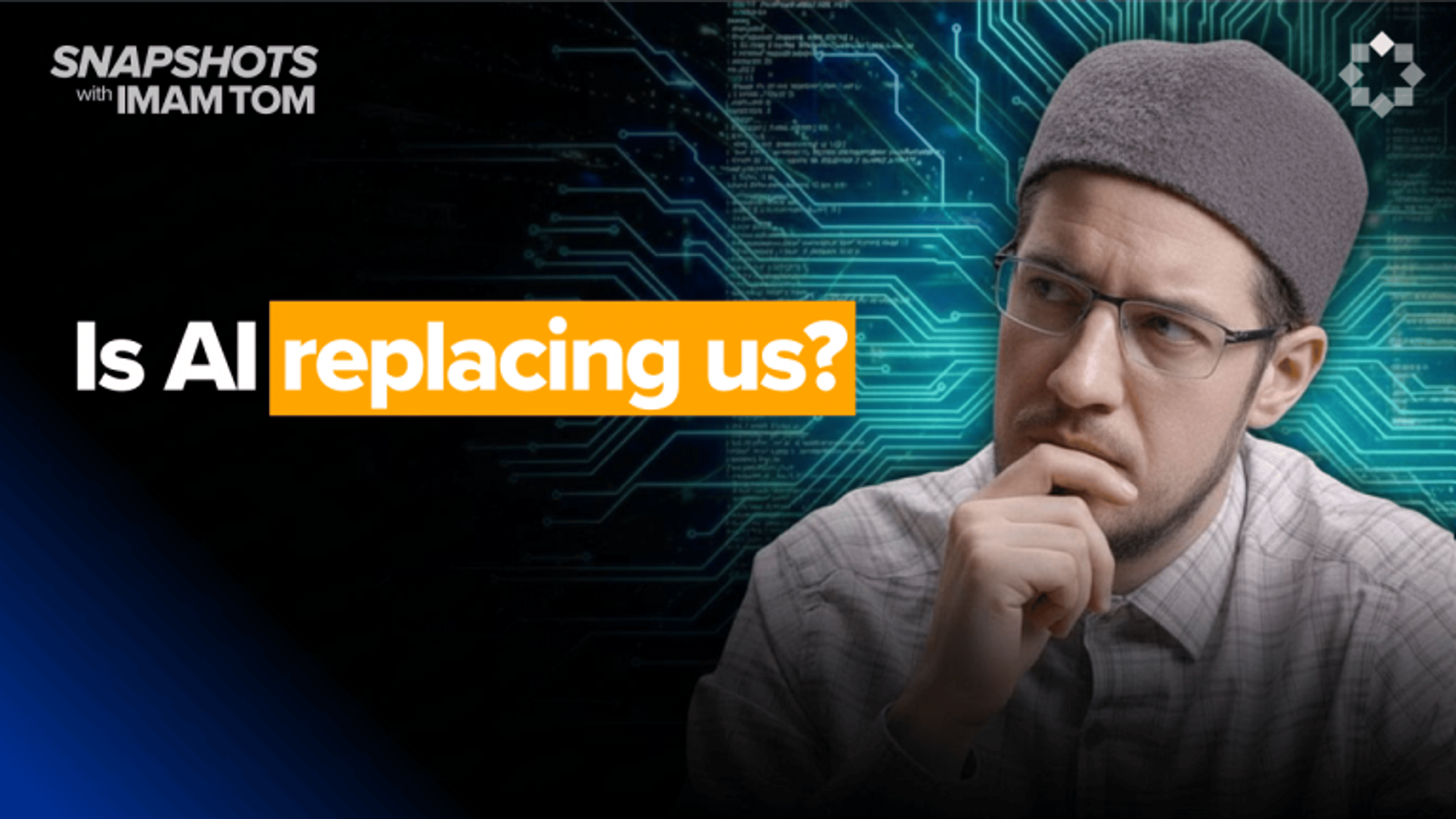
Artificial intelligence is advancing exponentially in both its learning and efficiency, but is it really a threat to human creativity? What will it mean when machines can outthink us, and will there still be a purpose for us?
Imam Tom explores the limitations of AI and the blessings that it can never replicate.
This transcript was auto-generated using AI and may contain misspellings.
Starting in 2026, I will be replaced at Yaqeen Institute by an AI robot. Nah, I'm just kidding. That's not gonna happen, insha'Allah.
But there's a lot of concern with the AI revolution upon us that we're gonna be replaceable. That these models of learning and fetching information are going to be so efficient and so powerful
and their learning is going to be so exponential that soon you and I and everybody, I don't know, maybe we'll just hang out at the beach and AI will run everything. I don't really believe that, to be honest with you.
I think that the tech enthusiasts, they have projected, I think, a bit when they call AI artificial intelligence.
I think that there's a longer and richer discussion that needs to be had about what intelligence truly is. I don't really see what AI is doing as intelligence.
Certainly not creativity and it's well known that the generative effect of AI is still quite limited compared to what human beings are able to come up with.
Literally, and this is fascinating actually because when we say that human beings themselves cannot truly create in the way that Allah subhanahu wa ta'ala creates. Allah subhanahu wa ta'ala creates from nothing.
You're going from there never used to exist something called earth, there never used to exist something called an atom or iron or magnesium to here it is.
Now we have iron, we have magnesium, we have water, we have earth. That's something that only Allah can do. Human beings, what we do and we quote unquote create is we rearrange and we manipulate.
We see a tree and we cut down the tree and then we mill the lumber into boards and then we use the boards and we make things, we make houses.
Or we might steam it and then curve it and bend it or we might treat it with different chemicals that we've discovered here or there.
We're limited in what we can use to manipulate and to act which is the elements that are already there to our disposal.
However, the creative element that human beings have, nonetheless is quite remarkable that we're able to think about the creative uses of things. Here is wood, here is stone, here is water. What can we use it for?
We can use it for tools, we can use it for work, we can use it for pleasure, we can use it for art, we can use it for all different types of things.
It's almost as if AI is a further degree removed from human beings that it even takes all of what we know, all of human knowledge that is out there and it is a very efficient librarian.
It is something that can collect it all and bring it back to you and even combine it in some interesting ways especially when it comes to the visual or the audio tools that are emerging.
But it doesn't seem to have the same creative capacity of human beings, at least not yet. And there's certainly room for using AI and I myself have started to experiment with AI when it comes to efficiencies.
Are there particular things in my research for example? There will always be a benefit to picking up a book and skimming through it.
AI will never be able to replace the eureka moment of dusting off an old book and then you're looking for one thing but you find something else on the way, right?
Like how many times the students of knowledge out there that that's happened to you find some gem of a quote. It wasn't what you were looking for.
AI will rob us of those moments to be frank because AI will only be spitting back to us according to the command prompt that we give it.
However, it will be an efficient tool, something that will save time, that will free up time in order to collect what's already out there. And the things that of course there aren't a lot of information out there about it will pretend like it knows.
But there's a couple very very important things that AI will never be able to replace and that is I think the heart of the conversation.
That we have a very important du'a from the Prophet (ﷺ) that shows us that knowledge is not just about using encyclopedias and it's not about the facts that are disentangled from context and from work.
That there's a spiritual element to knowledge that can't be minimized. That there is worship and morality that is going on when you learn something.
The Prophet (ﷺ) taught us, Allahumma 'allimna ma yanfa'una wa anfa'na bima 'allamtana wa zidna 'ilma
That Allah teach us what benefits us and benefit us by what You have taught us and increase us in knowledge.
Now the first third of that, teach us what benefits us, recognizes that there are two types of information out there. There is beneficial information and there is information that's not beneficial.
Now this opens a larger conversation. According to who? Benefit how? What benefit do we get from knowledge? Okay there could be benefit in this world but there is also benefit in the afterlife.
What type of knowledge benefits your afterlife? And what type of knowledge actually is a detriment to your afterlife? Celebrity gossip and this that and the third. Things that you really shouldn't know in the first place.
Eavesdropping and you know, namimah and ghibah and these types of things. But even knowledge that is objectively beneficial in your dunya and in your afterlife, that can be misused.
That can be misused as well. Which is why the second third of the du'a is, wa anfa'na bima 'allamtana And benefit us by what You have taught us. That You have taught us things. All knowledge comes from Allah.
We want to use it in the right way. That we are afraid that if we misuse it, even if it's knowledge of the Qur'an, even if it's knowledge of the Shari'ah. Can it be misused? Absolutely it can be misused.
And if it's misused, then that is actually going to be a cause of suffering for you in the afterlife. And the final thing that we ask for is we ask for an increase of knowledge. So when it comes to using AI,
AI can't replace that worship aspect of what you're doing. You have to realize that when you're using AI, AI is not getting hasanat in the afterlife. That you're the one who's getting hasanat.
And AI also doesn't have any niyyah. It doesn't have intention to it. And because it doesn't have any intention to it, it doesn't have any barakah. There's no blessing in it. It's not to say it's not useful. Not to say that you can't use it for positive things.
But you are irreplaceable as a human being who is mukallaf, who is responsible in front of Allah subhanahu wa ta'ala. Your learning is moral. Your learning is a religious duty.
And it has religious, spiritual dimensions to it. And your learning can be done with a proper intention or it can be done with a negative intention. Your learning can have blessing or it can be deprived of blessing.
So while AI might be an amazing tool, and it might be very efficient, and it might help you be more efficient, we have to focus on values, not just output. And you have to keep your eyes on the prize.
The most important thing going on is your relationship to Allah subhanahu wa ta'ala and how you're using things for good or for evil.