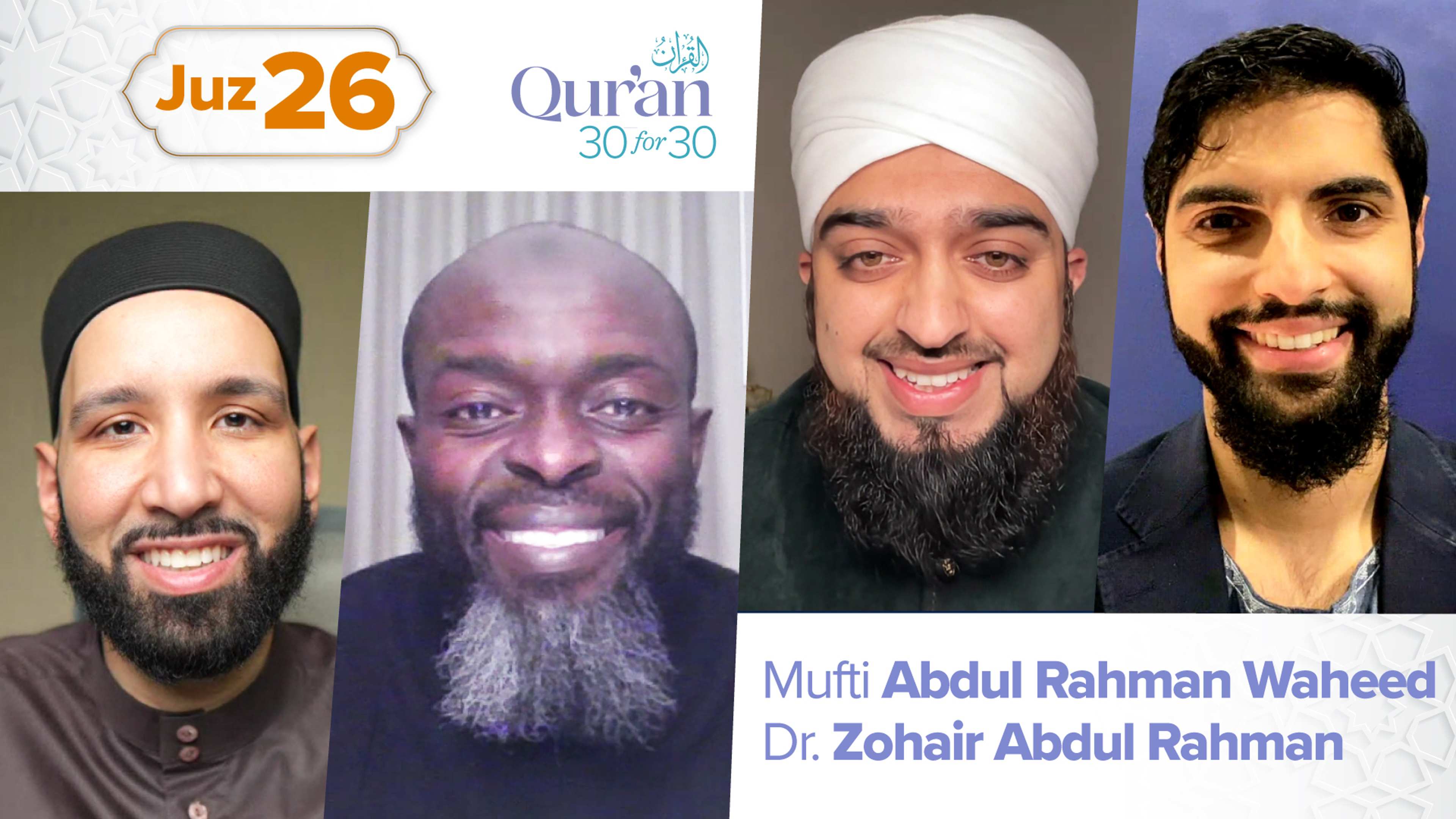
As-salamu alaykum wa rahmatullahi wa barakatuh, everyone. Welcome back to Qur'an 30 for 30.
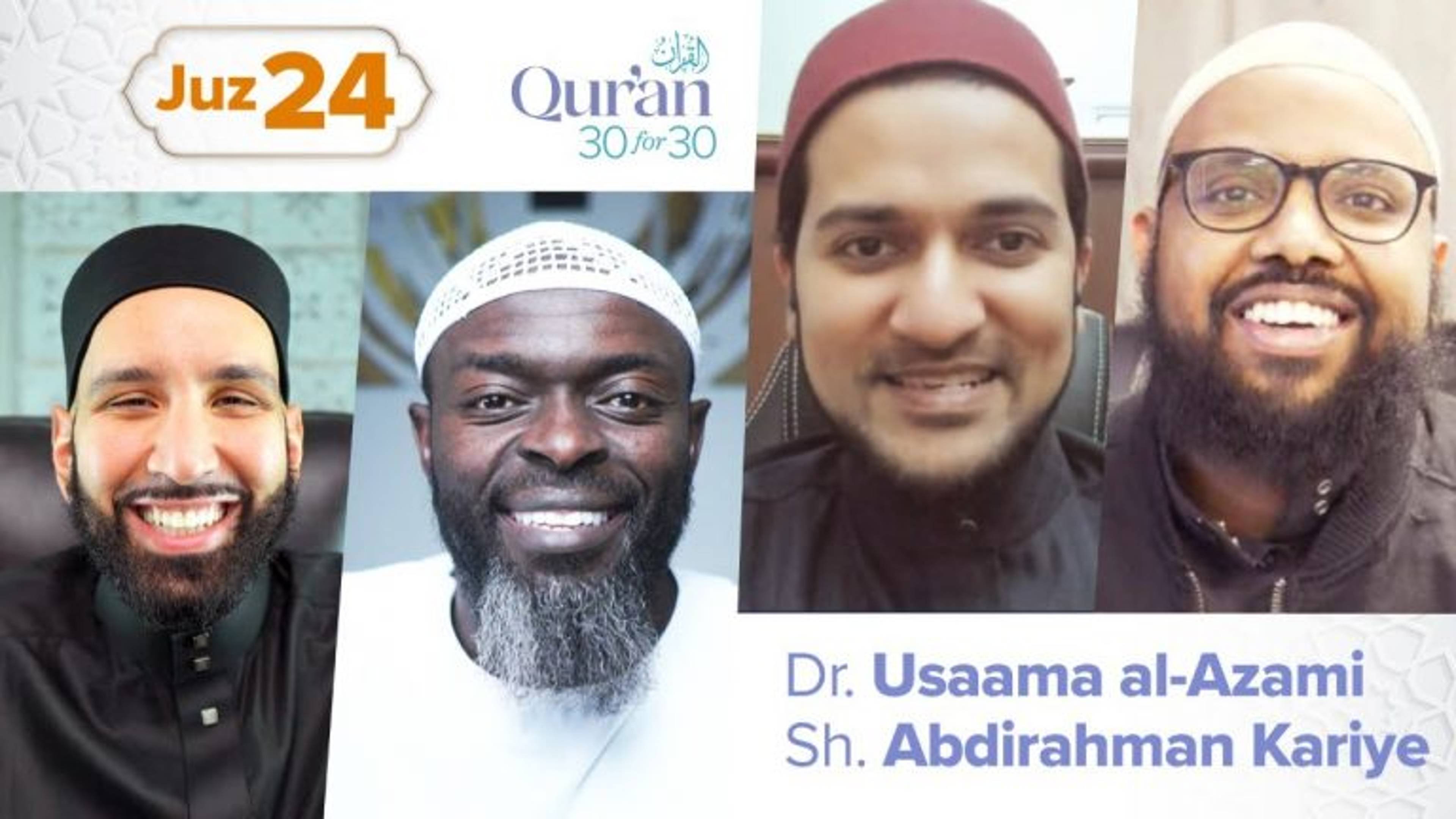
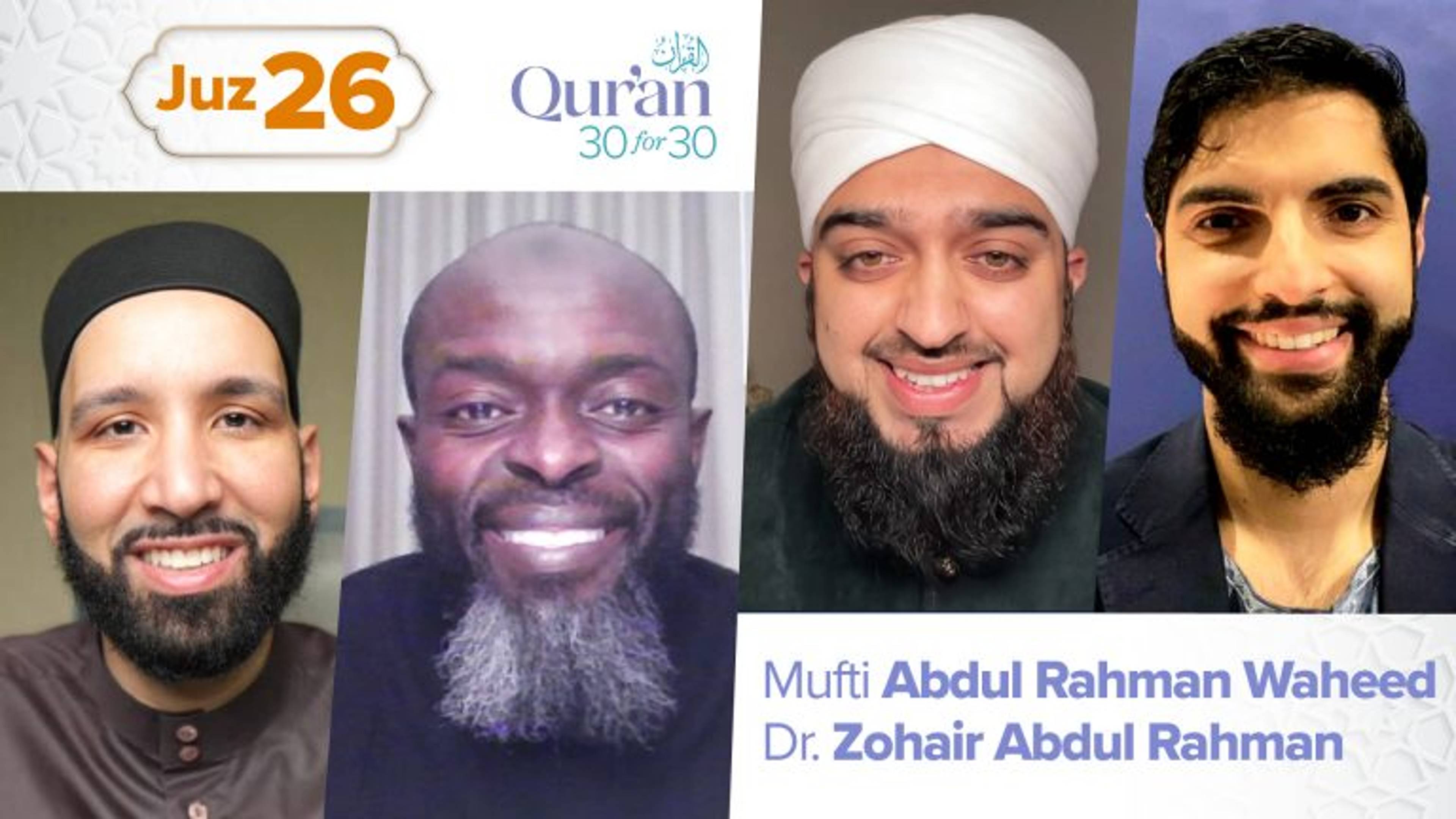
Alhamdulillah. We're at Juz 26 now. Alhamdulillah. And we're blessed, alhamdulillah, to have Mufti Abdur Rahman Waheed, Dr. Zuhair Abdur Rahman joining us. And before we get started, inshallah,
just a reminder, we know it's the last 10, biddenillahi ta'ala, please do contribute to Yaqeen. We need to see inshallah ta'ala that continued buy-in and investment so we can continue to create more resources free, as always, biddenillahi ta'ala, for your benefit. So please click that
link inshallah, especially in these last few nights, and make sure that you have your contribution inshallah. And as I said, we're blessed. We got Mufti Abdur Rahman and Dr. Zuhair. Dr. Zuhair
is in Australia, alhamdulillah. For once, he's not on a beach or in a hospital lounge or in, where were you last year? In front of him. Mufti sahib, can you run it back and tell us
how many times he's reused the same one? He does dhikr of his dad jokes, like he has, like there's a will to it. But this isn't a dad joke, it's just like stereotypes.
It doesn't work to anything. But look, hold on, can we just say this is the cleanest setup Dr. Zuhair has ever had on Quran for your 30th. People should donate to Yaqeen so they can have your proper setup, you know, put in place. Alhamdulillah. I have to give credit to my
wife for this one. Alhamdulillah. Mufti Abdur Rahman, I don't know where you are because you're always traveling, you're always in khuruj, you're never in one place, so I don't know which part of the world you're in. How many days are you ready for?
You've gone modern, you take an iPad now, you don't do the iPad.
By the way, Mufti sahib, people have asked about you. I don't want to like inflate your turbine, but like people have actually commented and said, when's the Mufti coming out? Like we actually have it on some of the episodes. We got comments. When's the guy coming on?
They're always asking about me. They want to know when the guy's coming on with the daif hadith,
you know? So as our one turbaned guest, I think Dr. Zuhair and Sheikh Abdullah decided to,
you know, in protest, not wear topis today. It's okay, we forgive you. I'm still on your team though, but Mufti sahib. Sheikh, you're supposed to wear a vest and let me tell you something about the vest, okay? Let me just give you some tips.
So when you come on live, you gotta button the top three, four. They make you look better, okay? The bottom can be open, no problem, but the top three, four have to be like this. Sheikh Abdullah,
isn't form while working out very important? Of course. It's everything. You said I shot like a, my shot looked like a pancake. It was flat as a pancake last time. That offended me all year,
all right? That's very offensive. Don't do that again. You mean offensive when you're supposed to pick up your guests the other day? What was that? You're supposed to pick up your guests from the hotel? I'm just trying to figure out which one was. That was offensive to me being
the guest that was left at the hotel room because Mufti sahib overslept and didn't pick me up for uh, for Fajr. Dr. Zaheer, that's a seven. That's a seven time. Even though Quran 30 for 30 years,
that's number seven. That's a good number. There's something special about the number seven, Sheikh. We love you guys. Jazakallah for having me on. I love coming on. I'm in Itikaf right now. To answer your question, last 10 nights, I've started to come on Yaqeen only the last 10 nights because
it's easier for me to be in one place. I'm in Itikaf. So just make du'a for us. We're with some youngsters over here. Make du'a, Allah accepts from us, Inshallah. I mean, I mean, I also want to bless you and accept from you and Allah allow you to, to reap the full reward.
Even when you're making that du'a, you were trying to, you're trying to be serious. You weren't serious, but it's fine. I'm serious. What do you mean? Come on. I made du'a for you. You know, I'm going to accept my du'a for you. I mean, I mean, I mean, thank you.
Jazakallah khair. Sheikh Abdullah, I mean, like he doesn't even trust my du'a for him anymore, man. What's up with that? I trust you. I trust your du'as even, you know, against my dad jokes. I trust those as well. I hope for the best.
All right, Sheikh Abdullah, you, you, you missed, let's be real though. You missed an easy one yesterday. Like I gave it to you. It was a slam dunk and you didn't take it. The, the hairdresser curls. And so I'm going to try, let's try this one. All right. And because we got in honor of
Dr. Zohair, who is another Canadian in Australia, you know, we're going to have a kangaroo dad joke. So what do you call a lazy kangaroo?
A lazy kangaroo? Dr. Zohair, you got it. You got it. In Australian? I got that one last time, but this one, a lazy kangaroo. I mean, they're all lazy. They just sit there and.
Apologize to our kangaroo audience for calling 30 for 30. Sheikh Abdullah does that every time we ask. Did he ever get one right? Maybe. Never. Have you been watching? Never.
You're part of the family, Sheikh. Hold on, hold on. I'm going to step in here. I'm going to step in here. You, do you know the answer? Boom. At least I'm not trying to act like I'm thinking about it. Sheikh Abdullah's like, okay.
I take offense to that. I was thinking very deeply. Yeah. You know, he's trying to, I think he's not trying to think about it. He's trying to say, just hurry up. He's just waiting for me to give the answer. Yeah. What is it? What do you call a lazy kangaroo? Yeah. A pouch potato. That's actually a pretty good one.
But they're not the only marsupials with pouches. The only what? Pouch potato. Okay. Marsupial. They're marsupials.
Because they have, because they have pouches. Okay. What, what, what, what is it? I think we need to go back to elementary school, uh, uh, biology, animal studies, whatever it is. Yeah.
We're good. We're good. We're good with that. We don't want to, that's fine. We're on Quran now. Inshallah. You guys all come, come to Australia. Inshallah. I'll show you all the kangaroos. Inshallah. Inshallah. Okay.
Sorry, Sheikh Abdullah. These guys are trying to pick on us with their, you know, but it's, it's all good. We'll, we'll, we'll, we'll, we'll, we'll, we'll take it. We'll still have them on for, we're still, we're still happy to have them on. Alhamdulillah. Thank you very much.
At the end of the day, Sheikh Abdullah, you can, you can, at the end of the day, you could take both of them at the same time. Just remember that. I'm training for Sheikh Abdullah because he scares me. So I have to, I have to be ready.
You see my punching bag behind the camera. That's right. Y'all did that workout thing together. So we gotta. I've got to get to, yeah. Alhamdulillah. Get it together.
But I look forward to Inshallah playing basketball with all you guys, Inshallah, one of these days. Cause you guys always put up all this stuff about basketball, basketball, this, this, this. I used to play. I was on my high school team, actually. I was the captain. Dr. Zuhair, let me tell you something about Sheikh Umar.
Yeah, that's right. Let me tell you something about Sheikh Umar. Sheikh Umar has all these angel series. His form is so broke. I'm like, you know, when you pass away, you have Nahn Awliyaakum Fil Hayat Duniya, the angels come to you and tell you, we're your friends. Sheikh Umar is going to have angels come to him and tell him,
we're the ones who used to take the ball and put in the hoop. Cause this guy's form is so broke, but somehow those shots drop. And he has, since he does all these angel series, I'm sure he has these angels that are just there, like taking the ball. And he just, he has one of these like,
you know, hook shots and he doesn't even get off the ground. I did see, I saw this one video, like you, you released like on your way down and it's just very, but it went in, it was like, Sabonis, you guys remember Sabonis?
But it went in, that should be a shirt for Sheikh Umar, but it went in. But it went in. Alright, yo, I think we're going to go ahead and get started inshaAllah.
People have logged in long time ago and Alhamdulillah, we got, we got a lot to reflect on inshaAllah. Jazakumullah khair for being on. Let's go ahead and get started inshaAllah ta'ala.
So SubhanAllah, in Juz 26 now, and one of the things that we notice in Juz 26 right away, is that every Surah connects to the next Surah in a way that you have the warning and then you
have the consequence. So immediately you'll see that Surah Ahqaf is followed by Surah Muhammad, and then it's followed by Surah Al-Fatihah. And I've talked about this in the past. Surah Al-Ahqaf
is the final warning. Surah Muhammad is also known as Surah Al-Qital. It's the battle that takes place afterwards. And Surah Al-Fatihah is the victory. So SubhanAllah, it's, it even
is laid out in that way in the Quran where you see the story being told. But there's also another thing that I want to point out. You know, there's the adab that we have with Allah and the Messenger
Sallallahu Alaihi Wasallam as Muslims. There's the adab that people are to have with the Messenger Sallallahu Alaihi Wasallam when he's in their midst. And there's the really being an inward
looking community. So just as you have Surah Muhammad, which is obviously, you know, a warning to those that that fought the Prophet Sallallahu Alaihi Wasallam and that persecuted the Prophet Sallallahu Alaihi Wasallam and rejected the Prophet Sallallahu Alaihi Wasallam. You also
have Surah Al-Hujurat, which talks about the adab of the believers towards the Prophet Sallallahu Alaihi Wasallam when he is in their midst. And you have that beautiful, you know, layout of how to maintain your mannerisms with Allah, with the Messenger Sallallahu Alaihi Wasallam, and with
the community as a whole. But what I'll talk about today inshallah and reflect on a bit, the very beginning of this juz to the very end of this juz. The very beginning of this juz is
Surah Al-Ahqaf. And Surah Al-Ahqaf is again giving you this situation of the final calls, the final warnings from Hud Ali Islam to his people, from parents to their children,
from children to their parents, from siblings to siblings. Basically, it is the last call, the last warning to heed and to pay attention to what Allah Subh'anaHu Wa Ta-A'la is calling you to.
And Surah Al-Ahqaf, at the end of this juz, is it all coming together. You know, it's when death actually comes to you. SubhanAllah, so everything that you're being spoken to about
in Surah Al-Ahqaf is now coming to reality in Surah Al-Ahqaf. And it's actually remarkable that it's in the same juz. So Surah Al-Ahqaf, you have the parents talking to their children
and especially the disobedient son who refuses to believe and he dismisses belief. أَتَعِدَانِنِي أَنْ أُخْرَجْ وَقَدْ خَلَتِ الْقُرُونُ مِنْ قَبْلِي وَهُمَا يَسْتَغِيثَانِ اللَّهِ وَيْلَكَ آمِنٌ إِنَّ وَعْدَ اللَّهِ حَقٌّ
فَيَقُولُ مَا هَذَا إِلَىٰ أَسَاتِرُ الْأَوَّلِينَ Where this, you know, this couple, this righteous couple, believing parents are speaking to their son who's not rejecting and he's saying أَتَعِدَانِنِي أَنْ أُخْرَجْ
You really think that this is going to come to pass? Are you really talking about a resurrection? Are you really talking about anything beyond death? Where nations have perished before me and the parents are begging that this person believe. They're begging Allah
Subhanahu Wa Ta'ala that he believe and they're begging this person to believe and the person dismisses it all as أَسَاتِرُ الْأَوَّلِينَ These are just fables from the past. So you have the believers and this is the third page of
Surah Al-Ahqaf, you have the believers that are assured, the believing family that understand that Jannah is a reality and that they should work towards it and they're praising Allah Subhanahu Wa Ta'ala for the blessing of having been guided to the means by which they can attain Jannah
and Allah Azawajal is talking about accepting them and rewarding them نَتَقَبَّلُ عَنْهُمْ أَحْسَنَ مَا عَمِلُوا وَنَتَّجَاوَزُوا عَنْ سَيِّئَاتِهِمْ فِي أَصْحَابِ الْجَنَّةِ وَاعْدُوا صِدْقٍ لَّذِي كَانُوا يُوعَدُونَ
Allah is talking about forgiving them, rewarding them, giving them the Jannah that they have been promised and this is Allah Azawajal, the most honorable, Al-Aziz, Al-Kareem, the most generous
who never forsakes his promise and then you have the warning أَذْهَبْتُمْ يَوْمَ يُعْرَضُ الَّذِينَ كَفَرُوا عَلَى النَّارِ أَذْهَبْتُمْ طَيِّبَاتِكُمْ فِي حَيَاتِكُمْ وَالدُّنْيَا وَاسْتَمْتَعَتُمْ بِهَا
people literally being presented to the fire after they denied it and being told that they have wasted themselves in the pursuit of this world and hence they are missing out on the hereafter سُبْحَانَ اللَّهِ سُرَىٰ قَافِ This is Surah Al-Ahqaf and now Surah Qaf
What does Allah Subh'anaHu Wa Ta-A'la mention
وَجَاءَتْ سَكْرَةُ الْمَوْتِ بِالْحَقِّ ذَلِكَ مَا كُنْتَ مِنْهُ تَحِيدٌ وَنُفِخَ فِي السُّورِ ذَلِكَ يَوْمُ الْوَعِيدُ وَجَاءَتْ كُلُّ نَفْسٍ مَعَهَا سَائِقٌ وَشَهِيدٌ لَقَدْ كُنْتَ فِي غَفْلَةٍ مِّنْ هَذَا فَكَشَفْنَا عَنْكَ غِطَاءَكَ أَبَصَرُكَ لِيَوْمَ حَدِيدٌ
Allah is mentioning death coming to the person and the person who is in denial suddenly having the sharp sight of the angels descending upon them and death becoming not just a reality but what follows death becoming such an obvious reality at this point being shown their place in paradise or in hellfire and this person now trying to find a way out the Shayateen making their argument this person making his argument the angel is just saying look all I did was record
and all of this happening while this person is trying to find a way now to escape after they did not listen to the initial call they're trying to escape the final consequence after having refused the initial call and Allah subhanahu wa ta'ala mentions the punishments and how rapid it is and how real it is in surah Qaf
so surah Qaf is one of the most real vivid displays of consequence and also reward وَأُزْلِفَةِ الْجَنَّةُ لِلْمُتَّقِينَ غَيْرَ بَعِيدٍ
and Jannah comes close it's brought so near to the believers to those that were God conscious pious and it's not far from that anymore هَذَا مَا تُعَدُونَ
once again Allah promised you this has Allah broken his promise Allah subhanahu wa ta'ala never breaks his promise اِنَّ اللَّهَ وَعَدَكُمْ وَعَدَ الْحَقِّ Allah azawajal has given you the true promise as for the shaitan وَعَدْتُكُمْ فَأَخْرَفْتُكُمْ
I made a promise to you and I lied to you I deceived you so subhanAllah you have the shaitan saying this and now you have again this person that had such confidence that there was nothing after death
being in such fear after he's realizing the consequences after death and the believers being assured that the promise of Allah subhanahu wa ta'ala was true
and their certainty and their confidence was upon that which was built upon a foundation of yaqeen of what we know to be true may Allah subhanahu wa ta'ala allow that to be our reality
allow us to realize that promise of his of reward and not to face the consequence of stubbornness allahumma ameen inshallah ta'ala I'll pass it on now to shaykh Abdullah Dua
barakAllahu feekum khayakumAllahu bismillah wa salatu wa salam wa ala rasool Allah wa ala alihi wa sahbihi wa man wala amma ba'd
this month of the Ramadan these last 10 days and trying to capture the odd nights and trying to really take advantage of every night it's important that we remember that this is the shahr of the Quran as well
Allah subhanahu wa ta'ala when speaking about the group of people that disbelieved in their heart but they showed belief outwardly being the munafiqoon and munafiqoon literally comes from nafak which means like a tunnel
so there is something that is hidden underground literally hidden in their hearts from the absence of true faith and true iman but showing something otherwise
Allah subhanahu wa ta'ala when speaking about them in the chapter of Muhammad verses roughly 20 to 26 when Allah subhanahu wa ta'ala is talking about the munafiqoon he's talking about gives a certain characteristic
and when Allah subhanahu wa ta'ala throughout the Quran gives characteristics of people it's important for us as Muslims and people that want to be with Allah subhanahu wa ta'ala be with the Prophets alayhimu salam in Jannah and drink from the fountain of the Prophet salallahu alayhi wa sallam
and have the fruits come down to us and to be sitting amongst each other in front of each other when we would be upon velvet couches and we go in there and we breathe and every breath we take is dhikr
all of this subhanAllah may Allah subhanahu wa ta'ala make us from the inhabitants of Jannah inshallah wa ta'ala Allah subhanahu wa ta'ala gives characteristics of people of Jannah gives characteristics of people of the hellfire
gives characteristics of those that are destined to these places and the munafiqoon are those that were destined to these places because they wanted Islam to perish but they were hiding that disbelief
so when Allah subhanahu wa ta'ala talks about them he gives a rhetorical question and this is important for us to ponder upon although it is particularly for the hypocrites
we have to look at those characteristics and see do we have them or do we possess them or is that predominant amongst us and the reason I say predominantly amongst us or within us is because sometimes when we have some characteristics that are not befitting
but what is predominant is what is important what is consistent, that is what is important so Allah subhanahu wa ta'ala says here after audhu billahi minash shaitanir rajim when he talks about the munafiqoon he says
Allah subhanahu wa ta'ala says in verse number 23 it is these whom upon the curse of Allah has been laid so he made them deaf and deprived them of their sight so when it comes to listening to the message
and it comes to having the basir or the insight of understanding the message to implement it, because of their arrogance, because of their plotting and planning it has been blocked from them and this is what we talked about before when Allah subhanahu wa ta'ala yudhillun nas
when he misguides people it is not as though the individuals didn't have an opportunity for guidance and if they would have had they would have chosen it rather it is something that was in their heart
and if they consistently desired that which is other than the message of God the message of Islam therefore the element of misguidance may afflict them and Allah is well aware of what is in their hearts but the next verse Allah subhanahu wa ta'ala asks a rhetorical question
meaning it's a question where we know the answer and it's a question because you know the answer you need to think about the answer for yourself as well Allah subhanahu wa ta'ala says
this is a profound verse Allah subhanahu wa ta'ala says do they then not reflect over the Quran or are there locks on their hearts this question is Allah saying
and tadabbur as we've mentioned before is to reflect or to ponder and even in English there's a certain level of beauty in it
because when you reflect on something you're looking back at yourself it is a spiritual mirror if you will and that definitely the month of Ramadan and these times and moments that we're spending is a time of reflection to look back at yourself before looking at anyone else
you know sometimes we read the Quran and we have to be aware of this we read the Quran and we say oh yeah that's so and so oh yeah that's so and so we need to stop and say am I from these people oh Allah please don't make me from these people so in this particular verse
do they not ponder over the Quran and tadabbur comes from that which is at the end of something when they're pondering and thinking they want to find as some say khafaya al-umur
they want to see what are the hidden gems behind this verse what is it alluding to what is it actually telling me there are people that spent their lives to find this out and these are the ulama particularly the mufassirun
the individuals that explain the meanings of the Quran from the words, from the tarqee from the ways the words are put together etc so here when one does tadabbur of the Quran they're pondering over the words they're thinking of events in their life
past and present and then also using that to motivate them to be better in the future they're looking at themselves first and that particularly subhanAllah in these last 10 days of irtikaf
irtikaf means to be stationary in a place stationary to stay away from distractions and to make sure that there is traction not distraction from the ultimate purpose of life
is for you to think of yourself and how you can be the best version of yourself for the sake of Allah subhanahu wa ta'ala fulfilling it with excellence to the best of your ability and the majority of moments in your life
so when Allah subhanahu wa ta'ala says do they not ponder over the Quran do they not reflect over the Quran or is are their hearts sealed, al-qufal, qufl and qufl is like locked
and some scholars mention the qulub here is because their hearts like the lock is hard their hearts are hard therefore nothing can enter inside of it it is locked from accepting guidance
it is not munsharah it is not salamat al-sadr alam nashrah laka sadrak when Allah says do we not cleave your heart as the sharih was known to be a butcher where the heart is open the lahm the meat is open and it is soft
ready to absorb and accept the message but when one plots and plans when one thinks that they are smarter when one thinks that they're more intelligent when one thinks that they are more uh have a they're conniving in regards to trying to
dupe other people or Muslims in particular or the message of Islam Allah subhanahu wa ta'ala being al-alim he is not unaware of that so brothers and sisters this beautiful verse is a reminder for us in this beautiful month of Ramadan and the remaining months as well
to establish some type of relationship with the Quran if you haven't done it till now try your best to establish a relationship with the book of Allah subhanahu wa ta'ala
because we just let's just keep it real simple if God was telling you something wouldn't you want to know if God was telling you how to live your life wouldn't you want to know wouldn't you want to memorize it wouldn't you want to try your best to live by it
wouldn't you want to if there was something that happened in your life you automatically know what Allah said about it that is the Quran that is a message of Islam and that is the unadulterated kalam that is the kalam that is the speech of Allah subhanahu wa ta'ala
that has no mistakes in it so take advantage of this beautiful month in reciting this beautiful book and pondering over this beautiful book and holding yourself accountable with this beautiful book may Allah subhanahu wa ta'ala make us of the people of the Quran Ameen
JazakAllah khair Sheikh Abdullah, beautiful words Mufti Sa'ad, Fadlan JazakAllah khair Sheikh Abdullah for that beautiful reflection and just to add on it like this month of Ramadan
we do see Quran being recited more we have so many khatams happening all over the country all over the world you know in one city you have multiple khatams especially in Dallas you have so many hufadh there so make it a point that have a schedule
that you have in mind already for after Ramadan if you don't have some sort of like prescription you know in prescription you have a set amount
like a set time number one set amount and you also have what you're going to be doing so a prescription has all three things what medication you're taking so these three things make sure we have it in our schedule before Ramadan ends like what
time am I going to read Quran how much am I going to read right so with where do you have Quran you have dhikr you have dua so what time in the day how much and which ones I'm doing I'm going to be
doing he says a person who doesn't have this willed then this person will not be able to feel the presence of Allah and get the inspiration from Allah and guidance from Allah
so a person who has it daily you know even if it's five ten minutes think of it my mother is very sick right now may Allah give her shifa think of an an older older person 65 70 years old I mean they if they don't take their
prescription on time in the way it's the way it's prescribed to them by the physician they can get sick and they can either they can even die if they don't take it on time and the way it's been prescribed to them so we're all sick as well so we need spiritually sick so we need to make sure we
abide by a certain you know with with a schedule a prescription and you know what Sheikh Abdullah mentioned about the Quran it's the best prescription for the heart so let's stick with it even afterwards speaking about that you know as I was reading the this juice today
uh the verse that always you know captures my mind is when the description of the sahaba when Allah describes them so we have our own way of speaking about them because they're such great people
and Allah has his own magnificent way of describing these individuals or the best individuals who step foot on this earth after the ambia alim salam and Allah doesn't you know say say much details like long
lengthy discussions few words but they mean so much so one of the ways Allah describes them in this juice it's for those who want to read this verse and do the tafseer of it it's the
29th verse um so 29th verse of surah fatah right you have uh Allah subhanahu wa ta'ala saying in the the portion that i'm going to speak about after Muhammad Rasulullah Allah is saying
their alama their distinction is in their faces the you could if would you the word wajh is mentioned but it's speaking about the entire presence it's like when someone says qiyam but they're speaking about the entire salah this is a
this is a way of balagha so their their distinction is in their presence in their like right when they're present right when you see them you can tell that there's something different about this individual that's why imam malik he says
when the christians and the jews when they saw the sahaba just when they saw them before they even spoke to them before they even heard from them they said
these people just by looking at them we can tell these are much better far better than the the followers and the supporters of isa just by looking at them right and they don't have to say anything so allah subhanahu wa ta'ala says
their distinction is in their presence why what makes them distinct what did they do different from the effects of such that even this allah says the word such that but he's speaking about the entire salah the daily salah
the nightly salah so what does that mean does it mean that they had like a a mark on their forehead you know one poet says
he says it matters little if your prostrations have left an impression on your forehead let your prostrations be such that they leave an abiding mark on the earth let leave some tears there you know
leave some like leave some tears there that's what leave something there like leave your stress there leave your worries there leave your concerns there because the moment you get up from such that you're done you've already presented your case to ar-rahman and he
will take care of you so we know it doesn't actually mean this just this mark of sujood on your forehead and that's why the salaf they spoke about this what does it mean abdullah bin abbas
he said it means this beautiful appearance the appearance of obedient servants of allah subhanahu wa ta'ala like when you're praying salah the salah is working and helping you become a person who just
obeys allah is humble in front of allah it helps you lower your gaze that your gaze is allah is saying put lower your gaze look down now go and ruku now you're going such that this
this is a whole exercise this exercise when you do this in the daytime it has an impact on you when you do it at night time it has a different impact on you that's why hassan al-basri rahmatullah was
asked why is it that the people who pray tahajjud they're so beautiful they're the most beautiful people among us so he replied
these people they isolate themselves with allah subhanahu wa ta'ala so allah gifted them with noor from his noor right
in the salaf you should say a person who increases their salah at night so the effect of that salah is visible during the day sufyan thawri he says
they used to pray privately in front of allah subhanahu wa ta'ala at night and the effects of that prayer of that that humility the that devotion that sincerity now you can see that during the day and i love this by qatad rahman he says
what does it mean that their salah dictated their life there's they worked you know we're trying to work we're trying in in our life right now like we count
how many times we read quran how many athkar we did but the real thing we should be counting is how many things have i changed in my life because a successful ramadan or umrah hajj is based on the changes you have made
how many sins have you left how many good deeds have you started to do and these changes if you want them to come in your life change the way you pray and the prayer will change your life
this is this verse sahaba changed the way they prayed they focused on their prayer making their prayer better making the sajda better making the dua better beautifying it more so the the moment they started to change that
allah changed their life they made their salah beautiful allah made their life beautiful they devoted the time in salah allah made it easy for them to devote their time outside of salah and look the difference between us and them today our salah
is weak so our life is weak as well so one poet says such that is quote
he said that such that with love for allah then there's gonna be enjoyment in that such that otherwise empty such does there's nothing more in those such as than just dunya so that salah can actually change your life so this quality that allah is mentioning
about them is their their when right when you seen them you can tell that these people were different why because the way they beautify their salah and that's how we should be with allah subhanahu wa ta'ala and
if if we're not the word that's used for qiyam is the same word that we're having the jannah series right now may allah bless shiekh umar for that um should give me a minute over here so qiyam is the same word when you're standing
in front of the day you stand in front of allah that's the same word that's used for qiyam and salah so if you're not prepared to stand in front of allah in this world then how do we expect to be prepared
to stand in front of allah in the next world if we are not excited to stand in front of allah now then how do you think we're going to be excited when malikul moth comes and he takes our soul from our body and it comes in one of the narrations that
malikul moth for a believer under this verse was sabiha to sabha will say like he will make this statement leave all soul from the body and go towards
allah the lord that will forgive you and mercy and comfort so the soul now the soul will it will the example is given like a person who stands like dr
zuhair next to the beach and the water is nice and warm it's beautiful water and you just dive right into it that's the example that's given for a person who's obedient to allah they will just
dive into akhirah nothing to worry about over here so how do you expect to be that excited when that moment comes when we are not excited when the moment of salah comes
and that's why uh ahmad bin hamad he says he says salah is something of akhirah that's it
so when you actually enter into salah you have left dunya and when they were used to when they used to be asked do you think of anything in salah and they used to reply
is there something more beloved to me than salah that i can remember in my salah i'm doing the most beloved thing that in my life so how can i remember
something else while i'm doing this so change our prayer our life will change prepare for your prayer then we'll be prepared for standing in front of allah be excited to stand in front of allah today you will be excited to stand in
front of allah and akhirah inshallah always uh beautiful and always urdu poetry uh that you bring in alhamdulillah uh i'm gonna try mine tonight
so i'll have to talk to you about it you know i'll give you my dose get my dose from you inshallah but uh to phase right into dr zuhair um dr zuhair masha'allah i i want you as you sort of comment on your section
to kind of summarize some of this and how it becomes very coherent from this just even leading into the next juz and how we can systematically think about this inshallah
the series firstly to sheikh omar and sheikh abdullah has been absolutely outstanding every year may allah reward you both for taking this time every night i wanted to talk about surah dhariyat
which is the 51st surah in the quran it's the last surah in this uh 26 juz the juz kind of goes right in the middle but as you mentioned and alluded to um sheikh omar
this surah almost ties in a lot of the different themes that we've been discussing in this episode uh so there have been themes of uh the akhirah uh that you yourself uh focused on in the connection between surah haqaf and surah qaf
of course surah qaf has very vivid descriptions of the akhirah one of the most beautiful descriptions and the most um i guess you can say awe-inducing or fear-inducing uh verses in the quran about the akhirah
really uh you can find them in surah qaf um and then sheikh abdullah speaking about the quran and the importance of reflecting upon the quran and then uh mufti saab speaking
really about ibadah talking about salah and talking about standing before allah and then linking that to the concept of the akhirah so the dhariyat really brings all of this uh together by focusing on different themes that we've spoken about here
but also a strong focus on the concept of purpose and you see that kind of in the background of the surah that ties a lot of these things together and this surah i mean technically it's in the next next juz but it's in the same surah
has the the most explicit verse on the purpose of life uh and subhanallah so you read uh and you listen to so many of the stories of people who convert to islam many people are struck with how
explicit and easy the understanding of the purpose of life is in islam literally such a small ayah
you know we haven't created uh the jinn and humankind except to worship me and this idea and this concept of of purpose ties everything together
so surah dhariyat starts with a series of oaths with dhariyati dharwa, falhamilati wikra, faljariyati yusra, falmuqassimati amra so four oaths at the beginning and subhanallah allah takes an oath
by uh different processes that happen in the natural world and so first the wind something that people may think is random like the most random thing that a person can think about
is the wind in this world but allah subhanahu wa ta'ala swears by it and draws attention to the fact that with the wind there's purpose and one of the most beautiful things you read in the books of tafsir and you read from ibn al-qayyim rahimahullah as well in his book
on the uh oaths of the quran ayman fil quran he actually contemplates this idea that the winds are actually necessary for life on this world because the winds they send the seeds of the plants they they lead to cross-pollination
they're at the driving force behind the beautiful landscapes that you see all around you when you go and you study from a quote-unquote scientific point of view they'll reduce it all to literally the winds the winds that send forward all this different organic material and whatnot
and the mixing this this this it's the winds subhanallah and the wind is something when you go outside you might think is the most random thing but allah is now drawing our attention to it that there is a purpose to that there is intention behind that so then what about our own lives?
and then allah speaks about the clouds that carry this uh you know and many of us mentioned that it's referring to the uh to the risk that we have and so the carrying of the of our risk in the clouds
and the driving of the clouds and the decision of where to where it rains where it doesn't rain all of that as well this is all developing maintaining and sustaining this beautiful world that you see
and so when you look at a beautiful landscape you realize the intentionality it's a sign for us that there's nothing random in this world because how could such beauty come from just blind random forces and then
and the mufasirun they differ is this referring to the ships that sail in the sea or is it referring to the stars that we see in the galaxy that that kind of are driven or they flow gently through
either in the night sky or of course on the ocean and um they lean towards the idea of of the stars and in both there's a lesson with that as well with the ships of course
and the floating of materials and whatnot that allow us to go from land to land and from the stars because when you look up at the stars especially back uh you know before there was navigation
that we could have you know easily within our maps and these sorts of things they would use the stars in the sky as a guide for them and so it was a means of of guiding them in the night time in a time of darkness
and so this is an indication of this idea of guidance that is found as well in this world so the world has two things in it number one the rizq that is there we see the rizq that Allah SWT spreads throughout this world
and number two guidance as well and so Allah mentions the idea of that this world is full of the ayat of his they're full of his signs Allah SWT says they're full of the signs but they're also full of rizq for us
so sustenance for our bodies and sustenance for our souls Allah SWT talks about how in the earth in the world in the on the earth there are signs for those who have certainty and Allah SWT talks about in the skies there are signs
and all of these are there to guide us as well so not just the stars to physically guide us but to spiritually guide us guide us to what? what are we being guided to? so we're being reminded in this surah about the purpose of everything even the wind
we're being reminded in the surah of the fact that everything has been created in this world to serve humanity and be a form of rizq for us a form of rizq for us to sustain us subhanAllah all of this
and if the purpose of that is for our rizq and for our sustenance then what is the lofty purpose and aim of the human being? and so Allah SWT answers us وَمَا خَلَقْتُ الْجِنَّ وَالْإِنسَ إِلَّا لِيَعْبُدُونَ that we haven't been
we haven't created the jinn and human beings except for worship that is the purpose of life that is all of our purpose in life and you know we have a paper on yaqeen published with Dr. Nazer on proving God's existence
and in it we talk about this concept of purpose and this idea that the purpose of life there's no intelligible or coherent way of looking at this question of purpose of life except in a relationship with Allah Azza wa Jal
except in striving to Allah Azza wa Jal and we go over the four different requirements that are needed for a purpose to make sense for there to be a purpose number one transcendence you know there has to be a creator
that's actually mentioned in this ayah وَمَا خَلَقْتُ الْجِنَّ وَالْإِنسَ إِلَّا لِيَعْبُدُونَ you can't determine your own purpose because the purpose has to be determined by the person by the one who brought you here he determines the purpose
so transcendence something beyond this world and the creator of course and that's mentioned in this ayah and then there has to be intention behind it a reason why the creator put us here and Allah mentions in the ayah after
مَا أُرِيدُ مِنْهُمْ رِزْقُ وَمَا أُرِيدُ آيُّ طَعِمُونَ that we don't intend so this irada of Allah Azza wa Jal is mentioned here and so intentionality is there and number three revelation
we have to be communicated this purpose from the creator because we don't have access to the creator to be able to speak back and forth and revelation is mentioned in the ayahs before Allah SWT says وَذَكِّرْ فَإِنَّ الدِّكْرَةَ تَنْفَعُ الْمُؤْمِنِينَ
write the ayah right before revelation that's required for us to know our purpose and then number four for purpose to make sense permanence there has to be life after death if there's no life after death there's no point
even if you say this is the point and whatnot if it all ends after a certain period of time then what was the point of all that striving and then Allah SWT references the hereafter
فَإِنَّ لِلَّذِينَ ظَلَمُوا ذُنُوبًا مِثْلَ ذُنُوبِ أَصْحَابِهِمْ فَلَا يَسْتَعَجِلُونَ Allah SWT then references the hereafter so all these points are actually mentioned right around this ayah of purpose
and these are all the important ingredients when it comes to understanding our purpose in life and so when it comes to ibadah and when it comes to coming closer to Allah Azza wa Jal and that being our purpose in life it's important for us to understand that
ibadah is not just rote rituals but ibadah is a I can't believe I'm the one quoting and Mufti hasn't quoted him yet but that faith is not just feeling or content
but it's an expression of the entire human being and that is what ibadah is ibadah is your expression of what you believe the meaning of your life to be and how you choose to then live it out
and so ibadah can be socially amongst each other as we reflect on the names and attributes of Allah and try to reflect that in our character ibadah can be as well intellectual as we strive to learn of his ayat and his signs in his book
and in creation and ibadah can also be of course intensely spiritual and this is a beautiful point that you were mentioning Mufti Sahib about the connection between ibadah and salah and the akhira
and this idea that the rituals that we do have in Islam are symbolic of realities that cannot be articulated but they're so powerful, the standing before Allah Azza wa Jal and then we can't help but think about the standing in the next life
the bowing and the sajda as well such beautiful postures of faith that cannot be articulated it's meaning, it can only be performed and so these intense ritual aspects that have to have the heart behind it and Ibn Qayyim Rahimahullah mentions that
ibadah is the pinnacle of mahabba and dhil it's the pinnacle of love and humility and so love is the driving force when it comes to our purpose in life what do you love? what do you want to attach to?
what is your deepest desire inside? inside your spirit, not your naft, inside your spirit and what do you want to go towards? what is that driving force? what are you being pushed towards? that is the meaning of life to search out what is deep inside of us
of what we all truly love and whether we know it or not it is only Allah Azza wa Jal and then Allah Subhanahu Wa Ta'ala mentions this point for the believers because we might think, oh we all know our purpose in life but Allah Subhanahu Wa Ta'ala says right before this ayah
وَذَكِّرْ فَإِنَّ الْدِكْرَةَ تَنْفُعُ الْمُؤْمِنِينَ realizing that for many Muslims we have to realign with our purpose and we may find ourselves that we are starting to stray from that purpose even within the pursuit of religiosity
we can start to do it for ulterior aims for nafsani cravings, for nafsani desires we have to reorient to realize and remember what is our purpose in life and take those times in salah take those times of reading Quran
and the word that you are mentioning as well these are the times of realignment of our purpose in life may Allah Subhanahu Wa Ta'ala give us the tawfiq to accept this and to be able to live our purpose in this life in a fulfilling way Ameen, Ameen, Ameen
JazakAllah MashaAllah, beautiful profound reflections today Sheikh Abdullah, what do you think? Do we invite both these guys again in the next season? Yes, InshaAllah Both of them? Mufti Saban and Dr. Zahir? Yes
Do you approve? Made it I approve I was kind of disappointed in Zahir I thought he was going to bring the poem in Urdu rather than English I brought shame upon my family last time
by filming in front of a closet I'll bring shame upon my family again if I try my Urdu Dr. Zahir, Dr. Zahir I did say Iqbal poems in Urdu but you know, just to let them go
now I don't remember Iqbal poems in Urdu anymore in Arabic so I'm going to give Sheikh Umar and Sheikh Abdullah a gift based on what you said a parting gift about salah and what Iqbal he says about this he says
We are the ones who woke up with their ears the world of creation from the desolation of hatred We are the ones who when they call for their prayer and the war floods the earth with a red blood They turned their faces to the Hijaz and were proud
in the hearing of the trustworthy spirit so they were proud Praiseworthy like Iyaz both of them stood up to you with submission praying and asking forgiveness and the servant and the master came to the feet of the righteous
and prostrated to your face humbly on the throne
You flex the ping pong thing way too much you're not that good Sheikh Who are you talking to? Is there someone else in here? Who are you talking to? Sheikh Umar Sheikh Umar you know how those people have selective hearing
they only hear things that they like they have selective memory Sheikh Umar has selective opponents he only chooses opponents that he likes like the ones he knows he's in a beat he only chooses them and says Oh yeah, I'm so good Sheikh, may Allah bless you man
that would explain why you were about to break the high note you couldn't just drop the mic you know what, it's a weekend so I'm going to put this out there we're late over time last time we played basketball you were on the other team
who won? Sheikh, listen I had a torn ACL this man claimed Sheikh Abdullah this man claimed he had a torn ACL he's running up and down the court he had a torn ACL apparently
he thinks he's some NFL what was that? like Phillip Rivers in like a championship game or something like that playing on a torn ACL no, no, no Sheikh Abdullah and Sheikh Umar let me tell you something may Allah forgive me for describing someone in my team so explicitly
that maybe people no, no, no we're going to stop we're not going to let you talk to your teammates I'm just messing with you we had you know how you always blame your teammates Sheikh Umar had selective teammates and he also chose us as opponents
I choose opponents I choose teammates I also choose how my shots go in even if the form is not prettiest I choose how to even you know it's all good I like Mufti Saab's angel theory though I think it makes a lot of sense
everything made sense when he mentioned that point we're going to go ahead and end here inshallah so we can at least cut under the 50 minute mark Jazakumullah khairan everyone we love you all for the sake of Allah Subhanahu wa ta'ala Assalamualaikum Warahmatullahi Wabarakatuh