Midnight Majlis
You Choose To Be Learned or Lost | Midnight Majlis
Is your knowledge making you worse?
You can memorize verses, master texts, even preach to others—and still be far from Allah. So what kind of knowledge actually purifies the soul?
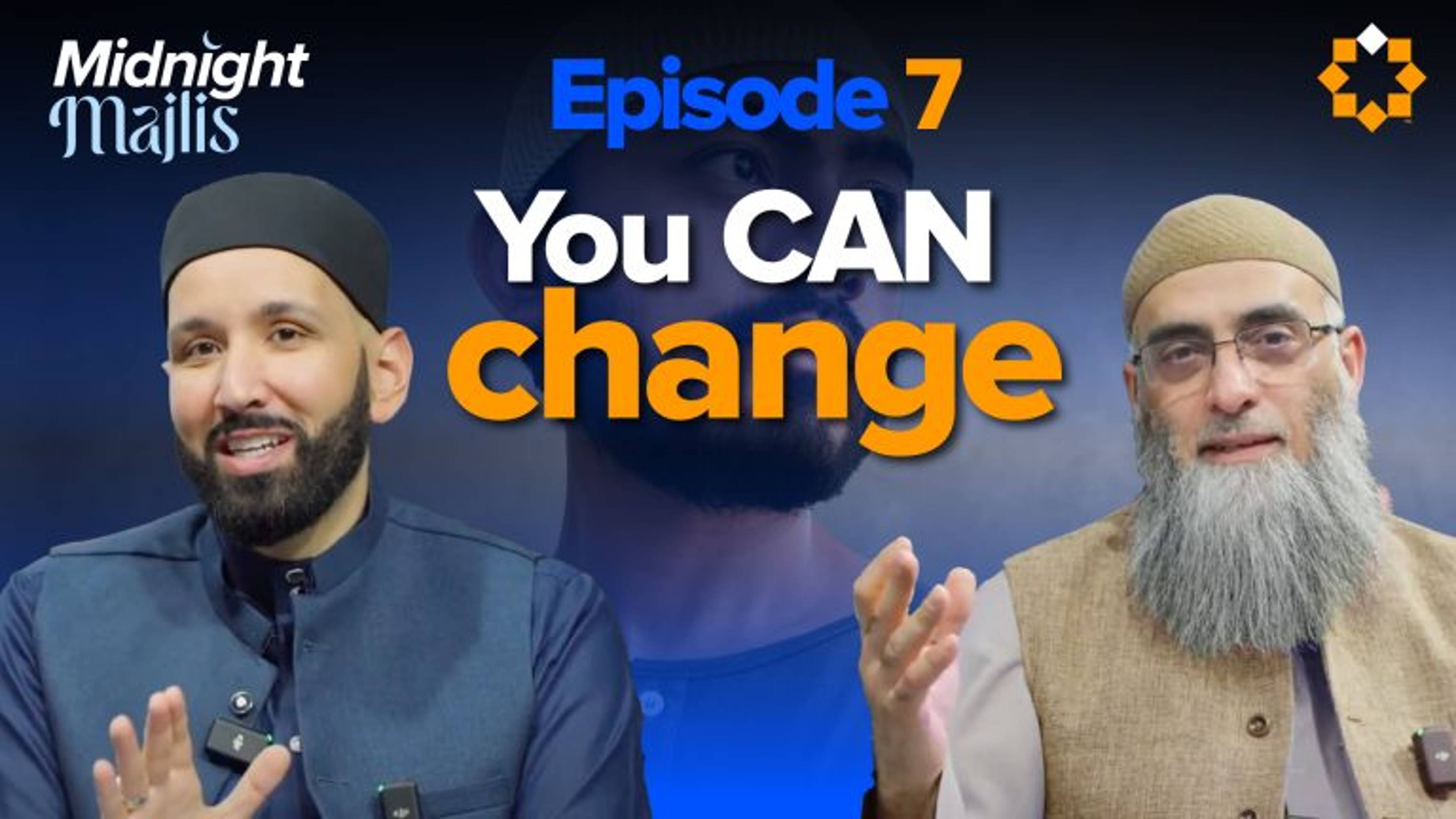
In this Midnight Majlis reflection, Dr. Omar Suleiman and Sh. Yaser Birjas explore Ibn Hazm’s advice about knowledge, ego, and the difference between true guidance and performative learning.
Ramadan is whirling by. Automate your donations for the last 10 nights.
This transcript was auto-generated using AI and may contain misspellings.
00:00As-salamu alaykum wa rahmatullahi wa barakatuhu. Alhamdulillah rabbil alameen, wa salatu wa salamu ala nabiyyina Muhammadin (ﷺ) wa ala alihi wa sahbihi wa sallam tasliman kathiran amma ba'd. Welcome back to the third night of the last ten nights, the 23rd night of Ramadan,
00:14this year from Valley Ranch Islamic Center. As we study together the beautiful book of Imam Ibn Hazm, Al-Akhlaq wa al-Siyar, Morals and Behaviors. Alhamdulillah, we have here Shaykh Omar.
00:28As always, we exchange these thoughts and ideas. And we were discussing this chapter actually earlier on the subject of knowledge. So those who are having the English version of it, it's going to be chapter 4, page 12, inshallah. Chapter 4, page 12. You can follow with us inshallah.
00:42If you have the Arabic version, it's on page 87, inshallah. Shaykh Omar, we were talking about this earlier, subhanAllah, the beginning of the night, how amazing this chapter is on the subject of knowledge, how Ibn Hazm, rahimahullah,
00:54the way he views the subject of knowledge and its value and how important it is for every human being and every individual, it's very unique. So bismillah, take us through that journey. Jazakumullah khair.
01:06So just to build, the first night we talked about what? The removal of what, as the goal of every human being? The removal of anxiety. And then yesterday we talked about what? The removal of ego, right?
01:20So the type of knowledge that Ibn Hazm, rahimahullah, is talking about here is that which removes anxiety and ego, right? So basically he's talking about higher pursuits, and you're right,
01:32it's the pursuit of knowledge that ultimately he sees as such a high pursuit. So we'll start inshallah. Qala rahimahullah Ibn Hazm: "Wa amma al-ilmu fa fadluhu azim."
01:44He says, "As for knowledge, its virtue is immense." "Wa huwa al-ladhi yajma'u laka al-fadail kullaha." "It is that which gathers for you all virtues."
01:56"Wa yaksibuka al-hasanat kullaha." "And it earns for you all good deeds." "Wa yughnika 'an al-shukuk al-mutiba."
02:08"And it suffices you from exhausting doubts." "Wa 'an al-amal al-kadhiba." "And from false hopes."
02:20"Wa 'an al-afkar al-mu'lima." "And from painful thoughts." "Fa in lam yakun fi fadlihi illa hadha la kafa."
02:32"If there were no virtue in it except this, it would suffice." So he's saying, look, knowledge, its virtue is immense. It gathers for you all virtues, it earns for you all good deeds.
02:44It helps you, it removes all your doubtful thoughts. Like when you have knowledge, all doubts are gone, alhamdulillah rabbil alameen. And these are exhausting doubts. You know, some people, they keep back and forth thinking about stuff that worries them
02:56and start getting into anxiety and they feel scared of these thoughts. He goes, knowledge will remove that for you. And also having false hopes for things.
03:08They keep trying to hope for things that will bring you nothing but pain. Like, for example, the pursuit of haram. They hope to get this much money so they can acquire a specific gain from this dunya
03:20or commit a sin, just false hopes. Knowledge will help you cut those hopes out. And also, it will suffice you from going through thoughts and ideas,
03:32building ideas that will bring you nothing but pain. Keep trying to build in your mind an idea that is not even achievable or wrong or haram and bring you nothing but pain.
03:44He says, if that is not enough as a rada, a deterrent, if the ilm is not enough to deter you from these thoughts, he goes, then I don't know what else I can tell you about its benefit
03:56in addition to what we mentioned before. Then he made a comparison. He said, that's why you see the kings, he has animosity about the political class of his time, obviously, from what happened to him.
04:08That's why you see all these kings doing what? They don't have that himmah, that high aspiration to pursue that knowledge. So what do they do? They go distract themselves with things like he mentioned over here:
04:20playing chess, playing games, and hunting, and drinking, and singing, and partying, and clubbing, basically. And that's what they do because they don't have that resolve
04:32or that himmah, that high aspiration to be knowledgeable people. So he says, "Fa ma al-fa'ida min dhalika?" Like, basically, what did I get out of this? Nothing.
04:44So is there any benefit from what they're doing? Absolutely nothing. Can I actually comment on his breakdown here? This is a different approach to ilm than any book of tazkiyah
04:56where you read about the virtues of ilm. Usually, when you open up, like Mukhtasar Minhaj al-Qasidin, which we study, ilm comes very quickly. But when you're studying the virtues of knowledge,
05:08it's fadl al-alim, the virtue of the scholar, or the virtue of... But here he's actually talking about your psychological well-being as a result of studying Islam. That's actually incredible.
05:20Your psychological well-being as a result of being thoroughly studied in Islam. So the first one is doubts. Your doubts are exhausting you. Okay, "Innama yakhsha Allaha min ibadihi al-ulama."
05:32Those who truly are in awe of Allah are people of knowledge, not people who indulge themselves in theory or indulge themselves in all these philosophies and talk about Islam in an academic way.
05:44You know, subhanAllah, one of those beautiful things I heard from Shaykh Tahir Wyatt, hafidh Allah, and I actually included it in my series, that some people know about Allah, but they don't know Allah. I loved how he said that. Some people know about Allah, but they don't know Allah.
05:56So I stole that from Shaykh Tahir. I've never stolen anything from Shaykh Yasser. I'll give you one. People have information about Allah. They don't have knowledge about Allah. Because Allah says, "Fa'lam annahu la ilaha illallah."
06:08Have the knowledge that there is no God worthy of worship but Allah. So people don't really have the knowledge of Allah. They have information about Allah, which is, subhanAllah, a lot of our younger generation today, and I see that as well.
06:20People come out, you know, boldly speaking about this, you know, in social media, why they left Islam, which brings a valid point that you would say is based on knowledge.
06:32Yeah, and you don't see people that are students of knowledge leaving Islam, like you see people that reach the epitome of knowledge in other traditions leaving those traditions to come to Islam as a natural progression.
06:44Like, I came to a realization that this is the way of Ibrahim (AS), this is the way of Isa (AS). How many students of knowledge do you see leaving Islam? Because even when you're reading a book of taharah,
06:56you're increasing in your yaqeen, you're increasing in your certainty. Sorry, it's a shameless plug. You're increasing in your certainty, you're increasing in your faith. I'm serious.
07:08You study water in the Sharia, you're like, if this is how much we have to learn about water, then how much more is there? This is so clearly based in something divine that Allah Azza wa Jalla has given us the basis by which we can know so much around us.
07:20That's why knowledge became a culture in Islam. How is it that ilm produced the greatest societies? How is it that Muslim scholars became at the forefront of mathematics and science and medicine?
07:32Because knowledge becomes addictive. And that's something that he's talking about here. Like, it becomes an addiction, and it dispels exhausting doubts. So the first thing is you become solid in your faith.
07:44So the first, you know, when someone comes to me and says that they're thinking about leaving Islam or that they're having questions about their faith, the first thing I say to them is, well, not everyone, obviously it's a different situation here and there,
07:56but one of the first things I usually say to someone is, like, did you ever really give it a chance before you left it? Like, did you ever really study it in order for you to come to the conclusion that it's not for you? Most of the time it's a personal trauma or something that's inducing the doubt,
08:08something emotional. But like, hey, did you ever really dive deep into this? Because there's something, subhanAllah, when you're in it, that peace of mind. Remember yesterday we were talking about peace of mind? Peace of mind.
08:20I know that I'm studying al-haqq. Like, I study the Prophet's life (ﷺ), and every single time I open up a book of seerah or anything about the Prophet (ﷺ), sadaqa Rasulullah (ﷺ), sadaqa Rasulullah (ﷺ), sadaqa Rasulullah (ﷺ).
08:32Like, this man is indeed a Prophet of Allah, and he speaks the truth. You become more attached to it. So dispelling of doubts. And then he mentions the endless fantasies that only produce stress, right?
08:44So he's talking about this world. If you know the nature of this world, then you won't be deceived by this world. So he's talking about the psychology of knowledge again.
08:56Like, I want to memorize more, I want to learn more, I want to read more, I'm getting addicted to this. So I'm not going to be deceived by all of these other lowly pursuits in this situation. And then the mental burden of a painful distraction.
09:08When you go through the natural difficulties of life, you will immediately go to Yusuf (AS), you will go to Ayyub (AS), you will go to this person and that person, you will go to Ta'if,
09:20you will go to Am al-Huzn, you will go to these beautiful words and these beautiful books of tazkiyah and the tribulations of the scholars, and it will give you peace of mind. Like, wait a minute, they went through this as well.
09:32You're elevating yourself, and you're putting yourself in the fraternity of these scholars. So be a scholar or be a student or be a follower. Be a scholar, be a student, be a lover, or be a follower,
09:44but don't be a fifth thing. Don't exclude yourself from the fraternity that surrounds knowledge. And wallahi, what I want to share with you all, dear brothers and sisters, come to the halaqat in the masjid after Ramadan is over.
09:56Come to the halaqat. Don't just suffice yourself with listening to lectures online. Go to the masjid, sit in the circles of knowledge. Shaykh Yasser does Taqseed, where they're reading classical texts as well.
10:08Be a part of your local halaqat, your local study circles, and you will see that not only is your faith increasing, but your worries are decreasing. Like, you're becoming a more purposeful person.
10:20When you're more purposeful, then it puts everything in perspective. So knowledge improves your psychology as well. I want to comment on something that is very important. I don't want to offend anybody here,
10:32but again, one of the signs of truly seeking knowledge, the knowledge that stays with you, is taking notes, really. And if you're not taking notes, you're just only enjoying the moment, that's all.
10:44You feel that your iman is increasing. And I heard from a brother yesterday, he's here in the crowd as well. He goes, I was sitting there, and every second you say something, I'm going to read these ones.
10:56He goes, it was all amazing. I don't know which one to keep. I said, if you really were taking notes, you wouldn't miss any one of them. So, my dear brothers and sisters, our scholars say,
11:08first of all, knowledge requires practice, which means if the knowledge is followed with practice, it stays. And also they said, "Al-ilmu saydu wa al-kitabatu qayduhu."
11:20Knowledge is just like a game, like you go hunting, for example, and your documentation is just like these strong ropes that you hold these animals to or these games to.
11:32Make sure that you hold your prize by tying it down very well. So documentation of knowledge is extremely, extremely important. The other thing, Shaykh, when you were talking about, as we were talking about knowledge,
11:44there is nothing little when it comes to the subject of knowledge, as long as it's truly a piece of knowledge or a piece of information that translates into knowledge. It's always virtuous.
11:56Allah subhanahu wa ta'ala, when He says in the Quran, He said, "Kunu rabbaniyyin bima kuntum tu'allimuna al-kitaba wa bima kuntum tadrusun." Be Rabbani by what you were teaching the book and what you were studying.
12:08But be Rabbani. The word Rabbani comes from the word rabb, which means to nurture, to grow, to raise. So the ulama, they say, "Al-Rabbani huwa al-ladhi yurabbi al-nasa bi sighar al-ilm qabla kibarih."
12:20The Rabbani is the one who raises people with the small matters of knowledge before the big matters of knowledge. So you start with the basics. And that's why, subhanAllah, when you look at the books of fiqh,
12:32they start with what? Taharah, purification. And some people, they say, "Why do we have to start with taharah? Why don't we start with something more interesting, like jihad or something like that?"
12:44Because that's what really, it's interesting. But to begin with something as basic as how even to use the bathroom, for them that's very inferior. And Hudhayfah (رضي الله عنه), when he was asked one time by an unbeliever,
12:56he says, like, your messenger, he taught you everything, including how to use the bathroom. He didn't use it that way. He actually used the actual slang word for using the bathroom.
13:08I don't need that right now. We already had the Roman's risk moment last year. Let's keep it clean. So he said to him, your Prophet (ﷺ) taught you everything, no, no, don't do it, please don't do it, how to use the bathroom.
13:20He said, yes, he did. He taught us how to use the bathroom. He said, basically, when you come to the bathroom, you know how to enter with your left foot and come out, of course, with your right, and don't use your right hand,
13:32and make the du'a, the basic things, the basic thing that I can tell a lot of adults probably they don't really know them, even though they probably have learned them at a young age, but we don't practice that. So knowledge, what he means by that again
13:44is the knowledge that stays with you, and that's when he comes next to the point. He said, "Wa man qadara ala talab al-ilm al-a'la fa lam yatlubhu fa huwa ka man yazra'u al-sha'ir fi ard al-hintah."
13:56He said, look, someone who is capable of seeking higher level of knowledge but they don't take that path, like they don't pursue the higher level of knowledge and education for themselves in matters of dunya and the akhirah as well too,
14:08it doesn't really matter. Like, if you can pursue higher education to become more knowledgeable and smarter and hopefully have a depth of that knowledge, because this is just like someone who is, unfortunately, planting corn
14:20in a field that gives you wheat. Like, yeah, you might get that corn, but it's not as valuable, it's not as good, it's not as maybe lucrative for you. So some of us are sitting here, their talents, it's amazing, unbelievable.
14:32And I think what's happening today is teaching many people to kind of summarize all their skills into one particular question, an equation I need to solve so they can get a PhD for it. And after that, that's it.
14:44They just kind of limit themselves and their ability to become encyclopedia of knowledge simply because they have been taught to take that path. I think, Shaykh, it's also like what I get from this text is why are you selling yourself so short?
14:56Like, you look around, I memorize a couple of verses of the Quran, I know a little bit here and there. Who are you comparing yourself to? We know people that convert to Islam, and within a few years,
15:08they memorize the Quran, they speak Arabic, they read the text and understand it. Why are you comparing yourself to the quote-unquote the average Muslim? So, yeah, you can say I know how to pray, I know how to do this, I know how to do that.
15:20Okay, you have been Muslim for 20, 25, 30 years. Why are you putting yourself at such a low level? You got your corn, you got a little bit here and there.
15:32And we are not saying the only alternative is to become a scholar, to become a shaykh, to become Imam Bukhari. No, no. Why weren't you building yourself this entire time? You have more capability, and Allah will ask you about that capacity as well.
15:44Just like Allah will ask you about the capacity of your health and your wealth and everything else, you had capacity to study more, to learn more. What caused you to learn less?
15:56By the way, Shaykh, one more thing I just came to my mind from yesterday. Jahl, the word jahl, of course, ignorance. We talk about jahl. Allah speaks of that pre-prophetic era as jahl.
16:08You know what the word jahl also means in Arabic poetry? Anyone know? Anger. Someone who is foul, who is angry, right? And subhanAllah, this idea, that's actually how some of the scholars of tafsir would talk about the ayah,
16:20"Wa ibad al-Rahman alladhina yamshuna ala al-ard hawnan wa idha khatabahum al-jahiluna qalu salama." The servants of the Most Merciful, when the ignorant approach them, ignorant of what? There are different Arabic poetries here. The word jahl, ignorance here,
16:32refers to a person who is actually foul-mouthed, who has no sense of control over their temper. What are they ignorant of? They are ignorant of themselves, right? They become fools. How are they acting foolish? How are they acting ignorant?
16:44The ignorance of Allah is the ignorance of self. You stop knowing how to behave, you stop knowing how to act, you stop knowing how to pursue, what to pursue. That ignorance is going to make you ignorant of purpose, ignorant of potential,
16:56as is what is being described here. Why are you pursuing something so little? You know what you are capable of. You could have done this a long time ago. You could have read so much more. I ask each and every single one of you,
17:08as we come towards the end of Ramadan, did you really read as much Quran as you were capable of? Why did you set the bar so low for yourself? You could have done more. You know that if you put a higher bar for yourself, you would have pushed yourself further.
17:20Why were you complacent with such a low goal for yourself? This is also part of what he is speaking about here in this regard. Now he is moving to talk about, now spreading that knowledge.
17:32His two points over here. Number one, make sure you don't spread that knowledge to the people who don't really appreciate that. Frankly, this is the most common today in our social media era. Why? Because a lot of people,
17:44they look for controversial questions and answers and issues, and then they go and put maybe a one-minute, two-minute video on that just for the sake of adding content. And eventually, you can check the comment section.
17:56The comment section is just unbelievable because these people don't even understand the background of the matter. So everybody is giving their fatwa because they have a microphone and they have access to a keyboard. So the idea is you have to be careful,
18:08even as a student of knowledge. When you give knowledge, give it to those who appreciate that and make sure to gauge and scale your audience, your people, your crowd, even online as well too. Because you have to be careful.
18:20The second thing he says, "Wa la tamnahu ila man la yastahiqquhu." Don't give it to those who don't deserve it. And then he says, "Wa la tamnahu ila man yastahiqquhu."
18:32And don't withhold it from those who deserve it. So he's saying, look, be careful. Don't give knowledge to those who don't deserve it, and don't withhold it from those who deserve it. So there's a balance here.
18:44You have to be wise in how you spread knowledge, inshallah ta'ala. Now, before we close, actually there is that point that we marveled at when we were talking earlier about it, subhanAllah. I want you to read and translate that for us.
18:56I love this section. This is like the real Ibn Hazm. So if there is any scholar in Islamic history that can be described as no filter, it is Ibn Hazm, rahimahullah, by the way. Like I said, even that praised him.
19:08They said, sometimes his tongue was sharp on some of the other scholars and things of that sort. And he is very transparent, very honest about himself as well too. The whole chapter that he is going to speak about his own faults, subhanAllah.
19:20Yeah, we have a chapter on his own faults where he writes about his faults. But he says, "Ghazani ahl al-jahl marratayni min umri." He said, ignorant people, again, if you were to use slang,
19:32but we are not going to do that because we are not going to go viral, right. But ignorant people made me mad twice in my life. One, when I was in my own days of ignorance, when they spoke about things
19:44that they had no idea about. So they spoke about things that they did not understand. And I was, I was very angry. And then he says, "Wa al-ukhra ba'd an a'lamani Allah." And the second time was after Allah taught me, when I see them speaking about things
19:56that they have no idea about. So he's saying, look, ignorant people made me mad twice. Once when I was ignorant myself, and once when I became knowledgeable. Because I see them speaking about things that they have no idea about.
20:08And this is a very important point. Like, you know, when you see people speaking about things that they have no idea about, it's very frustrating. And Ibn Hazm is saying, look, this is something that made me mad twice in my life.
20:20Once when I was ignorant, and once when I became knowledgeable. So, you know, be careful. Don't speak about things that you have no idea about. And if you see people speaking about things that they have no idea about,
20:32don't engage with them. Just move on, inshallah ta'ala. Now, he says, "Wa amma al-ilm fa fadluhu azim." He says, as for knowledge, its virtue is immense.
20:44"Wa huwa al-ladhi yajma'u laka al-fadail kullaha." It is that which gathers for you all virtues. "Wa yaksibuka al-hasanat kullaha."
20:56And it earns for you all good deeds. "Wa yughnika 'an al-shukuk al-mutiba." And it suffices you from exhausting doubts.
21:08"Wa 'an al-amal al-kadhiba." And from false hopes. "Wa 'an al-afkar al-mu'lima."
21:20And from painful thoughts. "Fa in lam yakun fi fadlihi illa hadha la kafa." If there were no virtue in it except this, it would suffice.
21:32So he's saying, look, knowledge, its virtue is immense. It gathers for you all virtues, it earns for you all good deeds. It helps you, it removes all your doubtful thoughts.
21:44Like when you have knowledge, all doubts are gone, alhamdulillah rabbil alameen. And these are exhausting doubts. You know, some people, they keep back and forth thinking about stuff that worries them and start getting into anxiety and they feel scared of these thoughts.
21:56He goes, knowledge will remove that for you. And also having false hopes for things. They keep trying to hope for things that will bring you nothing but pain.
22:08Like, for example, the pursuit of haram. They hope to get this much money so they can acquire a specific gain from this dunya or commit a sin, just false hopes.
22:20Knowledge will help you cut those hopes out. And also, it will suffice you from going through thoughts and ideas, building ideas that will bring you nothing but pain.
22:32Keep trying to build in your mind an idea that is not even achievable or wrong or haram and bring you nothing but pain. He says, if that is not enough as a rada, a deterrent,
22:44if the ilm is not enough to deter you from these thoughts, he goes, then I don't know what else I can tell you about its benefit in addition to what we mentioned before.
22:56Then he made a comparison. He said, that's why you see the kings, he has animosity about the political class of his time, obviously, from what happened to him. That's why you see all these kings doing what?
23:08They don't have that himmah, that high aspiration to pursue that knowledge. So what do they do? They go distract themselves with things like he mentioned over here: playing chess, playing games, and hunting, and drinking,
23:20and singing, and partying, and clubbing, basically. And that's what they do because they don't have that resolve or that himmah, that high aspiration to be knowledgeable people.
23:32So he says, "Fa ma al-fa'ida min dhalika?" Like, basically, what did I get out of this? Nothing. So is there any benefit from what they're doing? Absolutely nothing.
23:44Can I actually comment on his breakdown here? This is a different approach to ilm than any book of tazkiyah where you read about the virtues of ilm.
23:56Usually, when you open up, like Mukhtasar Minhaj al-Qasidin, which we study, ilm comes very quickly. But when you're studying the virtues of knowledge, it's fadl al-alim, the virtue of the scholar,
24:08or the virtue of... But here he's actually talking about your psychological well-being as a result of studying Islam. That's actually incredible. Your psychological well-being as a result of being thoroughly studied in Islam.
24:20So the first one is doubts. Your doubts are exhausting you. Okay, "Innama yakhsha Allaha min ibadihi al-ulama." Those who truly are in awe of Allah are people of knowledge,
24:32not people who indulge themselves in theory or indulge themselves in all these philosophies and talk about Islam in an academic way. You know, subhanAllah, one of those beautiful things I heard from Shaykh Tahir Wyatt, hafidh Allah,
24:44and I actually included it in my series, that some people know about Allah, but they don't know Allah. I loved how he said that. Some people know about Allah, but they don't know Allah. So I stole that from Shaykh Tahir. I've never stolen anything from Shaykh Yasser.
24:56I'll give you one. People have information about Allah. They don't have knowledge about Allah. Because Allah says, "Fa'lam annahu la ilaha illallah." Have the knowledge that there is no God worthy of worship but Allah.
25:08So people don't really have the knowledge of Allah. They have information about Allah, which is, subhanAllah, a lot of our younger generation today, and I see that as well. People come out, you know, boldly speaking about this, you know, in social media,
25:20why they left Islam, which brings a valid point that you would say is based on knowledge. Yeah, and you don't see people that are students of knowledge leaving Islam,
25:32like you see people that reach the epitome of knowledge in other traditions leaving those traditions to come to Islam as a natural progression. Like, I came to a realization that this is the way of Ibrahim (AS),
25:44this is the way of Isa (AS). How many students of knowledge do you see leaving Islam? Because even when you're reading a book of taharah, you're increasing in your yaqeen, you're increasing in your certainty.
25:56Sorry, it's a shameless plug. You're increasing in your certainty, you're increasing in your faith. I'm serious. You study water in the Sharia, you're like, if this is how much we have to learn about water,
26:08then how much more is there? This is so clearly based in something divine that Allah Azza wa Jalla has given us the basis by which we can know so much around us. That's why knowledge became a culture in Islam.
26:20How is it that ilm produced the greatest societies? How is it that Muslim scholars became at the forefront of mathematics and science and medicine? Because knowledge becomes addictive. And that's something that he's talking about here.
26:32Like, it becomes an addiction, and it dispels exhausting doubts. So the first thing is you become solid in your faith. So the first, you know, when someone comes to me and says that they're thinking about leaving Islam
26:44or that they're having questions about their faith, the first thing I say to them is, well, not everyone, obviously it's a different situation here and there, but one of the first things I usually say to someone is, like, did you ever really give it a chance before you left it?
26:56Like, did you ever really study it in order for you to come to the conclusion that it's not for you? Most of the time it's a personal trauma or something that's inducing the doubt, something emotional. But like, hey, did you ever really dive deep into this?
27:08Because there's something, subhanAllah, when you're in it, that peace of mind. Remember yesterday we were talking about peace of mind? Peace of mind. I know that I'm studying al-haqq. Like, I study the Prophet's life (ﷺ),
27:20and every single time I open up a book of seerah or anything about the Prophet (ﷺ), sadaqa Rasulullah (ﷺ), sadaqa Rasulullah (ﷺ), sadaqa Rasulullah (ﷺ). Like, this man is indeed a Prophet of Allah, and he speaks the truth.
27:32You become more attached to it. So dispelling of doubts. And then he mentions the endless fantasies that only produce stress, right? So he's talking about this world. If you know the nature of this world,
27:44then you won't be deceived by this world. So he's talking about the psychology of knowledge again. Like, I want to memorize more, I want to learn more, I want to read more,
27:56I'm getting addicted to this. So I'm not going to be deceived by all of these other lowly pursuits in this situation. And then the mental burden of a painful distraction. When you go through the natural difficulties of life, you will immediately
28:08go to Yusuf (AS), you will go to Ayyub (AS), you will go to this person and that person, you will go to Ta'if, you will go to Am al-Huzn, you will go to these beautiful words
28:20and these beautiful books of tazkiyah and the tribulations of the scholars, and it will give you peace of mind. Like, wait a minute, they went through this as well. You're elevating yourself, and you're putting yourself in the fraternity of these scholars.
28:32So be a scholar or be a student or be a follower. Be a scholar, be a student, be a lover, or be a follower, but don't be a fifth thing. Don't exclude yourself from the fraternity that surrounds knowledge.
28:44And wallahi, what I want to share with you all, dear brothers and sisters, come to the halaqat in the masjid after Ramadan is over. Come to the halaqat. Don't just suffice yourself with listening to lectures online.
28:56Go to the masjid, sit in the circles of knowledge. Shaykh Yasser does Taqseed, where they're reading classical texts as well. Be a part of your local halaqat, your local study circles,
29:08and you will see that not only is your faith increasing, but your worries are decreasing. Like, you're becoming a more purposeful person. When you're more purposeful, then it puts everything in perspective.
29:20So knowledge improves your psychology as well. I want to comment on something that is very important. I don't want to offend anybody here, but again, one of the signs of truly seeking knowledge,
29:32the knowledge that stays with you, is taking notes, really. And if you're not taking notes, you're just only enjoying the moment, that's all. You feel that your iman is increasing. And I heard from a brother yesterday,
29:44he's here in the crowd as well. He goes, I was sitting there, and every second you say something, I'm going to read these ones. He goes, it was all amazing. I don't know which one to keep.
29:56I said, if you really were taking notes, you wouldn't miss any one of them. So, my dear brothers and sisters, our scholars say, first of all, knowledge requires practice, which means
30:08if the knowledge is followed with practice, it stays. And also they said, "Al-ilmu saydu wa al-kitabatu qayduhu." Knowledge is just like a game, like you go hunting, for example,
30:20and your documentation is just like these strong ropes that you hold these animals to or these games to. Make sure that you hold your prize by tying it down very well.
30:32So documentation of knowledge is extremely, extremely important. The other thing, Shaykh, when you were talking about, as we were talking about knowledge, there is nothing little when it comes to the subject of knowledge,
30:44as long as it's truly a piece of knowledge or a piece of information that translates into knowledge. It's always virtuous. Allah subhanahu wa ta'ala, when He says in the Quran, He said,
30:56"Kunu rabbaniyyin bima kuntum tu'allimuna al-kitaba wa bima kuntum tadrusun." Be Rabbani by what you were teaching the book and what you were studying. But be Rabbani. The word Rabbani comes from the word rabb,
31:08which means to nurture, to grow, to raise. So the ulama, they say, "Al-Rabbani huwa al-ladhi yurabbi al-nasa bi sighar al-ilm qabla kibarih." The Rabbani is the one who raises people with the small matters of knowledge
31:20before the big matters of knowledge. So you start with the basics. And that's why, subhanAllah, when you look at the books of fiqh, they start with what? Taharah, purification.
31:32And some people, they say, "Why do we have to start with taharah? Why don't we start with something more interesting, like jihad or something like that?" Because that's what really, it's interesting. But to begin with something as basic as
31:44how even to use the bathroom, for them that's very inferior. And Hudhayfah (رضي الله عنه), when he was asked one time by an unbeliever, he says, like, your messenger, he taught you everything,
31:56including how to use the bathroom. He didn't use it that way. He actually used the actual slang word for using the bathroom. I don't need that right now. We already had the Roman's risk moment last year.
32:08Let's keep it clean. So he said to him, your Prophet (ﷺ) taught you everything, no, no, don't do it, please don't do it, how to use the bathroom. He said, yes, he did. He taught us how to use the bathroom.
32:20He said, basically, when you come to the bathroom, you know how to enter with your left foot and come out, of course, with your right, and don't use your right hand, and make the du'a, the basic things, the basic thing that I can tell a lot of adults
32:32probably they don't really know them, even though they probably have learned them at a young age, but we don't practice that. So knowledge, what he means by that again is the knowledge that stays with you, and that's when he comes next to the point.
32:44He said, "Wa man qadara ala talab al-ilm al-a'la fa lam yatlubhu fa huwa ka man yazra'u al-sha'ir fi ard al-hintah." He said, look, someone who is capable of seeking higher level of knowledge
32:56but they don't take that path, like they don't pursue the higher level of knowledge and education for themselves in matters of dunya and the akhirah as well too, it doesn't really matter. Like, if you can pursue higher education
33:08to become more knowledgeable and smarter and hopefully have a depth of that knowledge, because this is just like someone who is, unfortunately, planting corn in a field that gives you wheat. Like, yeah, you might get that corn,
33:20but it's not as valuable, it's not as good, it's not as maybe lucrative for you. So some of us are sitting here, their talents, it's amazing, unbelievable. And I think what's happening today is teaching many people to kind of summarize all their skills
33:32into one particular question, an equation I need to solve so they can get a PhD for it. And after that, that's it. They just kind of limit themselves and their ability to become encyclopedia of knowledge
33:44simply because they have been taught to take that path. I think, Shaykh, it's also like what I get from this text is why are you selling yourself so short? Like, you look around, I memorize a couple of verses of the Quran,
33:56I know a little bit here and there. Who are you comparing yourself to? We know people that convert to Islam, and within a few years, they memorize the Quran, they speak Arabic, they read the text and understand it.
34:08Why are you comparing yourself to the quote-unquote the average Muslim? So, yeah, you can say I know how to pray, I know how to do this, I know how to do that. Okay, you have been Muslim for 20, 25, 30 years.
34:20Why are you putting yourself at such a low level? You got your corn, you got a little bit here and there. And we are not saying the only alternative is to become a scholar, to become a shaykh,
34:32to become Imam Bukhari. No, no. Why weren't you building yourself this entire time? You have more capability, and Allah will ask you about that capacity as well. Just like Allah will ask you about the capacity of your health and your wealth and everything else,
34:44you had capacity to study more, to learn more. What caused you to learn less? By the way, Shaykh, one more thing I just came to my mind from yesterday.
34:56Jahl, the word jahl, of course, ignorance. We talk about jahl. Allah speaks of that pre-prophetic era as jahl. You know what the word jahl also means in Arabic poetry? Anyone know?
35:08Anger. Someone who is foul, who is angry, right? And subhanAllah, this idea, that's actually how some of the scholars of tafsir would talk about the ayah, "Wa ibad al-Rahman alladhina yamshuna ala al-ard hawnan wa idha khatabahum al-jahiluna qalu salama."
35:20The servants of the Most Merciful, when the ignorant approach them, ignorant of what? There are different Arabic poetries here. The word jahl, ignorance here, refers to a person who is actually foul-mouthed, who has no sense of control over their temper.
35:32What are they ignorant of? They are ignorant of themselves, right? They become fools. How are they acting foolish? How are they acting ignorant? The ignorance of Allah is the ignorance of self. You stop knowing how to behave,
35:44you stop knowing how to act, you stop knowing how to pursue, what to pursue. That ignorance is going to make you ignorant of purpose, ignorant of potential, as is what is being described here. Why are you pursuing something so little?
35:56You know what you are capable of. You could have done this a long time ago. You could have read so much more. I ask each and every single one of you, as we come towards the end of Ramadan, did you really read as much Quran as you were capable of?
36:08Why did you set the bar so low for yourself? You could have done more. You know that if you put a higher bar for yourself, you would have pushed yourself further. Why were you complacent with such a low goal for yourself?
36:20This is also part of what he is speaking about here in this regard. Now he is moving to talk about, now spreading that knowledge. His two points over here. Number one, make sure you don't spread that knowledge
36:32to the people who don't really appreciate that. Frankly, this is the most common today in our social media era. Why? Because a lot of people, they look for controversial questions and answers and issues,
36:44and then they go and put maybe a one-minute, two-minute video on that just for the sake of adding content. And eventually, you can check the comment section. The comment section is just unbelievable because these people don't even understand the background of the matter.
36:56So everybody is giving their fatwa because they have a microphone and they have access to a keyboard. So the idea is you have to be careful, even as a student of knowledge. When you give knowledge, give it to those who appreciate that
37:08and make sure to gauge and scale your audience, your people, your crowd, even online as well too. Because you have to be careful. The second thing he says, "Wa la tamnahu ila man la yastahiqquhu."
37:20Don't give it to those who don't deserve it. And then he says, "Wa la tamnahu ila man yastahiqquhu." And don't withhold it from those who deserve it.
37:32So he's saying, look, be careful. Don't give knowledge to those who don't deserve it, and don't withhold it from those who deserve it. So there's a balance here. You have to be wise in how you spread knowledge, inshallah ta'ala.
37:44Now, before we close, actually there is that point that we marveled at when we were talking earlier about it, subhanAllah. I want you to read and translate that for us. I love this section. This is like the real Ibn Hazm.
37:56So if there is any scholar in Islamic history that can be described as no filter, it is Ibn Hazm, rahimahullah, by the way. Like I said, even that praised him. They said, sometimes his tongue was sharp on some of the other scholars
38:08and things of that sort. And he is very transparent, very honest about himself as well too. The whole chapter that he is going to speak about his own faults, subhanAllah. Yeah, we have a chapter on his own faults where he writes about his faults.
38:20But he says, "Ghazani ahl al-jahl marratayni min umri." He said, ignorant people, again, if you were to use slang, but we are not going to do that because we are not going to go viral, right.
38:32But ignorant people made me mad twice in my life. One, when I was in my own days of ignorance, when they spoke about things that they had no idea about. So they spoke about things that they did not understand.
38:44And I was, I was very angry. And then he says, "Wa al-ukhra ba'd an a'lamani Allah." And the second time was after Allah taught me, when I see them speaking about things that they have no idea about. So he's saying, look, ignorant people made me mad twice.
38:56Once when I was ignorant myself, and once when I became knowledgeable. Because I see them speaking about things that they have no idea about. And this is a very important point. Like, you know, when you see people speaking about things
39:08that they have no idea about, it's very frustrating. And Ibn Hazm is saying, look, this is something that made me mad twice in my life. Once when I was ignorant, and once when I became knowledgeable.
39:20So, you know, be careful. Don't speak about things that you have no idea about. And if you see people speaking about things that they have no idea about, don't engage with them. Just move on, inshallah ta'ala.
39:32Now, he says, "Wa amma al-ilm fa fadluhu azim." He says, as for knowledge, its virtue is immense. "Wa huwa al-ladhi yajma'u laka al-fadail kullaha."
39:44It is that which gathers for you all virtues. "Wa yaksibuka al-hasanat kullaha." And it earns for you all good deeds.
39:56"Wa yughnika 'an al-shukuk al-mutiba." And it suffices you from exhausting doubts. "Wa 'an al-amal al-kadhiba."
40:08And from false hopes. "Wa 'an al-afkar al-mu'lima." And from painful thoughts.
40:20"Fa in lam yakun fi fadlihi illa hadha la kafa." If there were no virtue in it except this, it would suffice. So he's saying, look, knowledge, its virtue is immense.
40:32It gathers for you all virtues, it earns for you all good deeds. It helps you, it removes all your doubtful thoughts. Like when you have knowledge, all doubts are gone, alhamdulillah rabbil alameen.
40:44And these are exhausting doubts. You know, some people, they keep back and forth thinking about stuff that worries them and start getting into anxiety and they feel scared of these thoughts. He goes, knowledge will remove that for you.
40:56And also having false hopes for things. They keep trying to hope for things that will bring you nothing but pain. Like, for example, the pursuit of haram.
41:08They hope to get this much money so they can acquire a specific gain from this dunya or commit a sin, just false hopes. Knowledge will help you cut those hopes out.
41:20And also, it will suffice you from going through thoughts and ideas, building ideas that will bring you nothing but pain. Keep trying to build in your mind an idea that is not even achievable
41:32or wrong or haram and bring you nothing but pain. He says, if that is not enough as a rada, a deterrent, if the ilm is not enough to deter you from these thoughts,
41:44he goes, then I don't know what else I can tell you about its benefit in addition to what we mentioned before. Then he made a comparison. He said, that's why you see the kings,
41:56he has animosity about the political class of his time, obviously, from what happened to him. That's why you see all these kings doing what? They don't have that himmah, that high aspiration to pursue that knowledge.
42:08So what do they do? They go distract themselves with things like he mentioned over here: playing chess, playing games, and hunting, and drinking, and singing, and partying, and clubbing, basically.
42:20And that's what they do because they don't have that resolve or that himmah, that high aspiration to be knowledgeable people. So he says, "Fa ma al-fa'ida min dhalika?"
42:32Like, basically, what did I get out of this? Nothing. So is there any benefit from what they're doing? Absolutely nothing. Can I actually comment on his breakdown here?
42:44This is a different approach to ilm than any book of tazkiyah where you read about the virtues of ilm. Usually, when you open up, like Mukhtasar Minhaj al-Qasidin, which we study,
42:56ilm comes very quickly. But when you're studying the virtues of knowledge, it's fadl al-alim, the virtue of the scholar, or the virtue of... But here he's actually talking about your psychological well-being
43:08as a result of studying Islam. That's actually incredible. Your psychological well-being as a result of being thoroughly studied in Islam. So the first one is doubts. Your doubts are exhausting you.
43:20Okay, "Innama yakhsha Allaha min ibadihi al-ulama." Those who truly are in awe of Allah are people of knowledge, not people who indulge themselves in theory
43:32or indulge themselves in all these philosophies and talk about Islam in an academic way. You know, subhanAllah, one of those beautiful things I heard from Shaykh Tahir Wyatt, hafidh Allah, and I actually included it in my series, that some people know about Allah, but they don't know Allah.
43:44I loved how he said that. Some people know about Allah, but they don't know Allah. So I stole that from Shaykh Tahir. I've never stolen anything from Shaykh Yasser. I'll give you one. People have information about Allah.
43:56They don't have knowledge about Allah. Because Allah says, "Fa'lam annahu la ilaha illallah." Have the knowledge that there is no God worthy of worship but Allah. So people don't really have the knowledge of Allah. They have information about Allah,
44:08which is, subhanAllah, a lot of our younger generation today, and I see that as well. People come out, you know, boldly speaking about this, you know, in social media, why they left Islam, which brings a valid point
44:20that you would say is based on knowledge. Yeah, and you don't see people that are students of knowledge leaving Islam, like you see people that reach the epitome of knowledge in other traditions
44:32leaving those traditions to come to Islam as a natural progression. Like, I came to a realization that this is the way of Ibrahim (AS), this is the way of Isa (AS). How many students of knowledge do you see leaving Islam?
44:44Because even when you're reading a book of taharah, you're increasing in your yaqeen, you're increasing in your certainty. Sorry, it's a shameless plug. You're increasing in your certainty,
44:56you're increasing in your faith. I'm serious. You study water in the Sharia, you're like, if this is how much we have to learn about water, then how much more is there? This is so clearly based in something divine
45:08that Allah Azza wa Jalla has given us the basis by which we can know so much around us. That's why knowledge became a culture in Islam. How is it that ilm produced the greatest societies?
45:20How is it that Muslim scholars became at the forefront of mathematics and science and medicine? Because knowledge becomes addictive. And that's something that he's talking about here. Like, it becomes an addiction, and it dispels exhausting doubts.
45:32So the first thing is you become solid in your faith. So the first, you know, when someone comes to me and says that they're thinking about leaving Islam or that they're having questions about their faith, the first thing I say to them is,
45:44well, not everyone, obviously it's a different situation here and there, but one of the first things I usually say to someone is, like, did you ever really give it a chance before you left it? Like, did you ever really study it in order for you to come to the conclusion that it's not for you?
45:56Most of the time it's a personal trauma or something that's inducing the doubt, something emotional. But like, hey, did you ever really dive deep into this? Because there's something, subhanAllah, when you're in it, that peace of mind.
46:08Remember yesterday we were talking about peace of mind? Peace of mind. I know that I'm studying al-haqq. Like, I study the Prophet's life (ﷺ), and every single time I open up a book of seerah or anything about the Prophet (ﷺ),
46:20sadaqa Rasulullah (ﷺ), sadaqa Rasulullah (ﷺ), sadaqa Rasulullah (ﷺ). Like, this man is indeed a Prophet of Allah, and he speaks the truth. You become more attached to it. So dispelling of doubts.
46:32And then he mentions the endless fantasies that only produce stress, right? So he's talking about this world. If you know the nature of this world, then you won't be deceived by this world.
46:44So he's talking about the psychology of knowledge again. Like, I want to memorize more, I want to learn more, I want to read more, I'm getting addicted to this. So I'm not going to be deceived by all of these other lowly pursuits
46:56in this situation. And then the mental burden of a painful distraction. When you go through the natural difficulties of life, you will immediately go to Yusuf (AS), you will go to Ayyub (AS),
47:08you will go to this person and that person, you will go to Ta'if, you will go to Am al-Huzn, you will go to these beautiful words and these beautiful books of tazkiyah and the tribulations of the scholars,
47:20and it will give you peace of mind. Like, wait a minute, they went through this as well. You're elevating yourself, and you're putting yourself in the fraternity of these scholars. So be a scholar or be a student or be a follower.
47:32Be a scholar, be a student, be a lover, or be a follower, but don't be a fifth thing. Don't exclude yourself from the fraternity that surrounds knowledge. And wallahi, what I want to share with you all, dear brothers and sisters,
47:44come to the halaqat in the masjid after Ramadan is over. Come to the halaqat. Don't just suffice yourself with listening to lectures online. Go to the masjid, sit in the circles of knowledge.
47:56Shaykh Yasser does Taqseed, where they're reading classical texts as well. Be a part of your local halaqat, your local study circles, and you will see that not only is your faith increasing,
48:08but your worries are decreasing. Like, you're becoming a more purposeful person. When you're more purposeful, then it puts everything in perspective. So knowledge improves your psychology as well.
48:20I want to comment on something that is very important. I don't want to offend anybody here, but again, one of the signs of truly seeking knowledge, the knowledge that stays with you, is taking notes, really.
48:32And if you're not taking notes, you're just only enjoying the moment, that's all. You feel that your iman is increasing. And I heard from a brother yesterday, he's here in the crowd as well. He goes, I was sitting there,
48:44and every second you say something, I'm going to read these ones. He goes, it was all amazing. I don't know which one to keep. I said, if you really were taking notes, you wouldn't miss any one of them.
48:56So, my dear brothers and sisters, our scholars say, first of all, knowledge requires practice, which means if the knowledge is followed with practice, it stays.
49:08And also they said, "Al-ilmu saydu wa al-kitabatu qayduhu." Knowledge is just like a game, like you go hunting, for example, and your documentation is just like these strong ropes
49:20that you hold these animals to or these games to. Make sure that you hold your prize by tying it down very well. So documentation of knowledge is extremely, extremely important.
49:32The other thing, Shaykh, when you were talking about, as we were talking about knowledge, there is nothing little when it comes to the subject of knowledge, as long as it's truly a piece of knowledge or a piece of information
49:44that translates into knowledge. It's always virtuous. Allah subhanahu wa ta'ala, when He says in the Quran, He said, "Kunu rabbaniyyin bima kuntum tu'allimuna al-kitaba wa bima kuntum tadrusun."
49:56Be Rabbani by what you were teaching the book and what you were studying. But be Rabbani. The word Rabbani comes from the word rabb, which means to nurture, to grow, to raise.
50:08So the ulama, they say, "Al-Rabbani huwa al-ladhi yurabbi al-nasa bi sighar al-ilm qabla kibarih." The Rabbani is the one who raises people with the small matters of knowledge before the big matters of knowledge. So you start with the basics.
50:20And that's why, subhanAllah, when you look at the books of fiqh, they start with what? Taharah, purification. And some people, they say, "Why do we have to start with taharah?
50:32Why don't we start with something more interesting, like jihad or something like that?" Because that's what really, it's interesting. But to begin with something as basic as how even to use the bathroom, for them that's very inferior.
50:44And Hudhayfah (رضي الله عنه), when he was asked one time by an unbeliever, he says, like, your messenger, he taught you everything, including how to use the bathroom. He didn't use it that way.
50:56He actually used the actual slang word for using the bathroom. I don't need that right now. We already had the Roman's risk moment last year. Let's keep it clean. So he said to him, your Prophet (ﷺ) taught you everything,
51:08no, no, don't do it, please don't do it, how to use the bathroom. He said, yes, he did. He taught us how to use the bathroom. He said, basically, when you come to the bathroom, you know how to enter with your left foot
51:20and come out, of course, with your right, and don't use your right hand, and make the du'a, the basic things, the basic thing that I can tell a lot of adults probably they don't really know them, even though they probably have learned them at a young age,
51:32but we don't practice that. So knowledge, what he means by that again is the knowledge that stays with you, and that's when he comes next to the point. He said, "Wa man qadara ala talab al-ilm al-a'la fa lam yatlubhu
51:44fa huwa ka man yazra'u al-sha'ir fi ard al-hintah." He said, look, someone who is capable of seeking higher level of knowledge but they don't take that path, like they don't pursue the higher level of knowledge
51:56and education for themselves in matters of dunya and the akhirah as well too, it doesn't really matter. Like, if you can pursue higher education to become more knowledgeable and smarter and hopefully have a depth of that knowledge,
52:08because this is just like someone who is, unfortunately, planting corn in a field that gives you wheat. Like, yeah, you might get that corn, but it's not as valuable, it's not as good, it's not as maybe lucrative for you.
52:20So some of us are sitting here, their talents, it's amazing, unbelievable. And I think what's happening today is teaching many people to kind of summarize all their skills into one particular question, an equation I need to solve
52:32so they can get a PhD for it. And after that, that's it. They just kind of limit themselves and their ability to become encyclopedia of knowledge simply because they have been taught to take that path.
52:44I think, Shaykh, it's also like what I get from this text is why are you selling yourself so short? Like, you look around, I memorize a couple of verses of the Quran, I know a little bit here and there. Who are you comparing yourself to?
52:56We know people that convert to Islam, and within a few years, they memorize the Quran, they speak Arabic, they read the text and understand it. Why are you comparing yourself to the quote-unquote the average Muslim?
53:08So, yeah, you can say I know how to pray, I know how to do this, I know how to do that. Okay, you have been Muslim for 20, 25, 30 years. Why are you putting yourself at such a low level?
53:20You got your corn, you got a little bit here and there. And we are not saying the only alternative is to become a scholar, to become a shaykh, to become Imam Bukhari. No, no. Why weren't you building yourself this entire time?
53:32You have more capability, and Allah will ask you about that capacity as well. Just like Allah will ask you about the capacity of your health and your wealth and everything else, you had capacity to study more, to learn more.
53:44What caused you to learn less? By the way, Shaykh, one more thing I just came to my mind from yesterday. Jahl, the word jahl, of course, ignorance.
53:56We talk about jahl. Allah speaks of that pre-prophetic era as jahl. You know what the word jahl also means in Arabic poetry? Anyone know? Anger. Someone who is foul, who is angry, right?
54:08And subhanAllah, this idea, that's actually how some of the scholars of tafsir would talk about the ayah, "Wa ibad al-Rahman alladhina yamshuna ala al-ard hawnan wa idha khatabahum al-jahiluna qalu salama." The servants of the Most Merciful, when the ignorant approach them, ignorant of what?
54:20There are different Arabic poetries here. The word jahl, ignorance here, refers to a person who is actually foul-mouthed, who has no sense of control over their temper. What are they ignorant of? They are ignorant of themselves, right?
54:32They become fools. How are they acting foolish? How are they acting ignorant? The ignorance of Allah is the ignorance of self. You stop knowing how to behave, you stop knowing how to act, you stop knowing how to pursue, what to pursue.
54:44That ignorance is going to make you ignorant of purpose, ignorant of potential, as is what is being described here. Why are you pursuing something so little? You know what you are capable of. You could have done this a long time ago.
54:56You could have read so much more. I ask each and every single one of you, as we come towards the end of Ramadan, did you really read as much Quran as you were capable of? Why did you set the bar so low for yourself? You could have done more.
55:08You know that if you put a higher bar for yourself, you would have pushed yourself further. Why were you complacent with such a low goal for yourself? This is also part of what he is speaking about here in this regard.
55:20Now he is moving to talk about, now spreading that knowledge. His two points over here. Number one, make sure you don't spread that knowledge to the people who don't really appreciate that. Frankly, this is the most common today
55:32in our social media era. Why? Because a lot of people, they look for controversial questions and answers and issues, and then they go and put maybe a one-minute, two-minute video on that
55:44just for the sake of adding content. And eventually, you can check the comment section. The comment section is just unbelievable because these people don't even understand the background of the matter. So everybody is giving their fatwa because they have a microphone
55:56and they have access to a keyboard. So the idea is you have to be careful, even as a student of knowledge. When you give knowledge, give it to those who appreciate that and make sure to gauge and scale your audience, your people, your crowd,
56:08even online as well too. Because you have to be careful. The second thing he says, "Wa la tamnahu ila man la yastahiqquhu." Don't give it to those who don't deserve it. And then he says,
56:20"Wa la tamnahu ila man yastahiqquhu." And don't withhold it from those who deserve it. So he's saying, look, be careful. Don't give knowledge to those who don't deserve it,
56:32and don't withhold it from those who deserve it. So there's a balance here. You have to be wise in how you spread knowledge, inshallah ta'ala. Now, before we close, actually there is that point that we marveled at
56:44when we were talking earlier about it, subhanAllah. I want you to read and translate that for us. I love this section. This is like the real Ibn Hazm. So if there is any scholar in Islamic history that can be described as no filter,
56:56it is Ibn Hazm, rahimahullah, by the way. Like I said, even that praised him. They said, sometimes his tongue was sharp on some of the other scholars and things of that sort. And he is very transparent, very honest about himself as well too.
57:08The whole chapter that he is going to speak about his own faults, subhanAllah. Yeah, we have a chapter on his own faults where he writes about his faults. But he says, "Ghazani ahl al-jahl marratayni min umri."
57:20He said, ignorant people, again, if you were to use slang, but we are not going to do that because we are not going to go viral, right. But ignorant people made me mad twice in my life.
57:32One, when I was in my own days of ignorance, when they spoke about things that they had no idea about. So they spoke about things that they did not understand. And I was, I was very angry. And then he says, "Wa al-ukhra ba'd an a'lamani Allah."
57:44And the second time was after Allah taught me, when I see them speaking about things that they have no idea about. So he's saying, look, ignorant people made me mad twice. Once when I was ignorant myself, and once when I became knowledgeable.
57:56Because I see them speaking about things that they have no idea about. And this is a very important point. Like, you know, when you see people speaking about things that they have no idea about, it's very frustrating. And Ibn Hazm is saying,
58:08look, this is something that made me mad twice in my life. Once when I was ignorant, and once when I became knowledgeable. So, you know, be careful. Don't speak about things that you have no idea about.
58:20And if you see people speaking about things that they have no idea about, don't engage with them. Just move on, inshallah ta'ala. Jazakumullah khair, wa barakallahu fikum jami'an inshallah ta'ala.
58:32We'll see you tomorrow. As-salamu alaykum wa rahmatullahi wa barakatuhu.