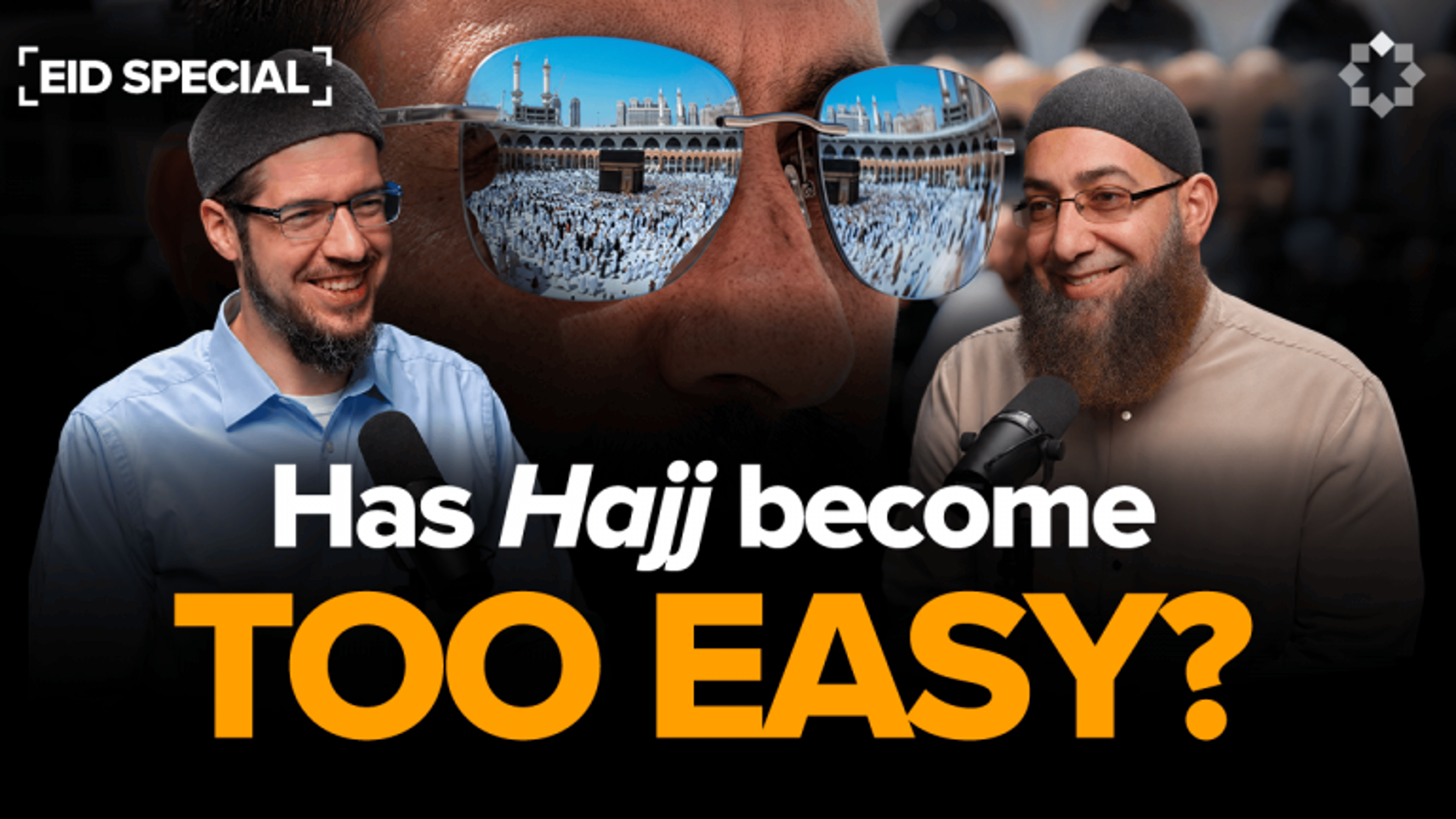
As-salamu alaykum. We're happy to have a very, very special guest with us today at Yaqeen Institute. Someone who needs no introduction whatsoever, Paul Williams from Blogging Theology.
Coming all the way from the UK. Yes, from England. It's such a privilege to be here. It's fantastic to meet you finally, Imam Tom. It's been ages. We've kind of missed each other like ships in the night in the UK. And finally I got to meet you this morning over breakfast. Alhamdulillah. It was an extraordinary
dream come true. And here we are in New York, an amazing city, which is usually made up of just neighborhoods and boroughs and things. So absolutely thrilled to be here. Thank you. Yes, the thrill is all ours. Now, I want to give you a chance to explain a little bit
about Blogging Theology and especially the more recent initiative that you've launched, Blogging Theology Academy. Can you tell us about that? Yeah, the Blogging Theology Academy. Actually, it's our second year now. And it was founded
by the Cambridge University philosopher Hassan Spiker and myself. And what we're trying to do really is to teach in that space, which is not occupied by mainstream seminaries or
universities. So we teach the Western tradition. We teach logic, metaphysics, the history of Christianity, the history of the Bible, the historical critical method from an Islamic
perspective. But we don't strawman it and we treat it in depth. So we really try to understand the history of the Western tradition, say Kant or Locke, the history of liberalism
or the New Testament scholarship and so on, as I say, from an Islamic point of view. And that's not really done. You're not really allowed to do that at universities. We've got people on our course who are studying at Harvard doing their doctorates and they
felt liberated and able to talk about the subjects and bring in the Islamic tradition, the Islamic intelligence, Islamic identity in a profound way. So it's been enormous fun,
actually. And alhamdulillah has been blessed. And we are in our second year now. And we've got lots of short courses now on Islamic psychology. We've got an executive from PlayStation. We've
got a leading AI expert from Cambridge University teaching these subjects on our shorter courses. So you can go on our website, bloggingtheologyacademy.com and you can see about those courses.
Absolutely incredible. We ask Allah to put barakah in it. It almost reminds me, at least some of the courses, like a school of Occidentalism as opposed to Orientalism.
Yeah, I like that. A school of Occidentalism. We're turning the lens around on the West and saying, well, what are the assumptions? What's really going on here? But as I say, not stereotyping it, try to understand it in depth.
And that's what would separate it from mere polemics or apologia. Absolutely. So we try and study John Locke in depth or metaphysics or philosophy, Kant in depth
or Plato in depth, but bringing to an Islamic perspective as well, which draws on incredible tradition. The Islamic tradition is absolutely extraordinary. So this kind of symbiosis is really key to what we do.
Brilliant stuff. And you're obviously very well positioned to lead such an initiative. And that's part of what we want to talk about today. We want to leverage your particular path and
journey and skill set to talk about Islam in a way that perhaps we don't necessarily talk about with many of our guests. And this is going to be a conversation that spans a lot of issues,
talking about not just a journey to Islam and your journey to Islam, but also Christianity, also about culture and even our own personal relationships to these things.
So we've got a list of questions here that will figure out a way how to portion between ourselves. But I'd like you to do most of the heavy lifting on these because you're the guest.
First category of question is about belief in theology. What's the most compelling reason that you believe in God? This is a kind of strange question for me because I have a profound belief in the reality and existence
of God, but it's not based on reasons. It's based on faith. And what I mean was before I became a Christian in my early 20s, I was a secular agnostic, very much centred on the dunya. And
then one day I became a Christian in my local Baptist church. And from that moment onwards, literally, I know it's a cliché Christian thing to say, but I had a profound belief in God and it
came to me as a gift. And it was just there. One moment I didn't have it, I had vague notions, but the next minute it was an epistemological and metaphysical certainty. And that's never left me.
And so this is something I'm grateful in my Christian journey for having received this gift from God. So it was never based on reasons. I do think there are excellent reasons for believing
in God, but that's not why I believe in God. And I think Islamically, we see this in the writings of Ibn Taymiyyah, for example, the idea of the fitrah. It is actually part of our DNA as our
species is actually to, I don't mean literal DNA, but metaphorical DNA, to believe in the transcendent God and to believe in right and wrong. And the sense of our being in life is to follow God.
So I think that was maybe activated or reinvigorated or vitalized in my Christian experience at that point. Interesting. So would you describe it? Because as you well know, there's a lot of conversations
within Christian theology and also Islamic theology that would try to place this within a larger debate as to how these things happen. Would you say that faith for you was an act of
grace or an act of providence? That it was a gift that was given to you? Is there a fideism a little bit part of this? Like that faith is not necessarily a conviction that is based on
rational proofs, but rather an exercise of a moral virtue or something of this nature? Where do you feel like your own personal experience maps onto these sort of classical debates as to what is faith?
I would never say my experience mapped onto anything so august as these great debates. I think I had a profound sense when I became a Christian of entering into a moral universe.
Whereas before I didn't really have any clear moral compass, but I accepted an absolute moral system. And at the heart of that was the sense of a glorious and transcendent God. It's
quite a Calvinist understanding, I think, at that time as an evangelical, which I was. And so there's a lot of good in Christianity. And I think I want to stress this. Our differences with Christianity, I think, are of important matters, but most of it, belief in God,
belief in the prophets, belief in angels, the afterlife, the resurrection of the dead, and so on and so on. We do share this. And so I've kept most of my beliefs there. But
for me, it was a spiritual transformation. It was a profound cognitive change. And that matured and developed and been refined in my later embracing of Islam. Islam wasn't
a complete revolution. It was a fulfillment, a development rather than a completely new thing. I find that very profound because sometimes when people who aren't converts, when they
talk to converts, they might have very simplistic notions of what it looks like to convert. And I have heard people say, wow, it must be so incredible to have every single thing that
was just wrong in your life. And now, you know, it's like complete darkness, complete light. And there are situations that people live in such stark binary experience of life. But for many people, I
mean, the words that you've used, refinement, I think is very, very rich. It's actually,
there are some meta skills, there are virtues, there are positive things that are there. And yet, Islam is a refinement of those things. And I think if even if you look at the way in which Islam
came to the Quraysh or came at the time of Prophet Muhammad (ﷺ), I don't think many people would be able to put together the argument that it was a complete revolution in every single way that
that society was based off of. That society had virtues, there was generosity, there was some sort of sense of duty, even though there were other things that were horrible that were going on.
And so Islam acted as a refinement or a filter of sorts. What do you think, to move on to another question, what's one thing that you feel people misunderstand about tawhid?
That's a really interesting question. And I think for many people in the West, maybe it's more widespread than that, at the back of their minds, if they're not already committed Muslims, for
example, that when they hear language about God and God's existence, they might think at the back of their mind that God is an object in the universe. So, you know, we have the universe and
we have God in the universe, sometimes very cruelly depicted, like an old man in the sky. We see this in many churches. It's interesting, actually. God, it's quite appalling, anthropomorphic
depictions of God as a male white, usually white figure with long hair and a beard of a certain age. And so I think a misunderstanding about Islamic tawhid would be that Muslims simply have an
Arabic sounding version of that. Now, that's absolutely not the case. And indeed, in many elements of the Christian tradition, that's not the case. I think you have Thomas Aquinas, for example,
where God is not part of the universe at all. He is the cause, the ground, the reason for
the existence of existence. Existence as such is a creation of God who transcends our categories.
And so real Islamic monotheism, the Islam of the Qur'an, is extraordinary and revolutionary in that sense. It smashes these man-made idols, these paradigms of God being a man or God being
an object in the universe, that he is beyond our conception, he's beyond our thinking. And so I think that's the misunderstanding that people have. They don't really have a correct understanding
of tawhid at all. But the Qur'an is very clear on that. I'd like to ask a corollary that's off script here, but I think it's relevant, especially with dialogue between Christianity
and Islam or Christians and Muslims. Many Christian apologists accuse Islam, the Qur'an, and Muslims
of strawmanning Christian theology. It's hard to pin down one Christian theology. Obviously,
there are many sects, and those schisms have profound, there's variety, let's just say, in Christology or theology between Eastern Orthodox and Roman Catholic or Protestant or
others. How would you respond to that? How would you respond to someone who's saying that the author, we'll put on the hat and imagine that we're Christian apologists, the author of the Qur'an doesn't properly understand Christian theology, and so the refutation that's found
therein is not accurate? Yeah, I sometimes hear that, but I don't think it is accurate. I think the Qur'an has a very nuanced understanding of Christian doctrine. I think the mistake is that
Christians think that the Qur'an is a theology textbook of Christian theology. So it's there to correctly define the Council of Nicaea or Chalcedon or Constantinople. It's not like that.
It can be polemical. It's trying to wake people up to true belief. So some of the statements in the Qur'an are not intended to be, as I say, academic treatises on Christian theology, trying
to represent how they see things. No, it's trying to, as I say, wake people up or criticize or subvert these categories, which are clearly mistaken. So I think they misunderstand what
the Qur'an is about. But I think sometimes we misrepresent Christianity as well. For example, the way some – and I'm not going to mention names – but sometimes the way the Apostle Paul,
as he's known, is spoken of amongst Muslims is to completely misrepresent him. So the idea, for example, that Paul abolished the law, the Jewish law. Now you can argue that if you want.
There are passages like Ephesians 2:15 which sound like that. But then the allegation is made that Paul is antinomian. Antinomian, the technical word meaning that he has no moral code and you can
basically do what you like. It's kind of a libertinism. You can be promiscuous, whatever, because as long as you have belief and faith in Christ, you're going to go to heaven. So you don't need to follow any moral code. And I've heard people say it's completely wrong, because although
Paul's relationship with the Jewish law is complicated and arguably he doesn't have a central place for the Jewish law at all in his salvation theory, nevertheless he is profoundly
moral in that if you look at the end of his letters, he's always exhorting people to righteousness and to live godly lives and to flee from immorality and sin. So that's not antinomianism. It's a kind
of non-Jewish law pietism. I don't know how to describe it, but that's a misrepresentation of Paul. But I think what Paul did in his polemics against the Jewish law, particularly in his
letters to Galatians, is profoundly problematic and has left the Christian world without a public role for divine law, because it basically sidelines it completely. And so his legacy
has defined the West, actually, in a very important way in its individualism and its secularism. He didn't intend that, but I think it's an unintended consequence of his theology,
is to rob us of a sense of the place of law, shari'ah, halakhah in the Jewish sense, in the public domain. And so the forces of secularism have taken over in this vacuum.
And I think that Paul could do that because he thought the world was not going to be around for very long. And so he didn't really see an issue. Those types of nuances are very important and
it doesn't do anyone any favors to caricaturize and to oversimplify. I think that many people, they want to reach for a scapegoat, and Paul is certainly the most convenient and ready-made
scapegoat for what went wrong with Christianity. But it is always more complicated than that. And so that makes a lot of sense. I tend to think of the history of thought as moving like a glacier,
right? That it has a glacial dimension to how it moves, in that it is slow, it is hard to steer,
but the pathways that are chosen or the pathways that things move in create opportunities that are, some are foreseen, some are unforeseen, and then it forecloses other opportunities.
So that's very, very interesting. Okay, turning to culture and modernity and how one can be religious in today's milieu. What's one modern trend or phenomenon that you think that Islam
warns us about? That's a good question. I don't really have any interesting answers to that. I think the profoundest, something that actually Solzhenitsyn, the Russian thinker, also pointed to,
and that is the West's godlessness. The West has forgotten God. And this is no trivial observation. Our civilization in the past, in America and Britain and so on, at least pretended to be
theocentric, even if it wasn't always in practice. There was an attempt to give a sense of a direction towards God in all that we did in our morality, in our lives, in our policy, in our everything.
And that has gone now, I think, or maybe it's been revived in America. I don't know. You can speak to that. But usually it's not been there now. And so Islam is a call back to
belief in the creator of the heavens and the earth in a very pure way. And so the message of Islam couldn't be more timely, actually, for the West. And it is ultimately the solution to the
West's existential and social crisis. It's a very interesting solution to and a very interesting call because most of, and I'll speak from the American context here, most of the attempts to
militate against this phenomenon of godlessness, which you so well articulated, they come from a sense of conservatism and going back. And usually they're rooted in a very highly idealistic sense
of Western civilization, one that's quite simplistic, one that maybe never really actually existed, or maybe it did exist but was simultaneously co-evil with lots of other
negative things. This again sort of sidesteps the historical problem that you bring up with a figure like Paul where interventions are made and that creates the possibilities that now where
those possibilities are unfolding. So my reflection often on the conservatives and the
conservative Christians in the US space is, if you imagine going back to a more idealized past, what sort of intervention is to be made that wouldn't simply just continue to follow
the same opportunities or openings or trajectory that was already trod to go down this path of godlessness? And perhaps the answer is not simply in trying to beckon towards our nostalgia,
and I use our there tongue-in-cheek because there's a lot of important discussions as to who is the us in that. But perhaps that the better solution is a solution from an unexpected place.
And I think that Islam offers that call. Now you've got certain people who are maybe more open to hearing that possibility and other people for whom they gloss Islam as just part of the
diversity parade of leftist identities and therefore, nope, absolutely not. Or there's others that have fallen to anti-Islamic propaganda that it's some just political ideology that's here
to cut your heads off or whatever. There's various different types. But I think that, again speaking to the American context, I think that people who are conservatives who yearn for
a more thickly religious society and life, I think they owe it to themselves to consider the invitation of Islam. Of course, I mean people they're free to agree or disagree but
I think the important thing is to have them take that seriously and not just categorically dismiss it. No, I absolutely agree and I think there's a great irony in all of this because I respect
the Christian yearning for a more spiritually and religiously thick, as you put it, public presence of faith. I respect that and I think it's an instinct which I have a lot of
sympathy for. But the irony is that, in my view, without intending to be polemical, it might sound it, that Christianity is, in my view, the most intolerant religion that the world has ever known in practice. The evidence of history is clear.
When we talk about the religious wars in Europe between the Roman Catholics and the Calvinists and the others, the Anabaptists, and the way that Luther called for the slaughter of his enemies,
particularly Jews, actually. Talk about antisemitism. You know, and Luther is this great reformer, you know, in 1517, called for the reformation of the church and also for the
wholesale slaughter of Jews at the same time. I mean, you couldn't make this up. It's so awful. And I mention this by way of contrast. Islam, this is a great irony, as I say, of history, at least in today's perspective, that Islam is one of the most tolerant religions.
I don't mean tolerant in a liberal sense. I mean that it's constitutive of the shari'ah itself, that people of the book, for example, Jews and Christians, and even that category is interpreted
in a very expansive way by the Hanafi madhhab to include, say, the Zoroastrians and others, even Hindus and so on, are given rights in law to worship as they please, to eat pork if that's
what they want, and drink alcohol, the Christians and so on. And this is real pluralism, not the West's phony, what I think is phony pluralism, where, yeah, you can believe what you want, but just don't let it get into the public sphere. Look at France, for example, the land of liberty
and equality, but just don't wear a hijab, and you're taboo. You know, I mean, excuse me, this is not pluralism. This is obviously a very militant form of secularism. So Islam is generally
pluralist. It can embrace all cultures, well, most cultures, and many religions very comfortably as part of its mainstream tradition historically. But Christianity isn't like that, and it's only
been, I think, tamed and brought to heel by secularism. And that's been quite deliberate. One of the unintended consequences of the Reformation has been the secularization of the West because of the wars of religion that ensued from the breakdown of the church, that people had
enough bloodshed, and they said, no, we can't take this anymore. We've got to have a secular space. You can believe what you like, but don't bring it into our public square because it's too lethal. But for Islam, we need it in the public. We need Islam in the public square to safeguard
people's rights to be Christians and Jews and so on as part of the shari'ah itself. And so Islam is the answer to this, I think, for the West. Yeah. And one of the greatest lies and perhaps tragedies
of the weaponization and the manipulation of history is what I call this projection onto Islam of Christian past. I really believe that the anti-Islamic propaganda that has unfolded,
that tries to portray Islam as having been spread by the sword, as being very intolerant towards religious minorities, is largely a projection of the Christian past onto Islam.
It's not based in history. It's very ahistorical. In fact, perhaps you're more aware of this than I
am, but even the memory of a Christian Europe in an existential struggle with Islam coming in
Vienna and Tours and all of these things doesn't seem to hold up to scrutiny when you really, really dig into the weeds. You see that the Ottoman Empire in particular and other Muslim
polities had political relationships with the Protestant reform groups, both in Germany and in England and in Eastern Europe, in Hungary and whatnot. And in fact, some of the conflicts that
happened near Vienna and the Ottomans pushing westward to Vienna were actually in response to calls for assistance from Protestant groups because they understood that the Ottoman Empire
would actually allow them to practice their faith in ways that other Christian groups wouldn't. Now, that doesn't fit into the politicized memory that I think is hegemonic at this point, which
says that Islam and Christianity are locked into this civilizational war and it's always been Christian Europe against the Islamic East. I think that the history is much more complicated and I
think that this weaponization of history and this faulty memory or this propaganda that serves as memory has been one of the main blockers to European Christians and American Christians
considering the real possibility of what Islam potentially has to offer. Yeah, and it is this deliberate forgetfulness about our Islamic past in Europe that is such
a contributor to Islamophobia today. I was thinking, I got back from Granada in Spain a few weeks ago, Andalusia, al-Andalus, which was historically part of Islamic Spain. Spain, by which I mean the
Iberian Peninsula really, which is what's now called Spain and Portugal, was Islamic for over 800 years and has an extraordinarily rich history of a very advanced civilization culturally,
scientifically, in terms of its scholarship, and it's extraordinarily rich, multi-religious, the nature of society. So Christians and Jews flocked to Islamic Spain, call it that anachronistically,
for purposes of learning, for education, for science. European, non-Islamic European science largely came from Ibn Sina's work and so on there. But it was the way it
ended where the Catholic, what's called the Reconquista of Spain under Ferdinand and Isabella, the two kings, the king and queen of Spain, it wasn't just that they pushed out Muslims
from Spain, but they had something called the purity of blood. I've discovered this recently. So this is a progenitor of almost like Nazi Germany, that unless you were racially pure,
you were kicked out of Spain, or you were forced to convert. And even then, if you were a suspect because you didn't look right, you could be purged. I mean, it's the most unbelievable history. And
this is part of so-called modern Spain's birth as a so-called Christian country, but that it's profoundly intolerant and racist and Islamophobic. And I can't see how in any way that's a good thing.
But we forget that in our history. So Muslims in Spain are re-articulating that, that Islam is, people are converting to Islam in Spain. I mean, you know, people from non-Muslim backgrounds
are discovering Islam in large numbers. So their own rich history is attracting them back to Islam. That's fantastic. Yeah. Even the fact that it is called, and this is memory,
right? This is the manipulation of memory. The fact that it's called the Reconquista, right? The reconquering, right? That's an ideological proposition. Like what was the previous? You're
saying that again, it's an ideological move to say there's an unproblematic Christian past that now we're bringing it back because it was temporarily lost, taken over by the Muslims, usurped by the Muslims. And as I said, there's an argument here, which I used to be,
I've been put right on this. So before the Muslims came and made their incursion across, you know, into Gibraltar, into Spain, it was a Christian country with the Visigoths
were the Christian tribe there. Now they were Arians. Okay. They weren't even what most Christians would call Christian. Only very late did they embrace Catholicism. But these Visigoths
themselves, oh, the indigenous people themselves were conquerors. They came from outside. They came from the East. So these so-called, oh, it was a Christian country first. They were conquerors.
They were heretics. Only very towards the end of their period there did they embrace Catholicism. So, you know, at what point do you stop the blame game here? Because that's not how it works. Well, all things of that nature,
identity bound politics are always socially and historically constructed. You know, I think I was on Jalal's program when we talked about British identity. And I know this is politically, it's a
very hot topic. What does it mean to be American? What does it mean to be British? And it really similar to post October 7th questions, like, where do you start history? Right? Are we going to roll
it back to the Norman invasion? Right. And say that, well, everything after the Norman invasion is truly British. And, you know, well, okay, then we have to say that the Normans came and they conquered and they mixed. And then before the Normans, it was the Saxons. And before it was
the Saxons, it was the Romans. Right. And you could keep going on. Right. So all of these things are socially and historically constructed. They don't have, they have a reality in as much as they
affect how people think. And there is some descriptive, a little bit of descriptive power to it. But at the end of the day, it's not essential. And it's actually very, very plastic. And it's very movable. And these things are forming and dissipating all the time. Right.
What it means to be British will be different 50 and a hundred years from now than it is now, if Britain is still a thing, you know, like nations, nations don't have a guarantee that they're
going to hang around forever. We should know that. Right. But in the individual political moment, we forget all those things and we rally behind this or that. So let's put the shoe on the
other foot. And now we look at the Muslim community and some of the aspersions or the accusations of folks who are a little bit more hostile to Muslims and Islam would say that Muslims are not
integrating properly, that they come from, they're not being British enough, that we wouldn't have any problem with Muslims. Let's say, you know, role play here. If they came and they ate beans and toast and they, you know, had high tea. Do you have a problem with beans on toast? So this
is an issue. Sorry, I forgot we're in New York. So I should say, you know, the subs and pizza. But the point is that the point is that there's a sense that there is a cultural identity and that
Muslims need to integrate into it. Obviously, that's problematic, especially in the United States, where there's people who have been here for multiple generations who aren't newcomers to the land. But OK, let's say for the sake of argument, are Muslims in the West too focused
on integration or are they insufficiently focused on integration or neither of those two things? Gosh, I mean, I'm not even sure I understand the question because what is integration? What is
assimilation? What do these terms mean? So let's reframe the question. What would be a more intelligent question or a more nuanced question? No, it's a valid question, but I'm just saying we need to deconstruct it because it's too abstract. We need to know exactly what are we
talking about with this particular group of people in this particular country in the light of its history, etc., etc. Otherwise, it becomes too vague, I think. I think in Britain, I think people,
many non-Muslims increasingly now are vocalizing because of political changes, their opposition to
the Muslim presence in Britain. And this is alarming and worrying. And I think part of it is just, if I can put it somewhat, not crassly, but superficially, it's a question of good manners.
Because many, many Muslims in the 1960s, 1970s were invited to the United Kingdom to help, you know, rebuild the country after the Second World War, to build industries, the National Health Service,
the steel industry and so on. They were invited to come to the UK as guests to live there, to live here, live there. And so, you know, they had children and now their grandchildren are
growing up. And suddenly turn around, you know, later and say, well, we don't really like you being here. I think, excuse me, I mean, where's your good manners? I know it sounds superficial, but it's a simple question of you don't treat people like that. You don't invite them in
to do a hard job of work, which they did, and they did it well. And then say, well, we don't really like you here anyway. Excuse me, that's my first objection. But also within this is
other issues to racism and the way that anti-Muslim sentiment is being whipped up in the West. It's not just a parochial British issue. I think we're seeing the rise of populist right-wing
movements in Europe and obviously in this country, in the States as well. So it is a macro movement going on here. It's not just within the confines of the UK. And that's the issue here. What's happening to the West at the moment, that I think is the issue. But I think people need to be
reminded, like during the Second World War, if you want to be jingoistic, millions and millions of Muslims fought on behalf of us, the West, over against them, the Nazis, if you want to put it
that way. In the British Empire, Muslims in India, for example, millions of them gave their lives or their time to defend what they saw as a just cause. And I'm not in any way casting doubt on
that as Persians. It's not my place to do that. So I think, again, an ingratitude for what we've done. And I go to a mosque in London called Regent's Park Mosque. It's a fascinating place
where I said my shahadah. But this is no ordinary mosque. It was given by, at the request of Winston Churchill after the Second World War, on behalf of a grateful nation, in the name of the king,
to the Muslims in gratitude for their duty to Britain in fighting. And so the land was given by royal decree for the Muslims and the mosque was built. And here we are, Regent's Park Mosque.
And the trustees, the people who run the mosque, are the ambassadors from the Muslim world. So I think the Saudi ambassador is our treasurer, about which I will say nothing, but it means we're not likely to go broke anytime soon, hopefully. But, you know,
these symbolic gestures, or more than gestures, are good and healthy and positive. And we're missing these notes of gratitude, these notes of appreciation for what the Muslims have done
in building up Britain after the war, and still what they're contributing today. I don't mind criticism of Muslims at all. I think often we've done things terribly. I'm not going to, you know, maybe talk about that, but at least appreciate the good things and express that. And that's missing
in the discourse that I hear in the media. Yeah, I agree with that sentiment as well. And that's funny that you mentioned that last point, because two recent talks I've given in various
mosques across the country dealing with Islamophobia actually began, or I began the talks by saying what Islamophobia is not. And one of the things that I mentioned is that Islamophobia
is not when people hold us and our community accountable for how we do or do not contribute to the places in which we live. Like, we have to be open to those conversations.
If we are not holding our weight, if we are not, if we're being too insular, and I don't, and I know that's a politicized and touchy subject and very subjective, but I mean, we need to be able to point to things to say, we built this and we contributed that,
and we did these things. And I see that both sides, maybe there's a bit of extremism going on. There's a lot of political opportunism going on from those on the far right who are attempting to
use these scare tactics, not very old scare tactics, in order to gin up this boogeyman and this opposition is usually papers over the real issues that are going on. When I was visiting
Ireland, you know, one of the things that I remarked was the threat to local culture is less about a biryani and it's more about McDonald's, right? Like neoliberal capitalism
is probably more likely to drive down birth rates and, you know, alienate you from, puts pressures on you so that, you know, families drift apart and fracture and you lose your culture and
you lose your way of life. I see that probably neoliberal capitalism is more responsible than Muslim immigrants, right? For that. So there's a middle ground, right? And I think that
that deals with that question well, which is really, you know, overly broad. It's about any relationship. If we imagine two individuals, right, it has to be a give and take. And that can
be also true for two communities, you know, as a give and take, neither is it, you know, entitlement on either side. Right. I think that's a key point. We've got a couple of
questions here that are more about interfaith and personal issues. If you would humor them, what's, and this is, I think a good one for you for something that you've already expressed. What's the most beautiful thing you've learned from another faith?
Learned from another faith. Yeah. I mean, as a Christian, I learned many of the rudiments of faith, which I still hold dear now. And one of the things I still treasure are the extraordinary Psalms in the Jewish Bible or what Christians call the Old Testament, the Psalms of David,
you know, the Lord is my shepherd and so on. Beautiful Psalms. And of course the Qur'an also references the revelation given to David. Now, whether or not that's coterminous with what we have now in the Old Testament, I don't know. But I like to, I like to think that
much of it is still intact there. And the book of Psalms is often called the prayer book of the church, for example. I think of another thing that I still respect enormously, and the Qur'an
alludes to this a little bit, is to an institution which is not authorized by God, but nevertheless, monasticism, the idea of priests and monks, and thinking of the election of the recent Pope,
Pope Leo XIV. Now, of course, it's very early days. We don't know him very well. He's an American citizen, apparently, born in Chicago. Deep dish pizza for everybody. Exactly. What a shock to everyone who thought, no way would he be an American, but hey, he's there. But he strikes
me as the kind of man, and I'm misreading it, the kind of man that the, you know, the Qur'an speaks very forthrightly of those who, you know, Muslims will encounter difficulties with, you know,
some Jews and the polytheists. But it separates out those who are humble and are not arrogant. And it specifically mentions, I think, monks and priests, I think it is. And I tweeted on that a
couple of weeks ago, well, about a week ago, when the current Pope was elected in the Vatican. And I thought, yeah, this actually, that verse, unbelievable, it shouldn't be unbelievable,
it's God's word, but unbelievably timely, that verse. And I tweeted it, and wow, this is laser like, this is fantastic. The Qur'an speaking directly to our contemporary world, how true that
is. Even though monasticism and the priesthood is not from God in that sense, institutional sense, nevertheless, these people are not arrogant. They're not enemies of Muslims. Right, Allah
mentions it there and also in Surah Al-Hadid. And even though he criticizes, or there is a criticism there for having invented it and not having stuck to it properly, there is
an implicit praise, I think, which is what you're sensing and pointing out that it's from their goodwill. Right, like the fact that they instituted it at all and the fact that there are people who are true worshippers, humble.
And I've known priests and monks in my life who are like that, actually. And if you were to speak to them about Islam, they would listen. I don't mean just with their ears, but with
their hearts. You get a real sense that these are people who God can, you know, people who can be, in a sense, ultimately Muslims if they would embrace Islam.
So let's take that in a little bit of a different direction. So what's one Islamic teaching that you think that Christians often overlook? Christians often overlook? Gosh, interesting question. I think one of the things that really
impressed me when I first encountered Islam or started to look into it was this whole, you see, if you're a Christian, normally now you have your personal relationship with God, personal relationship with Jesus. So you have a regular job and you go to the pub or the
bar and you have your family or you watch TV and then on a Sunday you'll spend 45 minutes intensely worshipping Jesus, you know. And then that's your religious duty, by the way. And then you may be, if you're particularly pious, you may read the Bible a couple of
times a week, but most probably don't. And this is kind of, I don't mean to, you know, be too rude about it, but, you know, it is more or less like that. Islam has, you
know, to use our language, it has the din, encompasses all of life. So Islam, faith, religion has a public role. You know, there is a role in our societies for divine law
because God made us. He's the Lord of creation. He knows how to organize societies in ways that enhance human flourishing and success in this life and the next. There's a reason why some things are haram, like interest or riba. You know, these things are damaging,
gambling is damaging, alcohol can destroy lives and so on. So it is that whole public
social dimension to faith understood in its widest expansive sense that is missing in
Christianity today. It wasn't always the case, but. And so Islam steps into the conversation and says, no, we have an understanding of society, which is much more holistic on many,
many levels, not just on the private, you know, my private relationship with God. So that is fantastic news. If people want an alternative to the crass consumerism and materialism
that the West embodies and exports to the globe, there is an alternative. And the thing is, this is the only alternative that I'm aware of in the world to this. It's not like we have a supermarket of options. Ooh, I'll have the Muslim option as opposed to all that.
There is no other option. I mean, since when is any other faith doing this? And not in a way that is actually scalable. Like you can't have a country of Buddhist monks, you know, who's going to bake the bread.
Judaism is for Jews. It's not for the whole human race. And they're supposed to be calling to the nations. That's the prophets in the Jewish Bible talking to the Israelites. Your role is to be a light, to call the nations to worship the one true God. They're not doing that in the main. But Islam is.
I think another dimension to that is that it's so baked into what Islam is from the source, right? Because I remember once I was on a plane and I think the lady next to me,
I noticed, was Catholic. She had her rosary beads and she was saying a prayer when we took off. And so I mentioned this aspect that you're referring to, to her, because
she became perturbed to learn that I accepted Islam. And that was one of the things that I often cite, that Islam has guidance for everything. And feeling, I think, like she
had to compensate. She was like, well, in the Catholic Church, we also have guidance for everything. We have prayers for this occasion and that occasion, we have feast days, we have this, we have that. And I wasn't going to argue with her there right on the plane,
but my experience is that a lot of that was extrapolation that was done quite later on
in order to fulfill or to fill out the social life and to fill all those gaps of space that you're left empty otherwise. It's not actually derived.
Like similarly, when I was in university doing my bachelor's in political science, I studied a bit about Christian liberation theology and it's all very much extrapolated, very
extrapolated. Like, you know, you're taking some very general things, very vaguely alluded to and then you're really trying to, you know, squeeze some lemonade out. And a lot of Marxism thrown in, of course. Which is nothing, not indigenous Christianity at all.
Of course, of course. Whereas with Islam, and this is one of the things that first appealed to me when I first came across translations of Islamic texts, was how direct and how everything was in the source texts. It wasn't the additions or the extrapolations of later people who
were building, you know, castles on the sand, right? It was actually right there from the start. That's very interesting. We've got a couple yes or no questions that are always going to be problematic, but you
can give either yes or no with a brief justification. Okay, let's see. Let's see how this goes. Is religion declining because of bad religious leadership? No. Any justification to that?
Religion isn't declining. Religion is booming. It's booming everywhere. I mean, have you noticed recently in America? Seriously. No, it's booming. What is in retreat, what is
failing is atheism. This so-called new atheism is on the retreat. Religion is booming everywhere. Or many people call it spirituality. If they don't like the word religion.
Is technology a bigger threat than ideology today? No. I agree with you there. Should interfaith dialogue focus more on truth or on common ground?
Well, gosh, the Qur'an says that we should speak to the people of the book in the best of ways and find that common ground, a common word. But I think also we need to speak the truth, the truth of tawhid, particularly to Christians. So I don't think it's either or,
I think it's both. OK, last one here. Yes or no? True or false? Most people reject religion due to emotional reasons, not intellectual ones. That is correct. And we have science to back that up. Scientific research to back that
up. No, one of my shaykhs says that human beings are emotional creatures who look for rationale. Rationalizations, post hoc rationalization. Oh, that's absolutely true. Most atheists are not really atheists. They just had a really bad experience in life or whatever. It's due to emotional reasons.
OK, let's see what else we have here. These are faith journey questions, personal beliefs. Let's see. I'll just pick the best ones here. What was the hardest part for you about converting to Islam?
Oh, I think the hardest part was an existential challenge, being part of the white Christian minority in Britain. And although being spiritually, intellectually convinced of the truth of Islam,
I was also realizing that I would identify henceforth with a often despised and misunderstood minority in my country. And crossing that invisible civilizational divide was actually,
I surprised myself. I didn't see it coming. It actually became an issue. Do I want to lose my friends? I did lose some very close friends who were Christians. Did I want to
become misunderstood? Did I want to be associated with this often despised group of people? So I'm ashamed to say that held me back for several months, but not in any formal intellectual
way. It was just a sense of, hmm, this is a bigger step than I realized. The stakes. The stakes were bigger than I realized. But then alhamdulillah I did. Did you have much of a sense of Islam before you accepted? And if you did, did you have
any misconceptions that were later corrected? Well, yes, I always had misconceptions. I'm constantly amazed at my own illusions and having to learn illusions about myself and the world around me. Life is a great journey
of unveiling and disillusionment in a positive sense for me. I had some sense of what Islam was about when I embraced Islam, but it was a huge education afterwards and still is to
learn the great riches and depths of the Islamic tradition. My own personal journey and joy is to then juxtapose that and compare and contrast it with the Western tradition, whatever that means. So to look at the cross currents and the differences intellectually into the
philosophy and theology, history, partly to understand the present, but also because it's absolutely fascinating. These things are not discrete and separate. They are historically very closely paralleled. And that I find very interesting.
What's one daily habit you have that keeps your faith alive? Well, that's easy. Praying five times a day. Without that, I would, I know from experience if you stop praying, then the spiritual current is switched off. And so I have to keep the
spiritual current switched on. The only way to do it is to, I have to read the Qur'an, which I do. Is there one part of Islamic worship that speaks to you the most outside of prayer? No, I think the one that more routine one, I'll put it like that, is praying in congregation
at the mosque. I think that that is always a very positive experience. Wonderful. All right. Last one for this. What's your favorite verse of the Qur'an and why? Well, my favorite surah, because there's a couple of verses, is surah 112. Yes.
Surah Al-Ikhlas, because it is an extraordinary piece of precision theology. And I won't go into it now, of course, but on another occasion, I like to, I enjoy waxing lyrical about surah 112,
what it says to me about theology, about the existence of God and about Christianity, and its sheer beauty in Arabic. I know by heart, we pray it in our prayers, of course,
quite often, because it's quite short. I think it's very difficult to have a favorite in the Qur'an because it keeps on changing. Right. It is a reflection of you, right? So wherever you're at in your life, that's what
I've at least experienced, that something will very much speak to me in a particular part of my life. And then as life continues to mold us, then we have different parts that are more. This is how we know that it's authentic revelation, because it has this capacity to
address us in these changing circumstances. Let's talk about something that's trending on social media, which is something, a sentence I almost never say, which is the so-called Islamic dilemma. A lot of Christian apologists are talking
about this Islamic dilemma. It's something that gets air under its wings every about five years or so. Some of the verses of Surah Al-Ma'idah, where Allah subhanahu wa ta'ala says that, you know, the Jews should implement what they have, the Christians should implement what they
have, and the apologists, they run with it and take it out of context and say that means that Allah is telling us to follow Christianity. If we're Christians, Allah is telling us to be Christians and to not follow Islam. What's your response to that?
Gosh. Well, I would normally say we need to look at the passages and go through them carefully and do some exegesis and tafsir. We're not going to do that. So I guess some very broad stroke, broad brush kind of responses, really. I mean, this is an old
canard that's been repackaged and been called the Islamic dilemma. As we were saying earlier on, this was circulating several years ago. It was never given this kind of catchy click baity title,
which is now captivating us on social media. The thing is, in terms of Western academic study of
the Qur'an, there's something I've learned through the work of Nicolai Sinai. Nicolai Sinai is a professor of Islamic studies at the University of Oxford, a German guy, I don't think he's a Muslim, and he's written a book called The Historical Critical Introduction to the Qur'an.
And in that book, which I use on Blogging Theology Academy, actually, to talk about the historical critical method, he says something very interesting. He said it used to be the case in Western academia, this is Orientalist scholarship, by the way, it's not Islamic scholarship, but Orientalist
scholarship. They used to say about the Qur'an that it basically copies stories from the Bible, copy and paste them, as we put it today. It sometimes made mistakes, but it's a pastiche
of biblical law, or another kind of apocryphal or Christian stories, often crudely just appropriated
and put into the Qur'an. Now that is a very simplistic way of putting it, but that paradigm, I'm told by Nicolai Sinai and others, is now in the bin. That's not what, in the main,
Western scholars don't do that anymore. What they focus on is something called intertextuality, which is a very boring way of looking at the way the Qur'an retells the stories of the people of
the book, whether they're found in the Jewish scriptures or in other Christian literature, which are not in the New Testament canon. But it doesn't just copy them, it retells them,
often with extreme care and precision, to correct what has been said before. So there are numerous examples of this. So the way the Qur'an speaks about Prophet Musa,
upon whom be peace, or Prophet Isa, upon whom be peace, is often similar to what we read, say, in Genesis or the Gospels. But either it is corrected or additional details are given,
or a denial of a story that we see in the Bible, a flat refutation. So given the obvious elephant in the room, the New Testament is absolutely clear that Jesus was crucified. The Qur'an is absolutely
clear that he wasn't, despite appearances to the contrary. It was made to appear to them, or words to that effect, it says in English, in the Qur'an. So the Qur'an is denying what's clearly there in the Bible, in the New Testament. So it's not simply endorsing the Bible.
But it admits that, it states that it appeared to them that he had been. So you can understand how the story got around. It makes sense. And the Gospels are not eyewitness testimony. We now know
this according to Western scholarship. Christian scholarship is almost a consensus on this point, that they're anonymous second-generation texts. They're not written by eyewitnesses.
So to come back to the Nicolai Sinai point, that the standard paradigm in the West now is not to talk about the Qur'an copying the Bible, but the Qur'an endorsing or correcting
or falsifying what is wrong in the previous scriptures. And this notion is also found in Surah Al-Ma'idah, where the Qur'an is like a muhaymim, that's the word. It's a word that
one scholar called like a quality control. The Qur'an is the final revelation. It is supreme over the previous revelations. And sometimes that's quite subtle. So to give a very subtle
example, Dr. Ali pointed out to me that the way in which the story of Joseph is told in the Bible makes a historical anachronism by referring to the king at the time as the pharaoh,
in which that's just not history. That's historically incorrect. There were no pharaonic dynasties at that time. And so you'll never find in the Qur'an, Allah subhanahu wa ta'ala
used the word pharaoh to describe the king or the ruler of that time. There are other terms that are used. Now that's not a head-on explicit correction like with the supposed crucifixion of
Jesus, but it is an implicit correction where Allah is using a different term in place of it. And this is really important. So the way that the Qur'an subtly retells these stories, according to his own understanding of the truth, is now what most Western so-called
Orientalist scholars are interested in. So these old crude notions of the Bible copying or misquoting, that is now in the bin. Unfortunately, Christian missionaries are still operating under this now
discredited and discarded paradigm, which Western scholars no longer follow. So they're about 100 years behind the curve, 100 years out of date. So one day, hopefully, Christian missionaries will actually learn what scholars are now talking about. I just want to mention one other thing. A
friend of mine, Usman Shaikh, who did his Master's in New Testament Studies and another Master's at Oxford in Qur'anic Studies, he's now doing his doctorate under Nicolai Sinai at Oxford.
Now his Master's thesis, Usman Shaikh's Master's thesis, was on this very subject of intertextuality. And I read it. It's absolutely marvelous work. He looked very carefully at how the Qur'an tells
these stories, corrects them, affirms details, you know, basically tells the story of what really happened. Now, I mention this because not only did Usman Shaikh's work get distinction, it was now,
Nicolai Sinai produced an extraordinary dictionary of Islam, of the Qur'an, sorry, for academics.
And Usman Shaikh's book, I think, was cited 12, about a dozen times in this top level academic work as a worthwhile reference on this very subject. So this is cutting-edge scholarship.
The Islamic dilemma is, in comparison, a trivial, uninteresting missionary waffle. I mean, it's a no, it doesn't have any academic rigor. But I was going to say there is serious scholarship
going on, which really gets to what's going on with the Qur'an, that that's where the interest lies. One last point, and yeah, I agree that these sorts of points from Christian missionaries are
sort of like gotcha, you know, attempts. But one of the things that we hear from these voices that,
well, the author of the Qur'an or the Qur'an itself is not refuting the right type of Christianity or is demonstrating an inaccurate understanding of either Christian theology or
Christian text. Now, this opens up a larger conversation that I hope that you could touch on when it comes to the canonization of biblical texts, right? Because if you're a Protestant,
your Bible's not the same as a Catholic, like, let alone historically the other types of documents that are out there that are considered apocrypha, the process by which those books are considered
canonical versus apocrypha. And then just the historically constructed nature of, yeah, like, well, what are we saying is the right Christianity that you're accusing the Qur'an or the author of
the Qur'an of misrepresenting? Could you touch on that a bit? Yeah, I remember I spoke to a guy called Keith Ward. He's a priest in the Church of England. He was also a professor of divinity at Oxford University, probably Britain's most senior Catholic Christian theologians, he's Anglican.
By the way, he accepts that Muhammad is a prophet of God. He said in his view, to talk of Christianity in an essentialist sense, that it is a thing, one thing, with a key core definition, is misleading.
There are many Christianities, plural, they may all come and go. This umbrella word, Christianity, but the reality is, say, their understanding of who Jesus was can be very, very different from group to group.
And in fact, Keith Ward's own understanding is very different, and he said this, from what evangelicals believe. And yet they're both technically Christians. And certainly legally, shari'ah-wise, they are, but we don't get involved in these discussions.
That's a different matter, it's a legal question. But in terms of theology, so the point is much more extreme when you go to the very early centuries of Christianity.
So right at the beginning, for example, it's now, I think, pretty well established that the earliest so-called Christians, and even that term is anachronistic, there were no Christians in the beginning,
there were Jewish followers of a Jewish messiah within Judaism, so-called Jewish Christians, or the Ebionites, as they're sometimes called,
had an understanding of Christianity, which would be almost unrecognizable to Christians today.
So these people were followers of the Jewish law, they upheld the Jewish law. Their leader was symbolically, or in reality, James, the brother of Jesus. I mean, the actual brother of Jesus, I don't mean some kind of, well, we're brothers, but we're not physically related.
No, this guy was an actual brother of Jesus, and we have multiple independent sources that speak of him. We have sources in Eusebius, Josephus, the first century Jewish historian, even the book of Acts mentions him, and Hegesippus.
I mean, I can go into a long list of independent early sources that speak of who James was as the head of the church, not Peter. That's where Catholics, unfortunately, are. Anyway, that's another subject.
And I mention them because they were not the only Christian group towards the end of the first century and the second century. We have other people, like the Gnostic Christians, who produced their own bunches of Gospels, had their own scriptures.
Even the Ebionites, the Jewish Christians, had a version of the Gospel of Matthew that they used in Hebrew. Our Gospel is not, it's in Greek, originally written. Then we have people who follow Marcion, or so-called Marcionites, in the second century.
And these people were the first to produce, so scholars think, our first canon of Scripture.
And for him, his canon, or his list of authoritative books, that is, includes the Gospel of Luke and Paul's letters.
And even they were interpolated, he thought, because he thought they were two gods. And this was a very popular movement in the Christian world in the second century, in the third century, in the fourth century.
So you had the Old Testament God, who clearly was wrathful, acts of genocide, very legalistic. And then you had the God of Jesus. And he was a God of love and mercy.
And his apostle was Paul. And he obviously commissioned Paul to preach the Gospel to the Gentiles. So any Jewish or legal understanding of Christianity was to be rejected.
That was a God of, an inferior God, or a wrathful deity. But the true God was the God of Jesus. Two gods. It's there in the sources. Gnostics believed in many gods, some even as many as 365 gods.
The Ebionites, slash Jewish Christians, believed in one God. They believed in tawhid. And it's those, the original followers of Jesus, so the records tell us, I think, that are closest to Islam. And indeed, that is what we would expect as Muslims.
Because they were on the din, so to speak, on the true path. So we have, we had the so-called Marcionites, we had the Ebionites, we had the Proto-Orthodox, as Professor Bart Ehrman calls them, from Chapel Hill.
These are the forerunners or the progenitors of what we would call Catholicism in the second and third century, represented by people like Irenaeus and Tertullian and others.
So the reason I'm giving this somewhat dry narrative of different forms of Christianity is precisely to stress the differences that existed. And all of these people thought they were authentic followers of Jesus.
They all had their scriptures. But none of them had what we would call the 27 books of the New Testament. And this canon, which is another way of saying a list of approved religious texts,
developed slowly over many generations. And even if you look at the earliest complete New Testament we have in the world, which is called the Codex Sinaiticus, which is in the British Library in London,
which you can see, it's in Greek, even that, which includes our 27 books, for sure, and this was produced, by the way, in the fourth century, around 350 AD, even that has two books which are not in any modern Bible, as far as I'm aware.
The Shepherd of Hermas and the Epistle of Barnabas. No one thinks they're part of scripture today. So you get the real sense how the boundaries or the edges of the canon were blurred and took a long time to develop.
And I could go on and on for hours about this. But the contrast with Islam couldn't be stronger. Here we have a single revelation given to the prophets, whether it be the Torah to Musa or the Qur'an to Muhammad (ﷺ)
or the Injil to Isa, peace be upon them all. That it was just revelation. It wasn't an inspired human list of books like the New Testament really is,
which were originally not thought to be inspired scripture, by the way. I don't think people thought that what Paul wrote was the Word of God. It just wasn't seen as on a par with the Torah initially,
but subsequent generations began to treat it that way. So there's a very different kind of trajectory and a genealogy of scriptures in the different religions. Yeah, fascinating.
So it would almost be limiting, let's say, if we imagine the Qur'an trying to pin down any one individual living in 2025, their preferred version of Christianity and refute exclusively that.
You find actually the polemics that are in the Qur'an towards Christianity are much more all-encompassing and also constructive. Kind of just cut through all of that and just say, don't say three.
As Allah says towards the end of Surah Al-Ma'idah, don't say that Isa is the son of God. I love that where the Qur'an refers to Jesus, son of Mary, son of Mary. You think, why is it calling Jesus son of Mary? This is my view.
You had the Christian affirmation, Jesus is the son of God. Muslims say, no, he's the son of Mary. So this is in a sense a replacement critique of a creed. Quite deliberate. Oh yes, everything.
And some of the scholars have noted that even when Allah SWT is criticizing the people of the book who came before, such as the Jews and the Christians, he will typically use the names that they gave themselves,
such as the Yahud and Nasara, the Jews and the Christians. Whereas when he is inviting them back to faith, and true faith being faith in the one God and following all the prophets, including Prophet Muhammad (ﷺ),
that he will call them people of revelation or people of the book. Because it's almost trying to touch on that identity, but also inviting them to make good on that identity by following the final revelation, the final refinement. Or as Allah says in Surah Al-Baqarah,
I know we were talking in the car on the way over here, that if they believe in the likes of what you believe, then they have been guided.
And this is one of the verses in Surah Al-Baqarah that's missing from all of the missionary work or the Islamic dilemmas out there. Yes. This has been a wonderful conversation, Paul. Thank you so much. Did I pass? I think you passed with flying colors. I did.
Excellent. Any final words, final thoughts you'd like to leave the audience with? There's so much I could say. I'm just so pleased to finally meet you, Imam Tom. And I just want to say that despite the many awful things there are about the United States, it is an amazing country, I must say.
Lovely British backhanded compliment. Well, it is a backhanded compliment. There are many extraordinary things about the people of this country and so on, despite all the awfulness as well. I guess that's true of human beings throughout history. So I'm very pleased to be in New York today. Alhamdulillah.
We will try to make it worth your while and give you a pleasant send-off. Insha'Allah. Barakah Fikum.