Jump to:
Ramadan Reflections (2025)
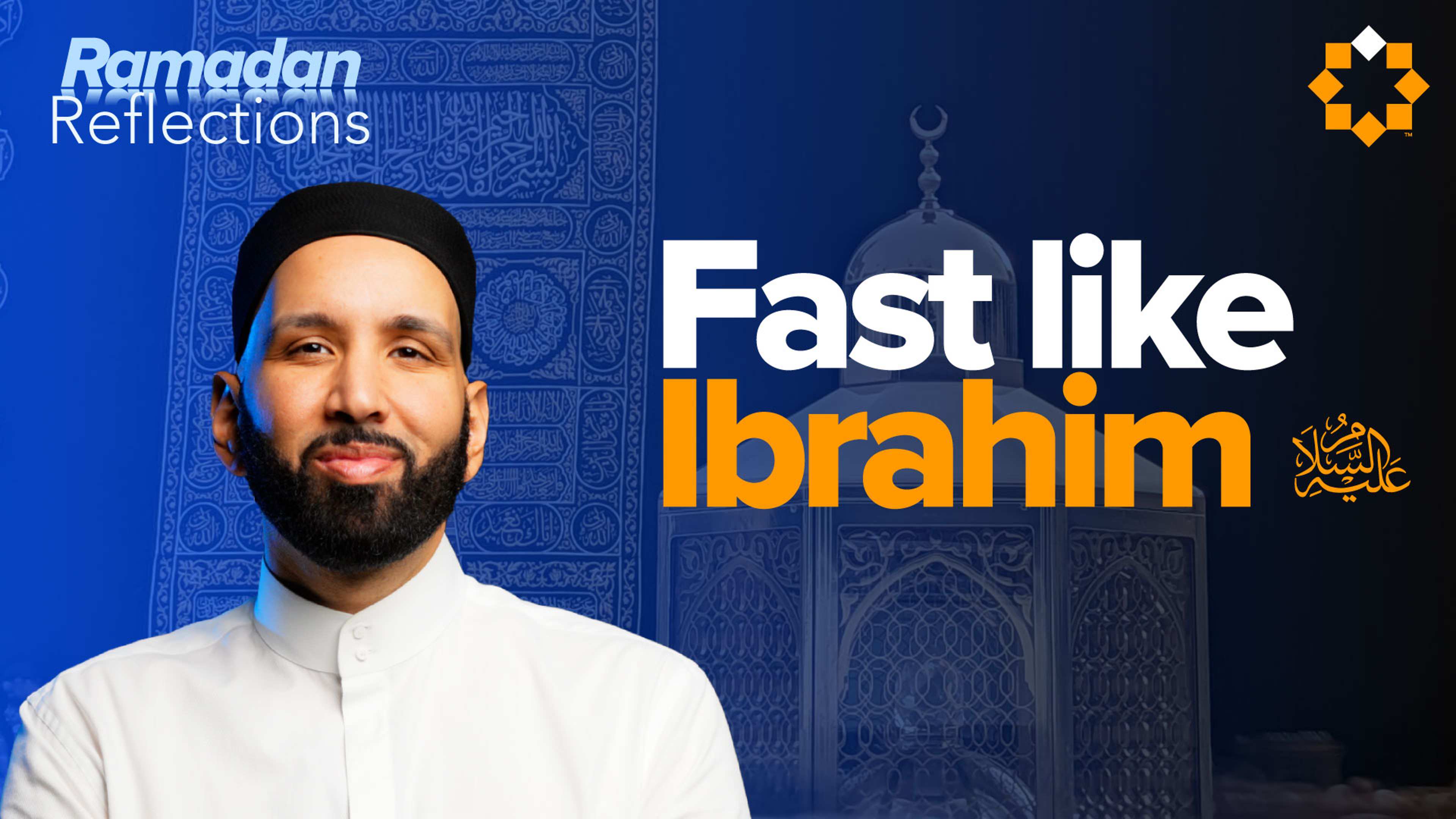
Did Past Nations Fast Like Muslims Today? | Ramadan Reflections
Fasting and prayer existed long before Islam, but not all nations preserved it. Who changed their way, and who kept the original fast? Dr. Omar Suleiman takes us back in time to nations past, their ways of worship, and the one prophet whose legacy we carry: Ibrahim (as).
This transcript was auto-generated using AI and may contain misspellings.
00:01What did the fasting of the people of Ibrahim A.S. look like? What did the salah of the people of Musa A.S. look like? What did zakah in the shari'ah of Isa A.S. look like?
00:15SubhanAllah, I want to start with this because when you're reading the beginning of the Qur'an, these first few chapters in particular, they start off with a visual of Ibrahim A.S. And who makes the claim to Ibrahim A.S.?
00:28Ibrahim A.S. making du'a to Allah S.W.T. For Allah S.W.T. to preserve what he has revealed to him in an ummah and with a prophet that will come after him.
00:40And then there are these chapters of the Qur'an where you learn more about the People of the Book in the very beginning of the Qur'an than any other part. And SubhanAllah, there's something very poetic about that. That the Qur'an starts with al-Madinah al-Munawwarah.
00:54It starts with the Muslims in Madinah differentiating themselves from the People of the Book and making the claim to Ibrahim A.S. Who gets to claim Ibrahim A.S.?
01:06Who gets to claim the way of Ibrahim A.S.? And just like the wahy, the original revelation of the people that came before us was lost over time, so too were the laws, were the legislation.
01:20And just like you have bits and pieces of the wahy, so you read sometimes the Old Testament and you say, this sounds just like what we have in the Qur'an. It may be that that's something that made it through, something that was preserved.
01:32Or you see something that's practiced in Jewish law and you say, that sounds just like the shari'ah of Muhammad S.A.W. And it could be that that was preserved from the law and that's one of the things that wasn't lost.
01:44But just like the original revelation is not intact, so too the original laws that came to each prophet are not intact. Now SubhanAllah, this religion is the religion of Ibrahim A.S. This is the way of Ibrahim A.S.
01:58Millat abikum Ibrahim, the way of Abraham. And Allah S.W.T. praises the way of Ibrahim A.S. And Allah specifically associates Ibrahim A.S. with a religion that is reasonable to practice,
02:12a religion of ease, a religion that doesn't have haraj in it, that doesn't have unnecessary burden or hardship in it. Wa ma ja'ala Allahu 'alaykum fi ad-dini min haraj. Millat abikum Ibrahim.
02:23Allah did not put any undue necessary difficulty in the religion. This is the way of your father Ibrahim A.S. And the Prophet S.A.W. said the most beloved of a deen,
02:34the most beloved of religion is al-hanifiyyah as-samhah, which is an authentic narration, the way of Ibrahim A.S., the monotheistic way of Ibrahim A.S., and the lenient way. Now here's the thing.
02:47How do you qualify what's a burden? How do you qualify what's leniency? Ultimately, you have to go back to what? You have to go back to the shari'ah itself. You have to go back to the law giver
02:59just as you go back to the one who gave the revelation in the first place. And this is a profound transition that Allah marks in the first few chapters of the Qur'an and I want us to attach ourselves to it immediately with as-siyam,
03:13what's most relevant to us right now of as-siyam, of fasting. Of the prophets of old, when it comes to the revelations, because of how early Ibrahim A.S. is, we don't have anything of the suhuf of Ibrahim A.S.,
03:27of the original revelation to Ibrahim A.S. We really don't know much about the exact practices of the way of Ibrahim A.S. But the ibadah of the Prophet S.A.W., the worship of the Prophet S.A.W. in Hira, before revelation came to him,
03:41was yatahannath or yatahannaf. He was worshipping in a monotheistic way, in a way like Ibrahim A.S. And the initial claim in Mecca was, this is the way of Ibrahim A.S. Now here's the thing.
03:54In Mecca, distinguishing yourself from the idol worshippers was pretty easy. Ibrahim A.S. was a monotheist. This was the belief in God. This was the unseen God who has no partners, who has no equals,
04:07who has no human likeness. It was much easier to distinguish ourselves as a community and lay claim to the way of Ibrahim A.S. The problem now is in Madinah. And SubhanAllah, this is extremely interesting
04:20because I want you to understand the psychology. We get to Madinah as a community, as an ummah. And the shari'ah is coming down and being defined alongside tribes of the People of the Book,
04:32Jewish tribes, who lay claim to the same prophets we lay claim to. And so there's this psychology of, do we assume that what they are doing is correct until Allah subhanahu wa ta'ala tells us otherwise?
04:46Because every ummah that came before had salah. It had some notion of prayer. And you can read in the narrations of tafsir. So for example, when Musa A.S. talked to the Prophet S.A.W. in al-Isra' wa al-Mi'raj,
04:59and he told the Prophet S.A.W. go back and ask Allah for a reduction, that the ummah of Musa A.S. had seven or ten prayers that were prescribed upon them and they fell short of them. Every nation that came before had fasting.
05:11Kutiba 'alaykum as-siyam kama kutiba 'ala alladhina min qablkum la'allakum tattaqun. Fasting has been prescribed upon you just as it was prescribed on those who came before you so that they could gain God consciousness, so that you could gain God consciousness.
05:25Some notion of charity was written upon every group of people. What did Isa A.S. say from the cradle? He said, as he spoke to his people the first time, Wa awsani bi as-salah wa az-zakah ma dumtu hayya.
05:37I will establish prayer and zakat and charity as long as I'm alive. And by the way, this is a sign of the return of Isa A.S. Because when Isa A.S. returns, ma dumtu hayya, he is establishing once again as-salah and az-zakah
05:51but on the shari'ah of Muhammad S.A.W. because he returns the second time after the legislation has come from Allah A.S. to the Prophet S.A.W. But every nation had this. Every nation had some notion of pilgrimage.
06:04Every nation had dietary laws. Some notion of halal food, what was halal for them or haram for them. Every nation had laws surrounding intimacy or surrounding al-hayth, surrounding menstruation. Every nation had that.
06:17But what we learn, is that every single nation that came before in the process of losing revelation, they lost the spirit and the law of the legislation itself, the tashri' itself.
06:30And that looks like two things. Affording yourselves licenses or giving yourself concessions that you were unlicensed to do so. So, giving yourself rukhas that Allah did not give you. And so, for example,
06:44there is a narration of Tabarani, not to get too much into detail, that the nation before, that the nation of Isa A.S., their initial fasting was also coinciding with Ramadan. But then they decided to fix the season of fasting in the time that was most convenient.
06:57And then they turned the fasting. So, imagine if we said, for example, every year Ramadan is going to be in December. Alright? Some of us are talking about how nice, me included by the way, how nice it is to break our fast earlier, right? I mean, SubhanAllah, the nights are longer,
07:10Maghrib is getting earlier. It's something that Allah A.S. has given us of ease. But what if we just said, you know what, from now on, Ramadan is always in December. Ramadan is always in December. Right? I'm sure you'll get some muftis on board.
07:23Not real muftis, but you'll get some muftis on board. Right? The muftis of the shaytan. You know, we'll give you something to justify that. Right? And then they partially, they turned fasting into partial fasting.
07:35So, it wasn't the relinquishing of food and drink altogether. But some food and drink was made halal. To the point that you have the narrations in tafsir that the most righteous of them would give up meat and give up some of the delicacies of food as well. Right?
07:49So, they gave themselves undue licenses or they gave themselves undue burdens as well. They made haram for themselves things that Allah 'Azza wa-Jal made halal for them. Now, here's the thing. You're in Medina,
08:03and you have a community. We pray towards Jerusalem in the first 16-17 months of Medina. They pray towards Jerusalem. Sujud was removed from salah. The core of the prayer, which was sajdah, was removed from the prayer.
08:17And Subhan'Allah, Isa A.S. in the Bible is described as falling on his face in prayer throughout the Bible. Somehow sajdah was taken away. Convenience. But then also, like if you read some of the laws around,
08:30especially dietary laws, and menstruation, like a woman not being allowed in her own home at the time, and the mixing of certain foods, and some of the laws around, like it's hard for people to apply.
08:42Here's the thing about the Shari'ah to Muhammad, sallallahu 'alayhi wa-sallam. Allah Subhanahu wa-Ta'ala gave us a Shari'ah, a legislation, that could be practiced across time and place. It has to be universal,
08:55and so it is, as Al-Qurtubi Rahimahullah says, by consensus, the easiest of the tashri'ah, the easiest of the legislations that was given to the ummah before. Why? Because it has to be transcendent of time and place.
09:08And here we are, 1400 years later, and let's be real, five times a day is not that hard, alhamdulillah. Our fasting of Ramadan is very reasonable. It's beautiful. Right? Allah Subhanahu wa-Ta'ala has given us something that we can practice.
09:21The believers in Medina were watching the Shari'ah come to them as they were simultaneously seeing a Shari'ah that may or may not have been original, being practiced by a community alongside them,
09:34all laying claim to Ibrahim A.S. And for the sake of time, I want to say in regards to fasting, Subhan'Allah, you'll see an ayah, for example, in Surah Al-Baqarah, where Allah 'Azza wa-Jal mentions, "Uhilla lakum laylatu as-siyam ar-rafathu ila nisa'ikum"
09:47Allah 'Azza wa-Jal made permissible for you intimacy with your spouses at night when you're fasting. Meaning the nights of Ramadan, please don't, you know, mistake my khatirah. The nights of fasting, the daytime you fast, but in the nights, intimacy is permissible.
10:01That wasn't permissible before. Right? The idea of it being made halal. Now, is it because Allah 'Azza wa-Jal gave a restriction to a previous ummah and then loosened the rule, the legislation?
10:14Or is it because people put on themselves an undue burden? To us, that's irrelevant. The point is that Allah 'Azza wa-Jal gave us rukhas. He gave us concessions. And he made it easy for us to apply. That during the day,
10:27you leave off food, drink, and intimacy. During the night, you can partake in food, drink, and intimacy. All of these things have been made halal for you. And Allah Subhanahu wa-Ta'ala is distinguishing us as an ummah with a reasonable legislation,
10:40but what is the spirit of Ibrahim 'Alayhi Assalam? "Ya ayyuha alladhina amanu udkhulu fi assalmi kaffah" O you who believe, enter into Islam wholeheartedly. "Idh qala lahu rabbuhu aslim qala aslamtu lirabbil 'alamin"
10:54When Allah told Ibrahim 'Alayhi Assalam to submit, he said, I submit. The spirit of Islam is that whether Allah gave us 'aza'im or rukhas, as the Prophet Sallallahu 'alayhi wa-sallam said, the hard things, relatively hard,
11:07not undue burdens, but things that require determination, or Allah gave us concessions. Allah loves that you partake in both. And in fact, Allah rewards you for partaking in both. And so, there is blessing in what?
11:21In delaying the suhur until the latest time. There is blessing in bringing up the breaking of the fast to the earliest time. There is blessing, because Allah loves that you take the matters of determination and the matters of concession. But you submit yourself to His Shari'ah
11:35as He gave it to you, and don't play with it. Don't play with it. Subhan'Allah, you read the last few ayat of Surah Al-Baqarah. "Rabbana la tu'akhidhna in nasina aw akhta'na" O our Lord, do not take us to account
11:49if we forget or we make a mistake. In Ramadan, when you fast, if you accidentally drink some water or eat something during the day, are you punished? Are you sinful? No, as long as you stop and you go back to your fasting and your abstinence. If you do something out of ignorance
12:03or mistake or forgetfulness, the Shari'ah forgives those things. Allah 'Azza wa-Jal has already put within the Shari'ah that you don't have to go do something that is so hard on you, because it's there. It's a gift from Allah Subhanahu wa-Ta'ala.
12:16You overslept, you ate by accident, it's a gift from Allah 'Azza wa-Jal. Just go back to what you know because you're following the way. It's already there. "Rabbana wa-la tahmil 'alayna isran kama hamaltahu 'ala alladhina min qablina" O our Lord, don't burden us
12:30with the burden of those that came before. Again, as Qatada Rahimahullah says, the Shari'ah that's been given to us is the easiest of the legislations that was given to the prophets of old. Our salah, our zakah, our siyam. Like imagine, for example,
12:43if our siyam included no talking. Like Maryam Alayha Assalam. وَقُولِ إِنِّي نَذَرْتُ لِلرَّحْمَٰنِ صَوْمًا فَلَنْ أُكَلِّمَ الْيَوْمَ إِنْسِيًا Like we couldn't speak throughout the day. Right? Our fasting is the easiest. Our praying is the easiest.
12:57Our hajj is the easiest. Everything has been made easy for you. But وَلَا تَحْمِلْ عَلَيْنَا إِسْرًا كَمَا حَمَلْتَهُ عَلَىٰ ٱلَّذِينَ مِنْ قَبْلِنَا رَبَّنَا وَلَا تُحَمِّلْنَا مَا لَا طَاقَةَ لَنَا بِهِ
13:10Allah did not say do not burden us with the burden of those who came before as if He overburdened them. Allah did not overburden any ummah. Okay? But Allah 'Azza wa Jall relieved it for us.
13:23And Allah has not given us something that is beyond our capacity. Here's the message that I want to give to you. If you are playing with the Shari'ah which already has within it the concessions that are necessary
13:36and we start to violate some of those rules and find loopholes and things of that sort, we are imitating the behavior that Allah 'Azza wa Jall is admonishing in the very first few surahs of the Qur'an.
13:49Don't play with it. It's already been given to you. It is already reasonable. The concessions are already baked in. And so once you start playing with halal and haram, once you start playing with your laws regarding 'ibadah, once you start playing
14:02with your laws regarding food and drink, once you start playing with your laws of hijab, once you start playing with your laws of intimacy, once you start playing with these laws, it's an irredeemable path. Because it's not the way of Ibrahim, Alayhi Assalam.
14:16The way of Ibrahim, Alayhi Assalam, is aslamt. I take it from Allah exactly as He gave it to me. May Allah 'Azza wa Jall make us firm on His path as He gave it to us. May Allah Subhanahu wa Ta'ala guide us to the way of Ibrahim, Alayhi Assalam, to adhere to it
14:30in the way of Muhammad, Sallallahu 'Alayhi wa Sallam. May Allah Subhanahu wa Ta'ala make our hearts firm, make our tongues firm, make our eyes firm. May Allah Subhanahu wa Ta'ala plant our feet firm. And may Allah Subhanahu wa Ta'ala make us amongst those people who hear and obey.
14:43And may Allah 'Azza wa Jall protect us from deceiving ourselves or others. Allahumma ameen. Jazakumullahu khair. Wa assalamu 'alaikum wa rahmatullahi wa barakatuh.